





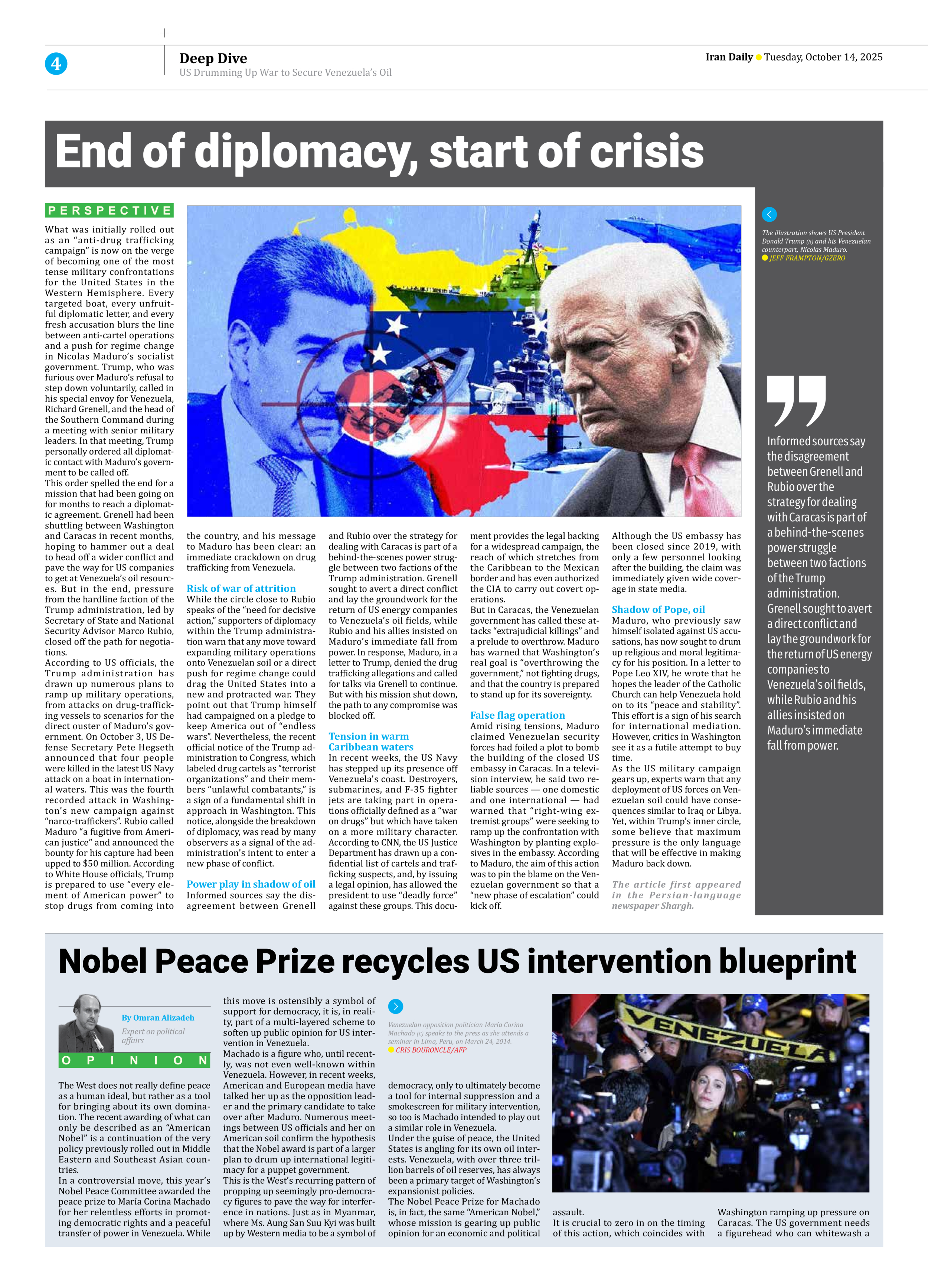


End of diplomacy, start of crisis
What was initially rolled out as an “anti-drug trafficking campaign” is now on the verge of becoming one of the most tense military confrontations for the United States in the Western Hemisphere. Every targeted boat, every unfruitful diplomatic letter, and every fresh accusation blurs the line between anti-cartel operations and a push for regime change in Nicolas Maduro’s socialist government. Trump, who was furious over Maduro’s refusal to step down voluntarily, called in his special envoy for Venezuela, Richard Grenell, and the head of the Southern Command during a meeting with senior military leaders. In that meeting, Trump personally ordered all diplomatic contact with Maduro’s government to be called off.
This order spelled the end for a mission that had been going on for months to reach a diplomatic agreement. Grenell had been shuttling between Washington and Caracas in recent months, hoping to hammer out a deal to head off a wider conflict and pave the way for US companies to get at Venezuela’s oil resources. But in the end, pressure from the hardline faction of the Trump administration, led by Secretary of State and National Security Advisor Marco Rubio, closed off the path for negotiations.
According to US officials, the Trump administration has drawn up numerous plans to ramp up military operations, from attacks on drug-trafficking vessels to scenarios for the direct ouster of Maduro’s government. On October 3, US Defense Secretary Pete Hegseth announced that four people were killed in the latest US Navy attack on a boat in international waters. This was the fourth recorded attack in Washington’s new campaign against “narco-traffickers”. Rubio called Maduro “a fugitive from American justice” and announced the bounty for his capture had been upped to $50 million. According to White House officials, Trump is prepared to use “every element of American power” to stop drugs from coming into the country, and his message to Maduro has been clear: an immediate crackdown on drug trafficking from Venezuela.
Risk of war of attrition
While the circle close to Rubio speaks of the “need for decisive action,” supporters of diplomacy within the Trump administration warn that any move toward expanding military operations onto Venezuelan soil or a direct push for regime change could drag the United States into a new and protracted war. They point out that Trump himself had campaigned on a pledge to keep America out of “endless wars”. Nevertheless, the recent official notice of the Trump administration to Congress, which labeled drug cartels as “terrorist organizations” and their members “unlawful combatants,” is a sign of a fundamental shift in approach in Washington. This notice, alongside the breakdown of diplomacy, was read by many observers as a signal of the administration’s intent to enter a new phase of conflict.
Power play in shadow of oil
Informed sources say the disagreement between Grenell and Rubio over the strategy for dealing with Caracas is part of a behind-the-scenes power struggle between two factions of the Trump administration. Grenell sought to avert a direct conflict and lay the groundwork for the return of US energy companies to Venezuela’s oil fields, while Rubio and his allies insisted on Maduro’s immediate fall from power. In response, Maduro, in a letter to Trump, denied the drug trafficking allegations and called for talks via Grenell to continue. But with his mission shut down, the path to any compromise was blocked off.
Tension in warm Caribbean waters
In recent weeks, the US Navy has stepped up its presence off Venezuela’s coast. Destroyers, submarines, and F-35 fighter jets are taking part in operations officially defined as a “war on drugs” but which have taken on a more military character. According to CNN, the US Justice Department has drawn up a confidential list of cartels and trafficking suspects, and, by issuing a legal opinion, has allowed the president to use “deadly force” against these groups. This document provides the legal backing for a widespread campaign, the reach of which stretches from the Caribbean to the Mexican border and has even authorized the CIA to carry out covert operations.
But in Caracas, the Venezuelan government has called these attacks “extrajudicial killings” and a prelude to overthrow. Maduro has warned that Washington’s real goal is “overthrowing the government,” not fighting drugs, and that the country is prepared to stand up for its sovereignty.
False flag operation
Amid rising tensions, Maduro claimed Venezuelan security forces had foiled a plot to bomb the building of the closed US embassy in Caracas. In a television interview, he said two reliable sources — one domestic and one international — had warned that “right-wing extremist groups” were seeking to ramp up the confrontation with Washington by planting explosives in the embassy. According to Maduro, the aim of this action was to pin the blame on the Venezuelan government so that a “new phase of escalation” could kick off.
Although the US embassy has been closed since 2019, with only a few personnel looking after the building, the claim was immediately given wide coverage in state media.
Shadow of Pope, oil
Maduro, who previously saw himself isolated against US accusations, has now sought to drum up religious and moral legitimacy for his position. In a letter to Pope Leo XIV, he wrote that he hopes the leader of the Catholic Church can help Venezuela hold on to its “peace and stability”. This effort is a sign of his search for international mediation. However, critics in Washington see it as a futile attempt to buy time.
As the US military campaign gears up, experts warn that any deployment of US forces on Venezuelan soil could have consequences similar to Iraq or Libya. Yet, within Trump’s inner circle, some believe that maximum pressure is the only language that will be effective in making Maduro back down.
The article first appeared in the Persian-language
newspaper Shargh.