







Tehran calls for joint action plan to boost INSTC transit to 15m tons
Energy ties, electricity corridor top Baku meeting agenda
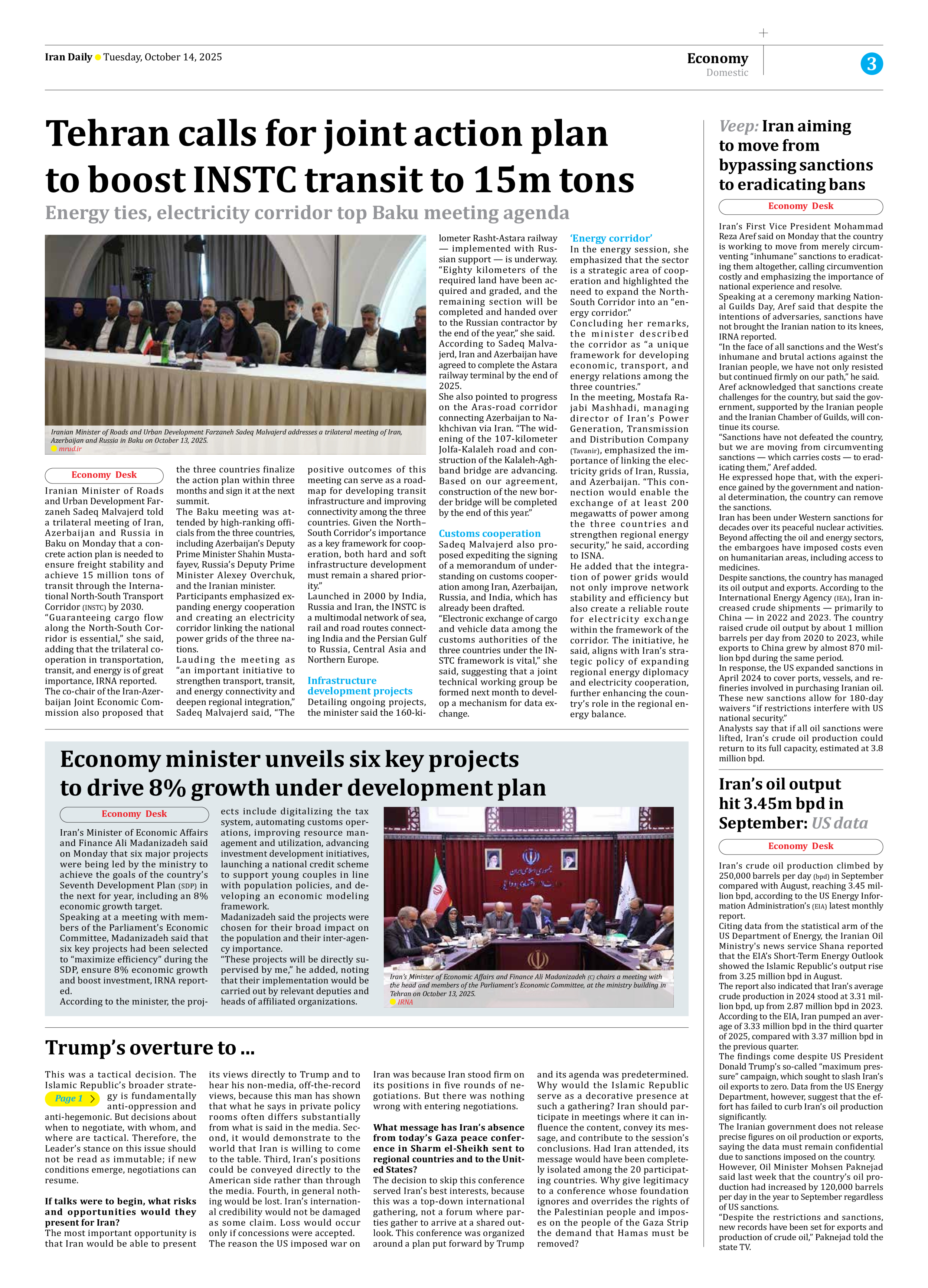
Iranian Minister of Roads and Urban Development Farzaneh Sadeq Malvajerd told a trilateral meeting of Iran, Azerbaijan and Russia in Baku on Monday that a concrete action plan is needed to ensure freight stability and achieve 15 million tons of transit through the International North-South Transport Corridor (INSTC) by 2030.
“Guaranteeing cargo flow along the North-South Corridor is essential,” she said, adding that the trilateral cooperation in transportation, transit, and energy is of great importance, IRNA reported.
The co-chair of the Iran-Azerbaijan Joint Economic Commission also proposed that the three countries finalize the action plan within three months and sign it at the next summit.
The Baku meeting was attended by high-ranking officials from the three countries, including Azerbaijan’s Deputy Prime Minister Shahin Mustafayev, Russia’s Deputy Prime Minister Alexey Overchuk, and the Iranian minister.
Participants emphasized expanding energy cooperation and creating an electricity corridor linking the national power grids of the three nations.
Lauding the meeting as “an important initiative to strengthen transport, transit, and energy connectivity and deepen regional integration,” Sadeq Malvajerd said, “The positive outcomes of this meeting can serve as a roadmap for developing transit infrastructure and improving connectivity among the three countries. Given the North–South Corridor’s importance as a key framework for cooperation, both hard and soft infrastructure development must remain a shared priority.”
Launched in 2000 by India, Russia and Iran, the INSTC is a multimodal network of sea, rail and road routes connecting India and the Persian Gulf to Russia, Central Asia and Northern Europe.
Infrastructure development projects
Detailing ongoing projects, the minister said the 160-kilometer Rasht-Astara railway — implemented with Russian support — is underway. “Eighty kilometers of the required land have been acquired and graded, and the remaining section will be completed and handed over to the Russian contractor by the end of the year,” she said.
According to Sadeq Malvajerd, Iran and Azerbaijan have agreed to complete the Astara railway terminal by the end of 2025.
She also pointed to progress on the Aras-road corridor connecting Azerbaijan to Nakhchivan via Iran. “The widening of the 107-kilometer Jolfa-Kalaleh road and construction of the Kalaleh-Aghband bridge are advancing. Based on our agreement, construction of the new border bridge will be completed by the end of this year.”
Customs cooperation
Sadeq Malvajerd also proposed expediting the signing of a memorandum of understanding on customs cooperation among Iran, Azerbaijan, Russia, and India, which has already been drafted.
“Electronic exchange of cargo and vehicle data among the customs authorities of the three countries under the INSTC framework is vital,” she said, suggesting that a joint technical working group be formed next month to develop a mechanism for data exchange.
‘Energy corridor’
In the energy session, she emphasized that the sector is a strategic area of cooperation and highlighted the need to expand the North-South Corridor into an “energy corridor.”
Concluding her remarks, the minister described the corridor as “a unique framework for developing economic, transport, and energy relations among the three countries.”
In the meeting, Mostafa Rajabi Mashhadi, managing director of Iran’s Power Generation, Transmission and Distribution Company (Tavanir), emphasized the importance of linking the electricity grids of Iran, Russia, and Azerbaijan. “This connection would enable the exchange of at least 200 megawatts of power among the three countries and strengthen regional energy security,” he said, according to ISNA.
He added that the integration of power grids would not only improve network stability and efficiency but also create a reliable route for electricity exchange within the framework of the corridor. The initiative, he said, aligns with Iran’s strategic policy of expanding regional energy diplomacy and electricity cooperation, further enhancing the country’s role in the regional energy balance.