







Hafez honored in Shiraz for timeless poetry
Minister hails poet’s global influence, as ‘one of the world’s top 20’
Iran celebrated the annual commemoration of 14th-century poet Hafez on Saturday at his mausoleum in Shiraz. Culture and Islamic Guidance Minister Abbas Salehi called Hafez “one of the world’s top 20 poets,” highlighting his lasting global impact, while scholars emphasized the poet’s unique literary style, spiritual depth, and ongoing influence on Iranian identity and cultural life.
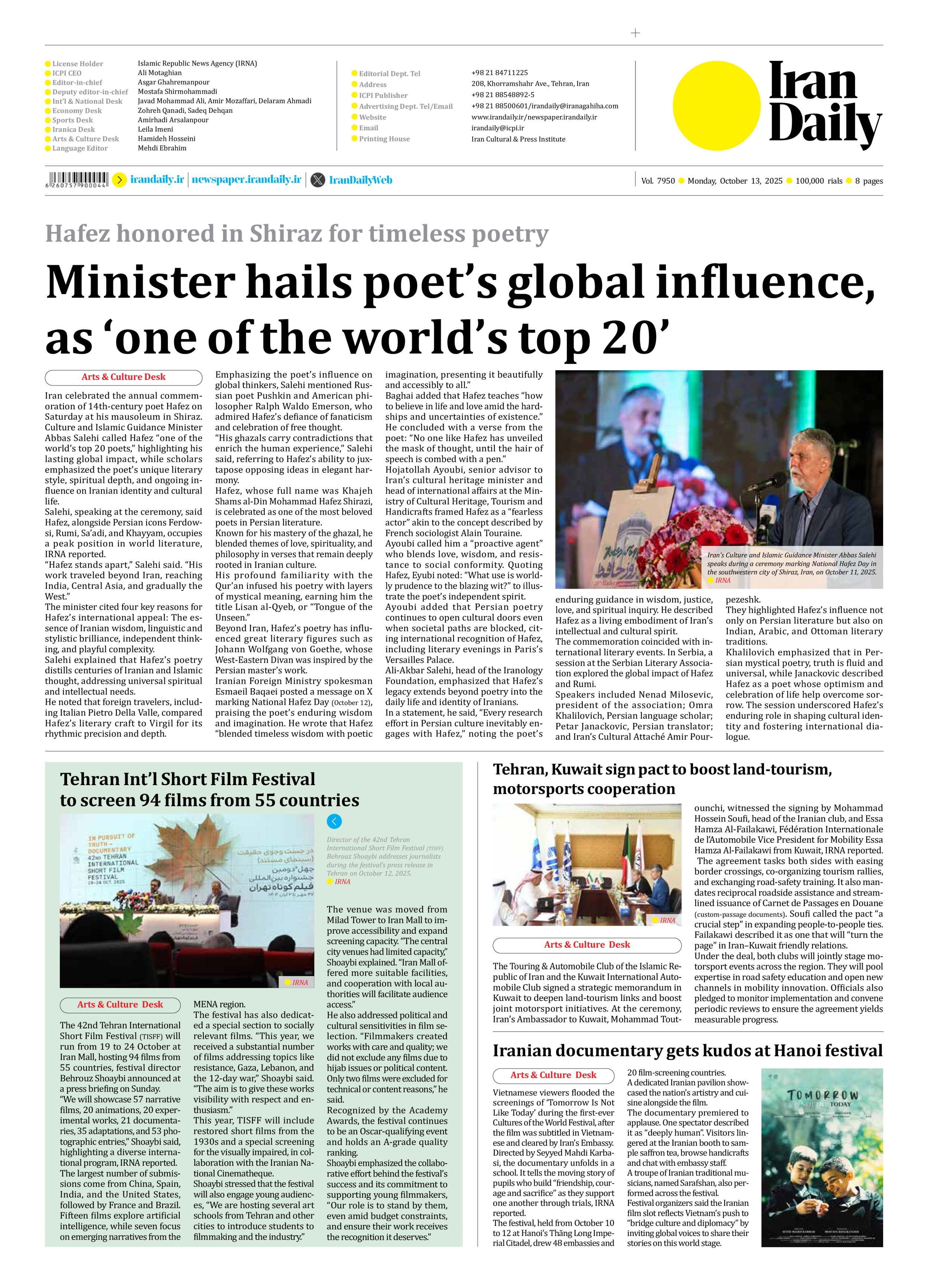
Salehi, speaking at the ceremony, said Hafez, alongside Persian icons Ferdowsi, Rumi, Sa’adi, and Khayyam, occupies a peak position in world literature, IRNA reported.
“Hafez stands apart,” Salehi said. “His work traveled beyond Iran, reaching India, Central Asia, and gradually the West.”
The minister cited four key reasons for Hafez’s international appeal: The essence of Iranian wisdom, linguistic and stylistic brilliance, independent thinking, and playful complexity.
Salehi explained that Hafez’s poetry distills centuries of Iranian and Islamic thought, addressing universal spiritual and intellectual needs.
He noted that foreign travelers, including Italian Pietro Della Valle, compared Hafez’s literary craft to Virgil for its rhythmic precision and depth.
Emphasizing the poet’s influence on global thinkers, Salehi mentioned Russian poet Pushkin and American philosopher Ralph Waldo Emerson, who admired Hafez’s defiance of fanaticism and celebration of free thought.
“His ghazals carry contradictions that enrich the human experience,” Salehi said, referring to Hafez’s ability to juxtapose opposing ideas in elegant harmony.
Hafez, whose full name was Khajeh Shams al-Din Mohammad Hafez Shirazi, is celebrated as one of the most beloved poets in Persian literature.
Known for his mastery of the ghazal, he blended themes of love, spirituality, and philosophy in verses that remain deeply rooted in Iranian culture.
His profound familiarity with the Qur’an infused his poetry with layers of mystical meaning, earning him the title Lisan al-Qyeb, or “Tongue of the Unseen.”
Beyond Iran, Hafez’s poetry has influenced great literary figures such as Johann Wolfgang von Goethe, whose West-Eastern Divan was inspired by the Persian master’s work.
Iranian Foreign Ministry spokesman Esmaeil Baqaei posted a message on X marking National Hafez Day (October 12), praising the poet’s enduring wisdom and imagination. He wrote that Hafez “blended timeless wisdom with poetic imagination, presenting it beautifully and accessibly to all.”
Baghai added that Hafez teaches “how to believe in life and love amid the hardships and uncertainties of existence.” He concluded with a verse from the poet: “No one like Hafez has unveiled the mask of thought, until the hair of speech is combed with a pen.”
Hojatollah Ayoubi, senior advisor to Iran’s cultural heritage minister and head of international affairs at the Ministry of Cultural Heritage, Tourism and Handicrafts framed Hafez as a “fearless actor” akin to the concept described by French sociologist Alain Touraine.
Ayoubi called him a “proactive agent” who blends love, wisdom, and resistance to social conformity. Quoting Hafez, Eyubi noted: “What use is worldly prudence to the blazing wit?” to illustrate the poet’s independent spirit.
Ayoubi added that Persian poetry continues to open cultural doors even when societal paths are blocked, citing international recognition of Hafez, including literary evenings in Paris’s Versailles Palace.
Ali-Akbar Salehi, head of the Iranology Foundation, emphasized that Hafez’s legacy extends beyond poetry into the daily life and identity of Iranians.
In a statement, he said, “Every research effort in Persian culture inevitably engages with Hafez,” noting the poet’s enduring guidance in wisdom, justice, love, and spiritual inquiry. He described Hafez as a living embodiment of Iran’s intellectual and cultural spirit.
The commemoration coincided with international literary events. In Serbia, a session at the Serbian Literary Association explored the global impact of Hafez and Rumi.
Speakers included Nenad Milosevic, president of the association; Omra Khalilovich, Persian language scholar; Petar Janackovic, Persian translator; and Iran’s Cultural Attaché Amir Pourpezeshk.
They highlighted Hafez’s influence not only on Persian literature but also on Indian, Arabic, and Ottoman literary traditions.
Khalilovich emphasized that in Persian mystical poetry, truth is fluid and universal, while Janackovic described Hafez as a poet whose optimism and celebration of life help overcome sorrow. The session underscored Hafez’s enduring role in shaping cultural identity and fostering international dialogue.