





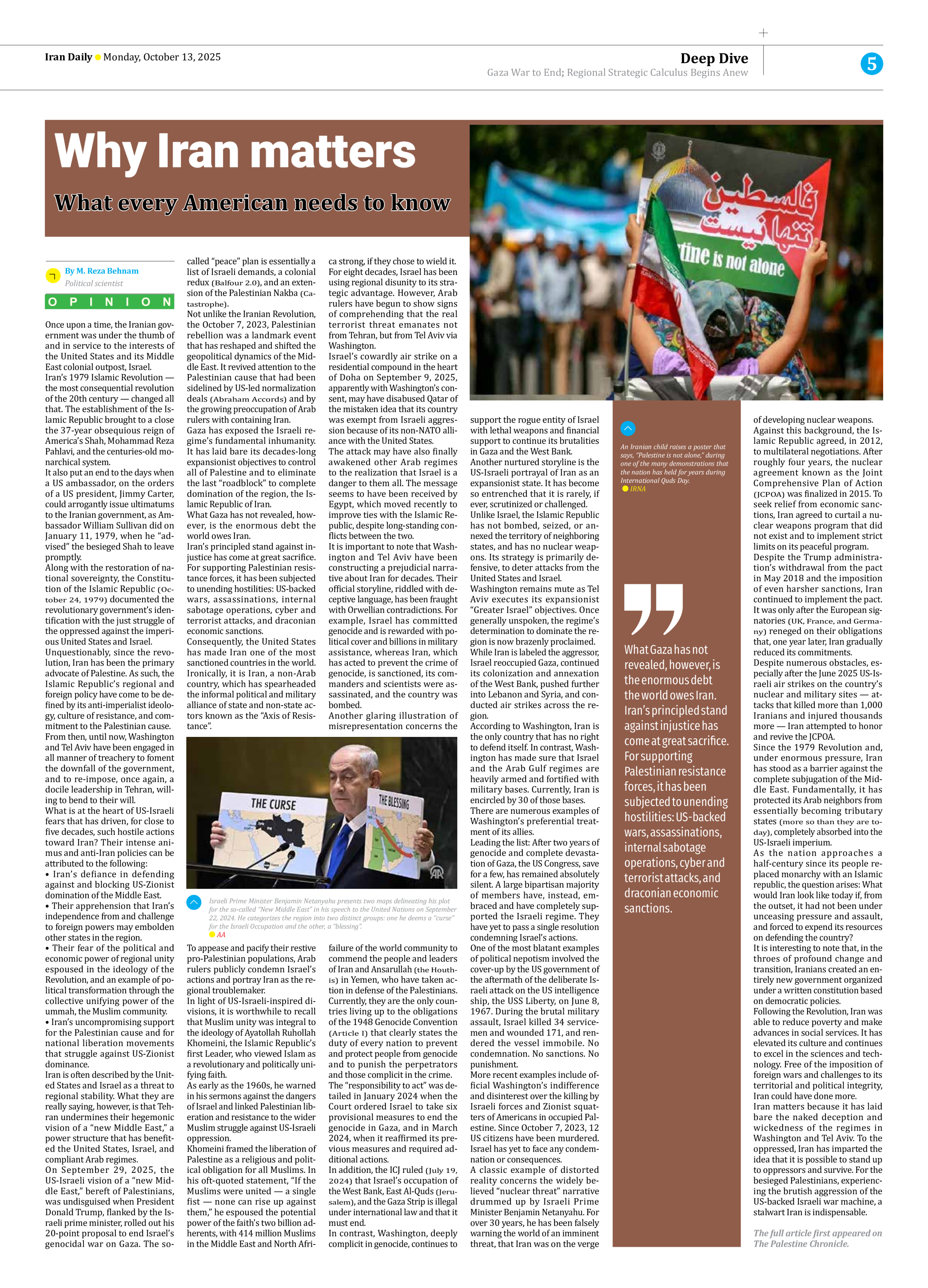


Why Iran matters
What every American needs to know
By M. Reza Behnam
Political scientist
Once upon a time, the Iranian government was under the thumb of and in service to the interests of the United States and its Middle East colonial outpost, Israel.
Iran’s 1979 Islamic Revolution — the most consequential revolution of the 20th century — changed all that. The establishment of the Islamic Republic brought to a close the 37-year obsequious reign of America’s Shah, Mohammad Reza Pahlavi, and the centuries-old monarchical system.
It also put an end to the days when a US ambassador, on the orders of a US president, Jimmy Carter, could arrogantly issue ultimatums to the Iranian government, as Ambassador William Sullivan did on January 11, 1979, when he “advised” the besieged Shah to leave promptly.
Along with the restoration of national sovereignty, the Constitution of the Islamic Republic (October 24, 1979) documented the revolutionary government’s identification with the just struggle of the oppressed against the imperious United States and Israel.
Unquestionably, since the revolution, Iran has been the primary advocate of Palestine. As such, the Islamic Republic’s regional and foreign policy have come to be defined by its anti-imperialist ideology, culture of resistance, and commitment to the Palestinian cause.
From then, until now, Washington and Tel Aviv have been engaged in all manner of treachery to foment the downfall of the government, and to re-impose, once again, a docile leadership in Tehran, willing to bend to their will.
What is at the heart of US-Israeli fears that has driven, for close to five decades, such hostile actions toward Iran? Their intense animus and anti-Iran policies can be attributed to the following:
• Iran’s defiance in defending against and blocking US-Zionist domination of the Middle East.
• Their apprehension that Iran’s independence from and challenge to foreign powers may embolden other states in the region.
• Their fear of the political and economic power of regional unity espoused in the ideology of the Revolution, and an example of political transformation through the collective unifying power of the ummah, the Muslim community.
• Iran’s uncompromising support for the Palestinian cause and for national liberation movements that struggle against US-Zionist dominance.
Iran is often described by the United States and Israel as a threat to regional stability. What they are really saying, however, is that Tehran undermines their hegemonic vision of a “new Middle East,” a power structure that has benefited the United States, Israel, and compliant Arab regimes.
On September 29, 2025, the US-Israeli vision of a “new Middle East,” bereft of Palestinians, was undisguised when President Donald Trump, flanked by the Israeli prime minister, rolled out his 20-point proposal to end Israel’s genocidal war on Gaza. The so-called “peace” plan is essentially a list of Israeli demands, a colonial redux (Balfour 2.0), and an extension of the Palestinian Nakba (Catastrophe).
Not unlike the Iranian Revolution, the October 7, 2023, Palestinian rebellion was a landmark event that has reshaped and shifted the geopolitical dynamics of the Middle East. It revived attention to the Palestinian cause that had been sidelined by US-led normalization deals (Abraham Accords) and by the growing preoccupation of Arab rulers with containing Iran.
Gaza has exposed the Israeli regime’s fundamental inhumanity. It has laid bare its decades-long expansionist objectives to control all of Palestine and to eliminate the last “roadblock” to complete domination of the region, the Islamic Republic of Iran.
What Gaza has not revealed, however, is the enormous debt the world owes Iran.
Iran’s principled stand against injustice has come at great sacrifice. For supporting Palestinian resistance forces, it has been subjected to unending hostilities: US-backed wars, assassinations, internal sabotage operations, cyber and terrorist attacks, and draconian economic sanctions.
Consequently, the United States has made Iran one of the most sanctioned countries in the world.
Ironically, it is Iran, a non-Arab country, which has spearheaded the informal political and military alliance of state and non-state actors known as the “Axis of Resistance”.
To appease and pacify their restive pro-Palestinian populations, Arab rulers publicly condemn Israel’s actions and portray Iran as the regional troublemaker.
In light of US-Israeli-inspired divisions, it is worthwhile to recall that Muslim unity was integral to the ideology of Ayatollah Ruhollah Khomeini, the Islamic Republic’s first Leader, who viewed Islam as a revolutionary and politically unifying faith.
As early as the 1960s, he warned in his sermons against the dangers of Israel and linked Palestinian liberation and resistance to the wider Muslim struggle against US-Israeli oppression.
Khomeini framed the liberation of Palestine as a religious and political obligation for all Muslims. In his oft-quoted statement, “If the Muslims were united — a single fist — none can rise up against them,” he espoused the potential power of the faith’s two billion adherents, with 414 million Muslims in the Middle East and North Africa strong, if they chose to wield it.
For eight decades, Israel has been using regional disunity to its strategic advantage. However, Arab rulers have begun to show signs of comprehending that the real terrorist threat emanates not from Tehran, but from Tel Aviv via Washington.
Israel’s cowardly air strike on a residential compound in the heart of Doha on September 9, 2025, apparently with Washington’s consent, may have disabused Qatar of the mistaken idea that its country was exempt from Israeli aggression because of its non-NATO alliance with the United States.
The attack may have also finally awakened other Arab regimes to the realization that Israel is a danger to them all. The message seems to have been received by Egypt, which moved recently to improve ties with the Islamic Republic, despite long-standing conflicts between the two.
It is important to note that Washington and Tel Aviv have been constructing a prejudicial narrative about Iran for decades. Their official storyline, riddled with deceptive language, has been fraught with Orwellian contradictions. For example, Israel has committed genocide and is rewarded with political cover and billions in military assistance, whereas Iran, which has acted to prevent the crime of genocide, is sanctioned, its commanders and scientists were assassinated, and the country was bombed.
Another glaring illustration of misrepresentation concerns the failure of the world community to commend the people and leaders of Iran and Ansarullah (the Houthis) in Yemen, who have taken action in defense of the Palestinians.
Currently, they are the only countries living up to the obligations of the 1948 Genocide Convention (Article I) that clearly states the duty of every nation to prevent and protect people from genocide and to punish the perpetrators and those complicit in the crime.
The “responsibility to act” was detailed in January 2024 when the Court ordered Israel to take six provisional measures to end the genocide in Gaza, and in March 2024, when it reaffirmed its previous measures and required additional actions.
In addition, the ICJ ruled (July 19, 2024) that Israel’s occupation of the West Bank, East Al-Quds (Jerusalem), and the Gaza Strip is illegal under international law and that it must end.
In contrast, Washington, deeply complicit in genocide, continues to support the rogue entity of Israel with lethal weapons and financial support to continue its brutalities in Gaza and the West Bank.
Another nurtured storyline is the US-Israeli portrayal of Iran as an expansionist state. It has become so entrenched that it is rarely, if ever, scrutinized or challenged.
Unlike Israel, the Islamic Republic has not bombed, seized, or annexed the territory of neighboring states, and has no nuclear weapons. Its strategy is primarily defensive, to deter attacks from the United States and Israel.
Washington remains mute as Tel Aviv executes its expansionist “Greater Israel” objectives. Once generally unspoken, the regime’s determination to dominate the region is now brazenly proclaimed.
While Iran is labeled the aggressor, Israel reoccupied Gaza, continued its colonization and annexation of the West Bank, pushed further into Lebanon and Syria, and conducted air strikes across the region.
According to Washington, Iran is the only country that has no right to defend itself. In contrast, Washington has made sure that Israel and the Arab Gulf regimes are heavily armed and fortified with military bases. Currently, Iran is encircled by 30 of those bases.
There are numerous examples of Washington’s preferential treatment of its allies.
Leading the list: After two years of genocide and complete devastation of Gaza, the US Congress, save for a few, has remained absolutely silent. A large bipartisan majority of members have, instead, embraced and have completely supported the Israeli regime. They have yet to pass a single resolution condemning Israel’s actions.
One of the most blatant examples of political nepotism involved the cover-up by the US government of the aftermath of the deliberate Israeli attack on the US intelligence ship, the USS Liberty, on June 8, 1967. During the brutal military assault, Israel killed 34 servicemen and wounded 171, and rendered the vessel immobile. No condemnation. No sanctions. No punishment.
More recent examples include official Washington’s indifference and disinterest over the killing by Israeli forces and Zionist squatters of Americans in occupied Palestine. Since October 7, 2023, 12 US citizens have been murdered. Israel has yet to face any condemnation or consequences.
A classic example of distorted reality concerns the widely believed “nuclear threat” narrative drummed up by Israeli Prime Minister Benjamin Netanyahu. For over 30 years, he has been falsely warning the world of an imminent threat, that Iran was on the verge of developing nuclear weapons.
Against this background, the Islamic Republic agreed, in 2012, to multilateral negotiations. After roughly four years, the nuclear agreement known as the Joint Comprehensive Plan of Action (JCPOA) was finalized in 2015. To seek relief from economic sanctions, Iran agreed to curtail a nuclear weapons program that did not exist and to implement strict limits on its peaceful program.
Despite the Trump administration’s withdrawal from the pact in May 2018 and the imposition of even harsher sanctions, Iran continued to implement the pact. It was only after the European signatories (UK, France, and Germany) reneged on their obligations that, one year later, Iran gradually reduced its commitments.
Despite numerous obstacles, especially after the June 2025 US-Israeli air strikes on the country’s nuclear and military sites — attacks that killed more than 1,000 Iranians and injured thousands more — Iran attempted to honor and revive the JCPOA.
Since the 1979 Revolution and, under enormous pressure, Iran has stood as a barrier against the complete subjugation of the Middle East. Fundamentally, it has protected its Arab neighbors from essentially becoming tributary states (more so than they are today), completely absorbed into the US-Israeli imperium.
As the nation approaches a half-century since its people replaced monarchy with an Islamic republic, the question arises: What would Iran look like today if, from the outset, it had not been under unceasing pressure and assault, and forced to expend its resources on defending the country?
It is interesting to note that, in the throes of profound change and transition, Iranians created an entirely new government organized under a written constitution based on democratic policies.
Following the Revolution, Iran was able to reduce poverty and make advances in social services. It has elevated its culture and continues to excel in the sciences and technology. Free of the imposition of foreign wars and challenges to its territorial and political integrity, Iran could have done more.
Iran matters because it has laid bare the naked deception and wickedness of the regimes in Washington and Tel Aviv. To the oppressed, Iran has imparted the idea that it is possible to stand up to oppressors and survive. For the besieged Palestinians, experiencing the brutish aggression of the US-backed Israeli war machine, a stalwart Iran is indispensable.
The full article first appeared on The Palestine Chronicle.