





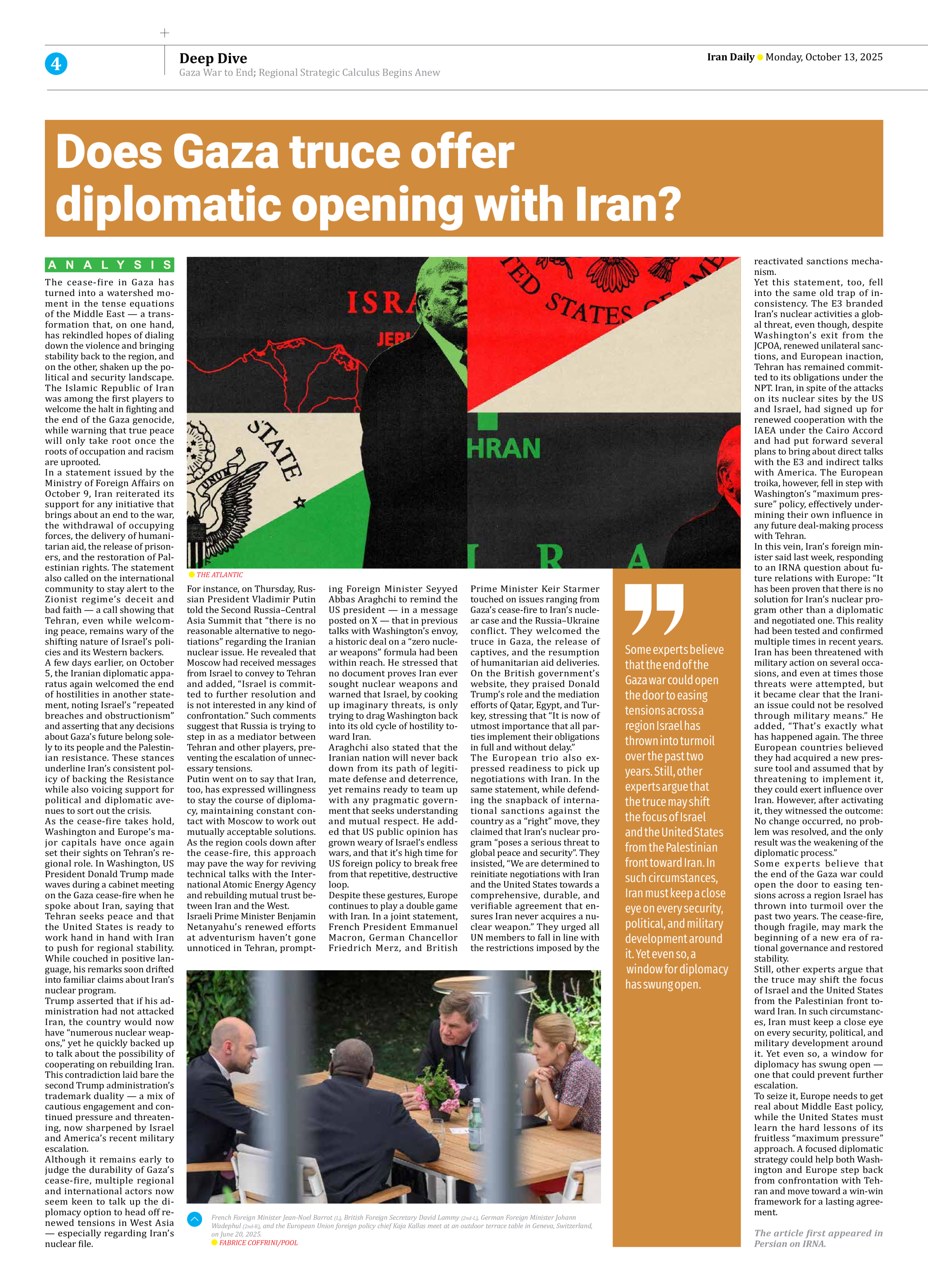


Does Gaza truce offer diplomatic opening with Iran?
The cease-fire in Gaza has turned into a watershed moment in the tense equations of the Middle East — a transformation that, on one hand, has rekindled hopes of dialing down the violence and bringing stability back to the region, and on the other, shaken up the political and security landscape. The Islamic Republic of Iran was among the first players to welcome the halt in fighting and the end of the Gaza genocide, while warning that true peace will only take root once the roots of occupation and racism are uprooted.
In a statement issued by the Ministry of Foreign Affairs on October 9, Iran reiterated its support for any initiative that brings about an end to the war, the withdrawal of occupying forces, the delivery of humanitarian aid, the release of prisoners, and the restoration of Palestinian rights. The statement also called on the international community to stay alert to the Zionist regime’s deceit and bad faith — a call showing that Tehran, even while welcoming peace, remains wary of the shifting nature of Israel’s policies and its Western backers.
A few days earlier, on October 5, the Iranian diplomatic apparatus again welcomed the end of hostilities in another statement, noting Israel’s “repeated breaches and obstructionism” and asserting that any decisions about Gaza’s future belong solely to its people and the Palestinian resistance. These stances underline Iran’s consistent policy of backing the Resistance while also voicing support for political and diplomatic avenues to sort out the crisis.
As the cease-fire takes hold, Washington and Europe’s major capitals have once again set their sights on Tehran’s regional role. In Washington, US President Donald Trump made waves during a cabinet meeting on the Gaza cease-fire when he spoke about Iran, saying that Tehran seeks peace and that the United States is ready to work hand in hand with Iran to push for regional stability. While couched in positive language, his remarks soon drifted into familiar claims about Iran’s nuclear program.
Trump asserted that if his administration had not attacked Iran, the country would now have “numerous nuclear weapons,” yet he quickly backed up to talk about the possibility of cooperating on rebuilding Iran. This contradiction laid bare the second Trump administration’s trademark duality — a mix of cautious engagement and continued pressure and threatening, now sharpened by Israel and America’s recent military escalation.
Although it remains early to judge the durability of Gaza’s cease-fire, multiple regional and international actors now seem keen to talk up the diplomacy option to head off renewed tensions in West Asia — especially regarding Iran’s nuclear file.
For instance, on Thursday, Russian President Vladimir Putin told the Second Russia–Central Asia Summit that “there is no reasonable alternative to negotiations” regarding the Iranian nuclear issue. He revealed that Moscow had received messages from Israel to convey to Tehran and added, “Israel is committed to further resolution and is not interested in any kind of confrontation.” Such comments suggest that Russia is trying to step in as a mediator between Tehran and other players, preventing the escalation of unnecessary tensions.
Putin went on to say that Iran, too, has expressed willingness to stay the course of diplomacy, maintaining constant contact with Moscow to work out mutually acceptable solutions. As the region cools down after the cease-fire, this approach may pave the way for reviving technical talks with the International Atomic Energy Agency and rebuilding mutual trust between Iran and the West.
Israeli Prime Minister Benjamin Netanyahu’s renewed efforts at adventurism haven’t gone unnoticed in Tehran, prompting Foreign Minister Seyyed Abbas Araghchi to remind the US president — in a message posted on X — that in previous talks with Washington’s envoy, a historic deal on a “zero nuclear weapons” formula had been within reach. He stressed that no document proves Iran ever sought nuclear weapons and warned that Israel, by cooking up imaginary threats, is only trying to drag Washington back into its old cycle of hostility toward Iran.
Araghchi also stated that the Iranian nation will never back down from its path of legitimate defense and deterrence, yet remains ready to team up with any pragmatic government that seeks understanding and mutual respect. He added that US public opinion has grown weary of Israel’s endless wars, and that it’s high time for US foreign policy to break free from that repetitive, destructive loop.
Despite these gestures, Europe continues to play a double game with Iran. In a joint statement, French President Emmanuel Macron, German Chancellor Friedrich Merz, and British Prime Minister Keir Starmer touched on issues ranging from Gaza’s cease-fire to Iran’s nuclear case and the Russia–Ukraine conflict. They welcomed the truce in Gaza, the release of captives, and the resumption of humanitarian aid deliveries. On the British government’s website, they praised Donald Trump’s role and the mediation efforts of Qatar, Egypt, and Turkey, stressing that “It is now of utmost importance that all parties implement their obligations in full and without delay.”
The European trio also expressed readiness to pick up negotiations with Iran. In the same statement, while defending the snapback of international sanctions against the country as a “right” move, they claimed that Iran’s nuclear program “poses a serious threat to global peace and security”. They insisted, “We are determined to reinitiate negotiations with Iran and the United States towards a comprehensive, durable, and verifiable agreement that ensures Iran never acquires a nuclear weapon.” They urged all UN members to fall in line with the restrictions imposed by the reactivated sanctions mechanism.
Yet this statement, too, fell into the same old trap of inconsistency. The E3 branded Iran’s nuclear activities a global threat, even though, despite Washington’s exit from the JCPOA, renewed unilateral sanctions, and European inaction, Tehran has remained committed to its obligations under the NPT. Iran, in spite of the attacks on its nuclear sites by the US and Israel, had signed up for renewed cooperation with the IAEA under the Cairo Accord and had put forward several plans to bring about direct talks with the E3 and indirect talks with America. The European troika, however, fell in step with Washington’s “maximum pressure” policy, effectively undermining their own influence in any future deal-making process with Tehran.
In this vein, Iran’s foreign minister said last week, responding to an IRNA question about future relations with Europe: “It has been proven that there is no solution for Iran’s nuclear program other than a diplomatic and negotiated one. This reality had been tested and confirmed multiple times in recent years. Iran has been threatened with military action on several occasions, and even at times those threats were attempted, but it became clear that the Iranian issue could not be resolved through military means.” He added, “That’s exactly what has happened again. The three European countries believed they had acquired a new pressure tool and assumed that by threatening to implement it, they could exert influence over Iran. However, after activating it, they witnessed the outcome: No change occurred, no problem was resolved, and the only result was the weakening of the diplomatic process.”
Some experts believe that the end of the Gaza war could open the door to easing tensions across a region Israel has thrown into turmoil over the past two years. The cease-fire, though fragile, may mark the beginning of a new era of rational governance and restored stability.
Still, other experts argue that the truce may shift the focus of Israel and the United States from the Palestinian front toward Iran. In such circumstances, Iran must keep a close eye on every security, political, and military development around it. Yet even so, a window for diplomacy has swung open — one that could prevent further escalation.
To seize it, Europe needs to get real about Middle East policy, while the United States must learn the hard lessons of its fruitless “maximum pressure” approach. A focused diplomatic strategy could help both Washington and Europe step back from confrontation with Tehran and move toward a win-win framework for a lasting agreement.
The article first appeared in Persian on IRNA.