





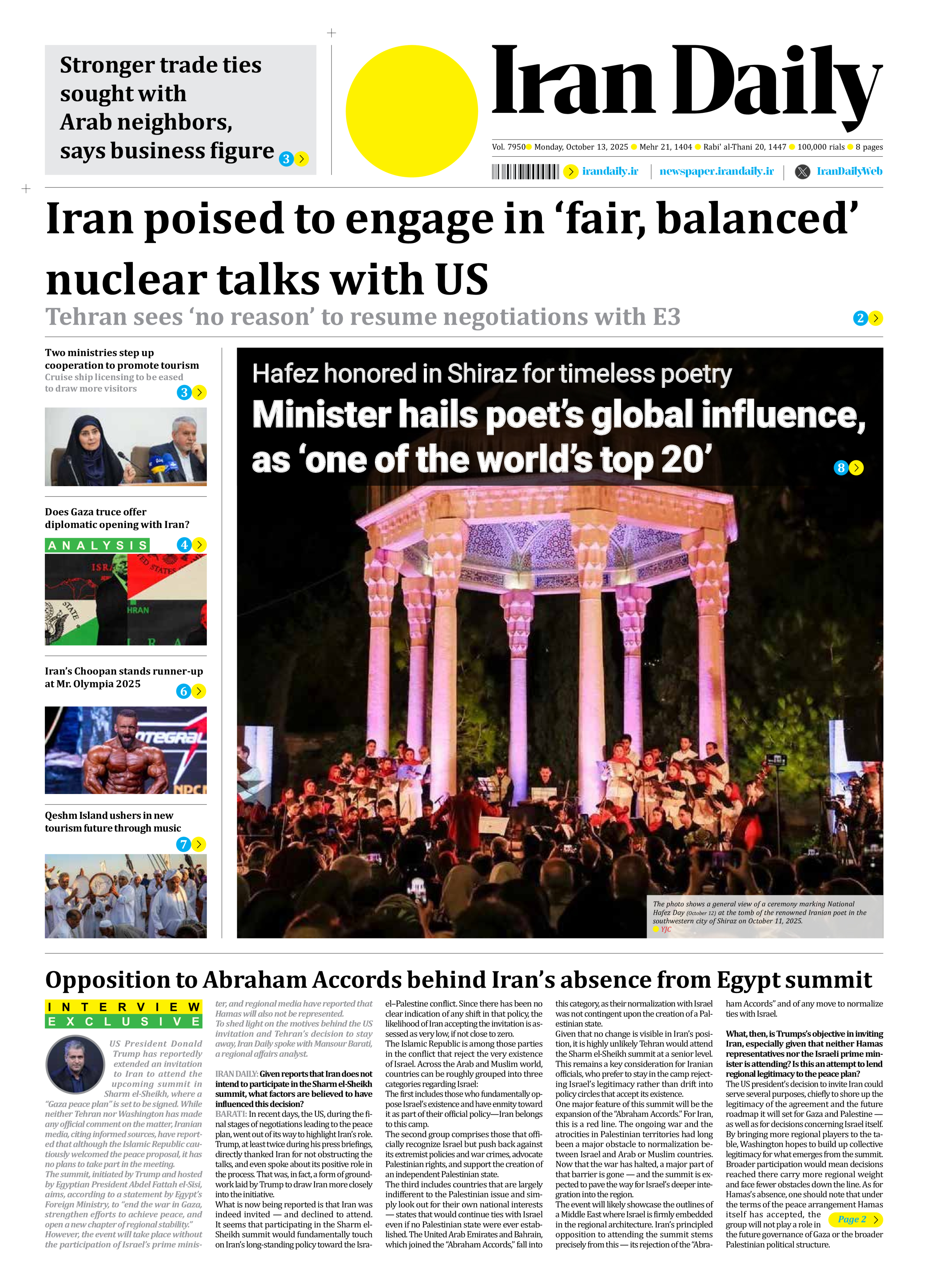


Opposition to Abraham Accords behind Iran’s absence from Egypt summit
US President Donald Trump has reportedly extended an invitation to Iran to attend the upcoming summit in Sharm el-Sheikh, where a “Gaza peace plan” is set to be signed. While neither Tehran nor Washington has made any official comment on the matter, Iranian media, citing informed sources, have reported that although the Islamic Republic cautiously welcomed the peace proposal, it has no plans to take part in the meeting.
The summit, initiated by Trump and hosted by Egyptian President Abdel Fattah el-Sisi, aims, according to a statement by Egypt’s Foreign Ministry, to “end the war in Gaza, strengthen efforts to achieve peace, and open a new chapter of regional stability.”
However, the event will take place without the participation of Israel’s prime minister, and regional media have reported that Hamas will also not be represented.
To shed light on the motives behind the US invitation and Tehran’s decision to stay away, Iran Daily spoke with Mansour Barati, a regional affairs analyst.
IRAN DAILY: Given reports that Iran does not intend to participate in the Sharm el-Sheikh summit, what factors are believed to have influenced this decision?
BARATI: In recent days, the US, during the final stages of negotiations leading to the peace plan, went out of its way to highlight Iran’s role. Trump, at least twice during his press briefings, directly thanked Iran for not obstructing the talks, and even spoke about its positive role in the process. That was, in fact, a form of groundwork laid by Trump to draw Iran more closely into the initiative.
What is now being reported is that Iran was indeed invited — and declined to attend. It seems that participating in the Sharm el-Sheikh summit would fundamentally touch on Iran’s long-standing policy toward the Israel–Palestine conflict. Since there has been no clear indication of any shift in that policy, the likelihood of Iran accepting the invitation is assessed as very low, if not close to zero.
The Islamic Republic is among those parties in the conflict that reject the very existence of Israel. Across the Arab and Muslim world, countries can be roughly grouped into three categories regarding Israel:
The first includes those who fundamentally oppose Israel’s existence and have enmity toward it as part of their official policy—Iran belongs to this camp.
The second group comprises those that officially recognize Israel but push back against its extremist policies and war crimes, advocate Palestinian rights, and support the creation of an independent Palestinian state.
The third includes countries that are largely indifferent to the Palestinian issue and simply look out for their own national interests — states that would continue ties with Israel even if no Palestinian state were ever established. The United Arab Emirates and Bahrain, which joined the “Abraham Accords,” fall into this category, as their normalization with Israel was not contingent upon the creation of a Palestinian state.
Given that no change is visible in Iran’s position, it is highly unlikely Tehran would attend the Sharm el-Sheikh summit at a senior level. This remains a key consideration for Iranian officials, who prefer to stay in the camp rejecting Israel’s legitimacy rather than drift into policy circles that accept its existence.
One major feature of this summit will be the expansion of the “Abraham Accords.” For Iran, this is a red line. The ongoing war and the atrocities in Palestinian territories had long been a major obstacle to normalization between Israel and Arab or Muslim countries. Now that the war has halted, a major part of that barrier is gone — and the summit is expected to pave the way for Israel’s deeper integration into the region.
The event will likely showcase the outlines of a Middle East where Israel is firmly embedded in the regional architecture. Iran’s principled opposition to attending the summit stems precisely from this — its rejection of the “Abraham Accords” and of any move to normalize ties with Israel.
What, then, is Trumps’s objective in inviting Iran, especially given that neither Hamas representatives nor the Israeli prime minister is attending? Is this an attempt to lend regional legitimacy to the peace plan?
The US president’s decision to invite Iran could serve several purposes, chiefly to shore up the legitimacy of the agreement and the future roadmap it will set for Gaza and Palestine — as well as for decisions concerning Israel itself.
By bringing more regional players to the table, Washington hopes to build up collective legitimacy for what emerges from the summit. Broader participation would mean decisions reached there carry more regional weight and face fewer obstacles down the line. As for Hamas’s absence, one should note that under the terms of the peace arrangement Hamas itself has accepted, the group will not play a role in the future governance of Gaza or the broader Palestinian political structure.
Page 2