





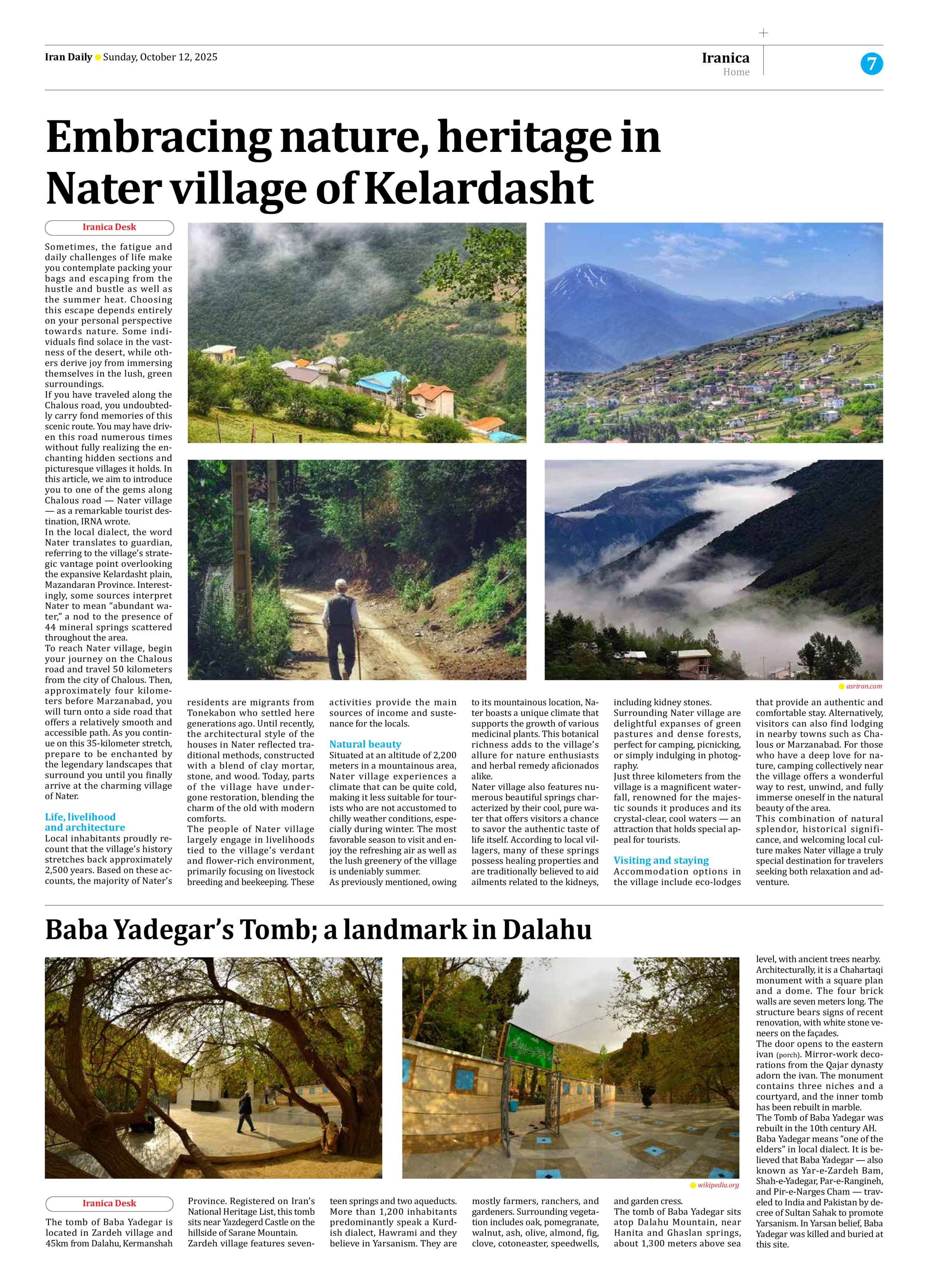


Baba Yadegar’s Tomb; a landmark in Dalahu
The tomb of Baba Yadegar is located in Zardeh village and 45km from Dalahu, Kermanshah Province. Registered on Iran’s National Heritage List, this tomb sits near Yazdegerd Castle on the hillside of Sarane Mountain.
Zardeh village features seventeen springs and two aqueducts. More than 1,200 inhabitants predominantly speak a Kurdish dialect, Hawrami and they believe in Yarsanism. They are mostly farmers, ranchers, and gardeners. Surrounding vegetation includes oak, pomegranate, walnut, ash, olive, almond, fig, clove, cotoneaster, speedwells, and garden cress.
The tomb of Baba Yadegar sits atop Dalahu Mountain, near Hanita and Ghaslan springs, about 1,300 meters above sea level, with ancient trees nearby.
Architecturally, it is a Chahartaqi monument with a square plan and a dome. The four brick walls are seven meters long. The structure bears signs of recent renovation, with white stone veneers on the façades.
The door opens to the eastern ivan (porch). Mirror-work decorations from the Qajar dynasty adorn the ivan. The monument contains three niches and a courtyard, and the inner tomb has been rebuilt in marble.
The Tomb of Baba Yadegar was rebuilt in the 10th century AH.
Baba Yadegar means “one of the elders” in local dialect. It is believed that Baba Yadegar — also known as Yar-e-Zardeh Bam, Shah-e-Yadegar, Par-e-Rangineh, and Pir-e-Narges Cham — traveled to India and Pakistan by decree of Sultan Sahak to promote Yarsanism. In Yarsan belief, Baba Yadegar was killed and buried at this site.