







US presence in Bagram poses compound threat to China, Russia, and Iran: Expert
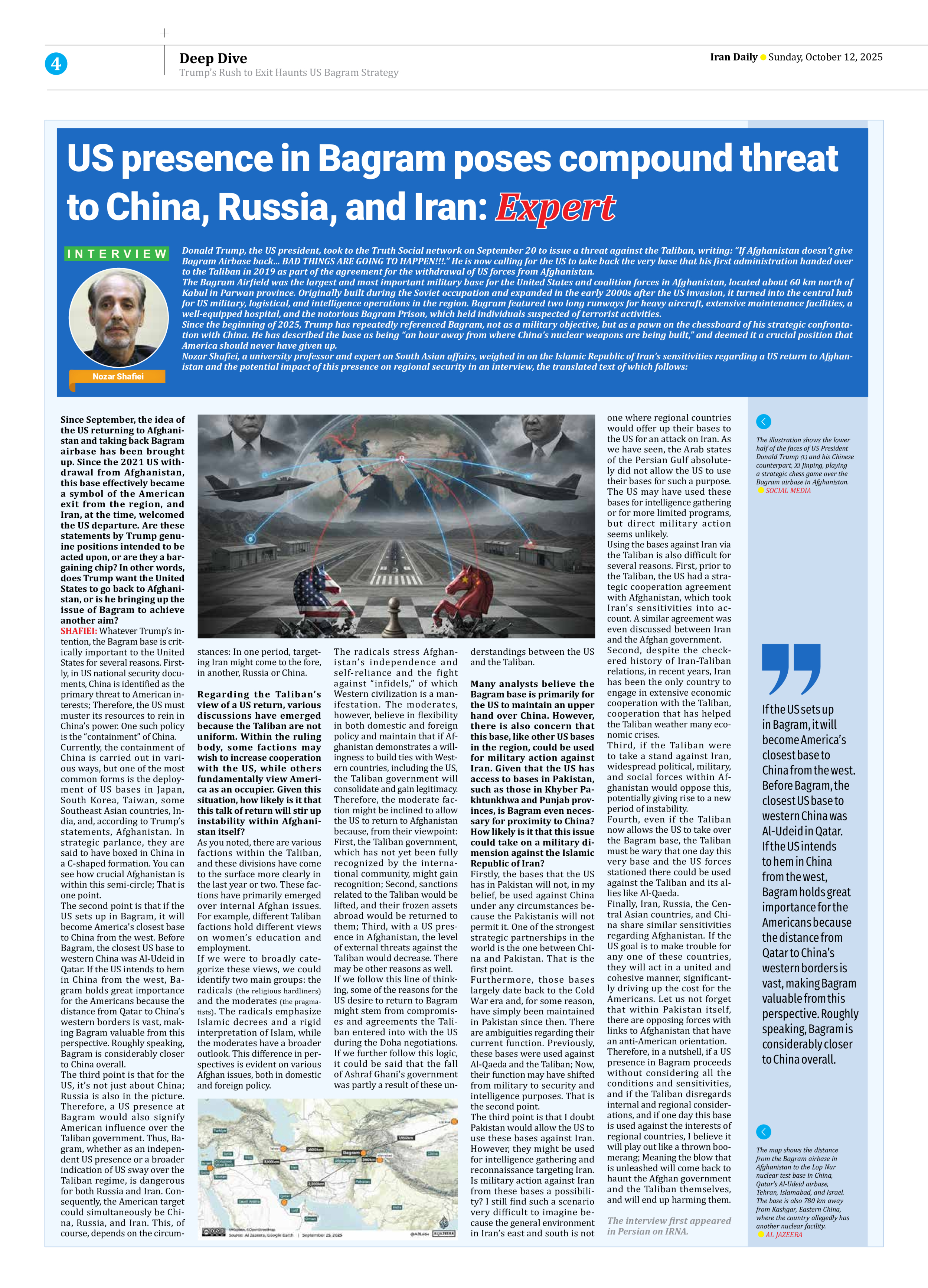
Donald Trump, the US president, took to the Truth Social network on September 20 to issue a threat against the Taliban, writing: “If Afghanistan doesn’t give Bagram Airbase back… BAD THINGS ARE GOING TO HAPPEN!!!.” He is now calling for the US to take back the very base that his first administration handed over to the Taliban in 2019 as part of the agreement for the withdrawal of US forces from Afghanistan. The Bagram Airfield was the largest and most important military base for the United States and coalition forces in Afghanistan, located about 60 km north of Kabul in Parwan province. Originally built during the Soviet occupation and expanded in the early 2000s after the US invasion, it turned into the central hub for US military, logistical, and intelligence operations in the region. Bagram featured two long runways for heavy aircraft, extensive maintenance facilities, a well-equipped hospital, and the notorious Bagram Prison, which held individuals suspected of terrorist activities. Since the beginning of 2025, Trump has repeatedly referenced Bagram, not as a military objective, but as a pawn on the chessboard of his strategic confrontation with China. He has described the base as being “an hour away from where China’s nuclear weapons are being built,” and deemed it a crucial position that America should never have given up. Nozar Shafiei, a university professor and expert on South Asian affairs, weighed in on the Islamic Republic of Iran’s sensitivities regarding a US return to Afghanistan and the potential impact of this presence on regional security in an interview, the translated text of which follows:
Nozar Shafiei
Since September, the idea of the US returning to Afghanistan and taking back Bagram airbase has been brought up. Since the 2021 US withdrawal from Afghanistan, this base effectively became a symbol of the American exit from the region, and Iran, at the time, welcomed the US departure. Are these statements by Trump genuine positions intended to be acted upon, or are they a bargaining chip? In other words, does Trump want the United States to go back to Afghanistan, or is he bringing up the issue of Bagram to achieve another aim?
SHAFIEI: Whatever Trump’s intention, the Bagram base is critically important to the United States for several reasons. Firstly, in US national security documents, China is identified as the primary threat to American interests; Therefore, the US must muster its resources to rein in China’s power. One such policy is the “containment” of China.
Currently, the containment of China is carried out in various ways, but one of the most common forms is the deployment of US bases in Japan, South Korea, Taiwan, some Southeast Asian countries, India, and, according to Trump’s statements, Afghanistan. In strategic parlance, they are said to have boxed in China in a C-shaped formation. You can see how crucial Afghanistan is within this semi-circle; That is one point.
The second point is that if the US sets up in Bagram, it will become America’s closest base to China from the west. Before Bagram, the closest US base to western China was Al-Udeid in Qatar. If the US intends to hem in China from the west, Bagram holds great importance for the Americans because the distance from Qatar to China’s western borders is vast, making Bagram valuable from this perspective. Roughly speaking, Bagram is considerably closer to China overall.
The third point is that for the US, it’s not just about China; Russia is also in the picture. Therefore, a US presence at Bagram would also signify American influence over the Taliban government. Thus, Bagram, whether as an independent US presence or a broader indication of US sway over the Taliban regime, is dangerous for both Russia and Iran. Consequently, the American target could simultaneously be China, Russia, and Iran. This, of course, depends on the circumstances: In one period, targeting Iran might come to the fore, in another, Russia or China.
Regarding the Taliban’s view of a US return, various discussions have emerged because the Taliban are not uniform. Within the ruling body, some factions may wish to increase cooperation with the US, while others fundamentally view America as an occupier. Given this situation, how likely is it that this talk of return will stir up instability within Afghanistan itself?
As you noted, there are various factions within the Taliban, and these divisions have come to the surface more clearly in the last year or two. These factions have primarily emerged over internal Afghan issues. For example, different Taliban factions hold different views on women’s education and employment.
If we were to broadly categorize these views, we could identify two main groups: the radicals (the religious hardliners) and the moderates (the pragmatists). The radicals emphasize Islamic decrees and a rigid interpretation of Islam, while the moderates have a broader outlook. This difference in perspectives is evident on various Afghan issues, both in domestic and foreign policy.
The radicals stress Afghanistan’s independence and self-reliance and the fight against “infidels,” of which Western civilization is a manifestation. The moderates, however, believe in flexibility in both domestic and foreign policy and maintain that if Afghanistan demonstrates a willingness to build ties with Western countries, including the US, the Taliban government will consolidate and gain legitimacy.
Therefore, the moderate faction might be inclined to allow the US to return to Afghanistan because, from their viewpoint: First, the Taliban government, which has not yet been fully recognized by the international community, might gain recognition; Second, sanctions related to the Taliban would be lifted, and their frozen assets abroad would be returned to them; Third, with a US presence in Afghanistan, the level of external threats against the Taliban would decrease. There may be other reasons as well.
If we follow this line of thinking, some of the reasons for the US desire to return to Bagram might stem from compromises and agreements the Taliban entered into with the US during the Doha negotiations. If we further follow this logic, it could be said that the fall of Ashraf Ghani’s government was partly a result of these understandings between the US and the Taliban.
Many analysts believe the Bagram base is primarily for the US to maintain an upper hand over China. However, there is also concern that this base, like other US bases in the region, could be used for military action against Iran. Given that the US has access to bases in Pakistan, such as those in Khyber Pakhtunkhwa and Punjab provinces, is Bagram even necessary for proximity to China? How likely is it that this issue could take on a military dimension against the Islamic Republic of Iran?
Firstly, the bases that the US has in Pakistan will not, in my belief, be used against China under any circumstances because the Pakistanis will not permit it. One of the strongest strategic partnerships in the world is the one between China and Pakistan. That is the first point.
Furthermore, those bases largely date back to the Cold War era and, for some reason, have simply been maintained in Pakistan since then. There are ambiguities regarding their current function. Previously, these bases were used against Al-Qaeda and the Taliban; Now, their function may have shifted from military to security and intelligence purposes. That is the second point.
The third point is that I doubt Pakistan would allow the US to use these bases against Iran. However, they might be used for intelligence gathering and reconnaissance targeting Iran. Is military action against Iran from these bases a possibility? I still find such a scenario very difficult to imagine because the general environment in Iran’s east and south is not one where regional countries would offer up their bases to the US for an attack on Iran. As we have seen, the Arab states of the Persian Gulf absolutely did not allow the US to use their bases for such a purpose. The US may have used these bases for intelligence gathering or for more limited programs, but direct military action seems unlikely.
Using the bases against Iran via the Taliban is also difficult for several reasons. First, prior to the Taliban, the US had a strategic cooperation agreement with Afghanistan, which took Iran’s sensitivities into account. A similar agreement was even discussed between Iran and the Afghan government.
Second, despite the checkered history of Iran-Taliban relations, in recent years, Iran has been the only country to engage in extensive economic cooperation with the Taliban, cooperation that has helped the Taliban weather many economic crises.
Third, if the Taliban were to take a stand against Iran, widespread political, military, and social forces within Afghanistan would oppose this, potentially giving rise to a new period of instability.
Fourth, even if the Taliban now allows the US to take over the Bagram base, the Taliban must be wary that one day this very base and the US forces stationed there could be used against the Taliban and its allies like Al-Qaeda.
Finally, Iran, Russia, the Central Asian countries, and China share similar sensitivities regarding Afghanistan. If the US goal is to make trouble for any one of these countries, they will act in a united and cohesive manner, significantly driving up the cost for the Americans. Let us not forget that within Pakistan itself, there are opposing forces with links to Afghanistan that have an anti-American orientation.
Therefore, in a nutshell, if a US presence in Bagram proceeds without considering all the conditions and sensitivities, and if the Taliban disregards internal and regional considerations, and if one day this base is used against the interests of regional countries, I believe it will play out like a thrown boomerang; Meaning the blow that is unleashed will come back to haunt the Afghan government and the Taliban themselves, and will end up harming them.
The interview first appeared in Persian on IRNA.