







Hamas pursues ‘Yes, but’ strategy in talks: Former envoy
Iran’s response to Gaza peace plan rational, constructive
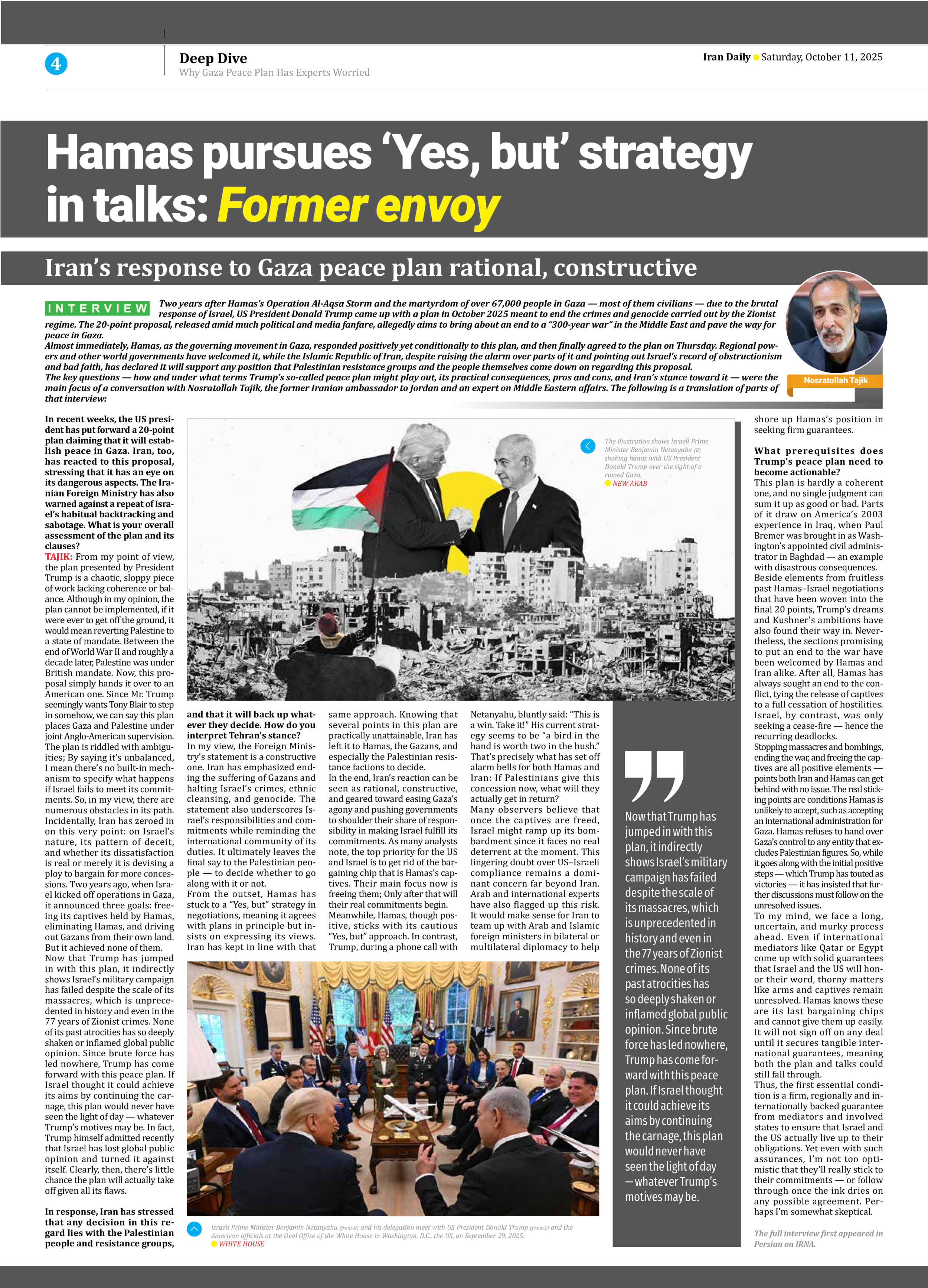
Two years after Hamas’s Operation Al-Aqsa Storm and the martyrdom of over 67,000 people in Gaza — most of them civilians — due to the brutal response of Israel, US President Donald Trump came up with a plan in October 2025 meant to end the crimes and genocide carried out by the Zionist regime. The 20-point proposal, released amid much political and media fanfare, allegedly aims to bring about an end to a “300-year war” in the Middle East and pave the way for peace in Gaza. Almost immediately, Hamas, as the governing movement in Gaza, responded positively yet conditionally to this plan, and then finally agreed to the plan on Thursday. Regional powers and other world governments have welcomed it, while the Islamic Republic of Iran, despite raising the alarm over parts of it and pointing out Israel’s record of obstructionism and bad faith, has declared it will support any position that Palestinian resistance groups and the people themselves come down on regarding this proposal. The key questions — how and under what terms Trump’s so-called peace plan might play out, its practical consequences, pros and cons, and Iran’s stance toward it — were the main focus of a conversation with Nosratollah Tajik, the former Iranian ambassador to Jordan and an expert on Middle Eastern affairs. The following is a translation of parts of that interview:
Nosratollah Tajik
In recent weeks, the US president has put forward a 20-point plan claiming that it will establish peace in Gaza. Iran, too, has reacted to this proposal, stressing that it has an eye on its dangerous aspects. The Iranian Foreign Ministry has also warned against a repeat of Israel’s habitual backtracking and sabotage. What is your overall assessment of the plan and its clauses?
TAJIK: From my point of view, the plan presented by President Trump is a chaotic, sloppy piece of work lacking coherence or balance. Although in my opinion, the plan cannot be implemented, if it were ever to get off the ground, it would mean reverting Palestine to a state of mandate. Between the end of World War II and roughly a decade later, Palestine was under British mandate. Now, this proposal simply hands it over to an American one. Since Mr. Trump seemingly wants Tony Blair to step in somehow, we can say this plan places Gaza and Palestine under joint Anglo-American supervision.
The plan is riddled with ambiguities; By saying it’s unbalanced, I mean there’s no built-in mechanism to specify what happens if Israel fails to meet its commitments. So, in my view, there are numerous obstacles in its path. Incidentally, Iran has zeroed in on this very point: on Israel’s nature, its pattern of deceit, and whether its dissatisfaction is real or merely it is devising a ploy to bargain for more concessions. Two years ago, when Israel kicked off operations in Gaza, it announced three goals: freeing its captives held by Hamas, eliminating Hamas, and driving out Gazans from their own land. But it achieved none of them.
Now that Trump has jumped in with this plan, it indirectly shows Israel’s military campaign has failed despite the scale of its massacres, which is unprecedented in history and even in the 77 years of Zionist crimes. None of its past atrocities has so deeply shaken or inflamed global public opinion. Since brute force has led nowhere, Trump has come forward with this peace plan. If Israel thought it could achieve its aims by continuing the carnage, this plan would never have seen the light of day — whatever Trump’s motives may be. In fact, Trump himself admitted recently that Israel has lost global public opinion and turned it against itself. Clearly, then, there’s little chance the plan will actually take off given all its flaws.
In response, Iran has stressed that any decision in this regard lies with the Palestinian people and resistance groups, and that it will back up whatever they decide. How do you interpret Tehran’s stance?
In my view, the Foreign Ministry’s statement is a constructive one. Iran has emphasized ending the suffering of Gazans and halting Israel’s crimes, ethnic cleansing, and genocide. The statement also underscores Israel’s responsibilities and commitments while reminding the international community of its duties. It ultimately leaves the final say to the Palestinian people — to decide whether to go along with it or not.
From the outset, Hamas has stuck to a “Yes, but” strategy in negotiations, meaning it agrees with plans in principle but insists on expressing its views. Iran has kept in line with that same approach. Knowing that several points in this plan are practically unattainable, Iran has left it to Hamas, the Gazans, and especially the Palestinian resistance factions to decide.
In the end, Iran’s reaction can be seen as rational, constructive, and geared toward easing Gaza’s agony and pushing governments to shoulder their share of responsibility in making Israel fulfill its commitments. As many analysts note, the top priority for the US and Israel is to get rid of the bargaining chip that is Hamas’s captives. Their main focus now is freeing them; Only after that will their real commitments begin.
Meanwhile, Hamas, though positive, sticks with its cautious “Yes, but” approach. In contrast, Trump, during a phone call with Netanyahu, bluntly said: “This is a win. Take it!” His current strategy seems to be “a bird in the hand is worth two in the bush.” That’s precisely what has set off alarm bells for both Hamas and Iran: If Palestinians give this concession now, what will they actually get in return?
Many observers believe that once the captives are freed, Israel might ramp up its bombardment since it faces no real deterrent at the moment. This lingering doubt over US–Israeli compliance remains a dominant concern far beyond Iran. Arab and international experts have also flagged up this risk. It would make sense for Iran to team up with Arab and Islamic foreign ministers in bilateral or multilateral diplomacy to help shore up Hamas’s position in seeking firm guarantees.
What prerequisites does Trump’s peace plan need to become actionable?
This plan is hardly a coherent one, and no single judgment can sum it up as good or bad. Parts of it draw on America’s 2003 experience in Iraq, when Paul Bremer was brought in as Washington’s appointed civil administrator in Baghdad — an example with disastrous consequences.
Beside elements from fruitless past Hamas–Israel negotiations that have been woven into the final 20 points, Trump’s dreams and Kushner’s ambitions have also found their way in. Nevertheless, the sections promising to put an end to the war have been welcomed by Hamas and Iran alike. After all, Hamas has always sought an end to the conflict, tying the release of captives to a full cessation of hostilities. Israel, by contrast, was only seeking a cease-fire — hence the recurring deadlocks.
Stopping massacres and bombings, ending the war, and freeing the captives are all positive elements — points both Iran and Hamas can get behind with no issue. The real sticking points are conditions Hamas is unlikely to accept, such as accepting an international administration for Gaza. Hamas refuses to hand over Gaza’s control to any entity that excludes Palestinian figures. So, while it goes along with the initial positive steps — which Trump has touted as victories — it has insisted that further discussions must follow on the unresolved issues.
To my mind, we face a long, uncertain, and murky process ahead. Even if international mediators like Qatar or Egypt come up with solid guarantees that Israel and the US will honor their word, thorny matters like arms and captives remain unresolved. Hamas knows these are its last bargaining chips and cannot give them up easily. It will not sign off on any deal until it secures tangible international guarantees, meaning both the plan and talks could still fall through.
Thus, the first essential condition is a firm, regionally and internationally backed guarantee from mediators and involved states to ensure that Israel and the US actually live up to their obligations. Yet even with such assurances, I’m not too optimistic that they’ll really stick to their commitments — or follow through once the ink dries on any possible agreement. Perhaps I’m somewhat skeptical.
The full interview first appeared in Persian on IRNA.