







Copy in clipboard...
‘Utterly outrageous’: Russia raps reimposition of UN sanctions on Iran
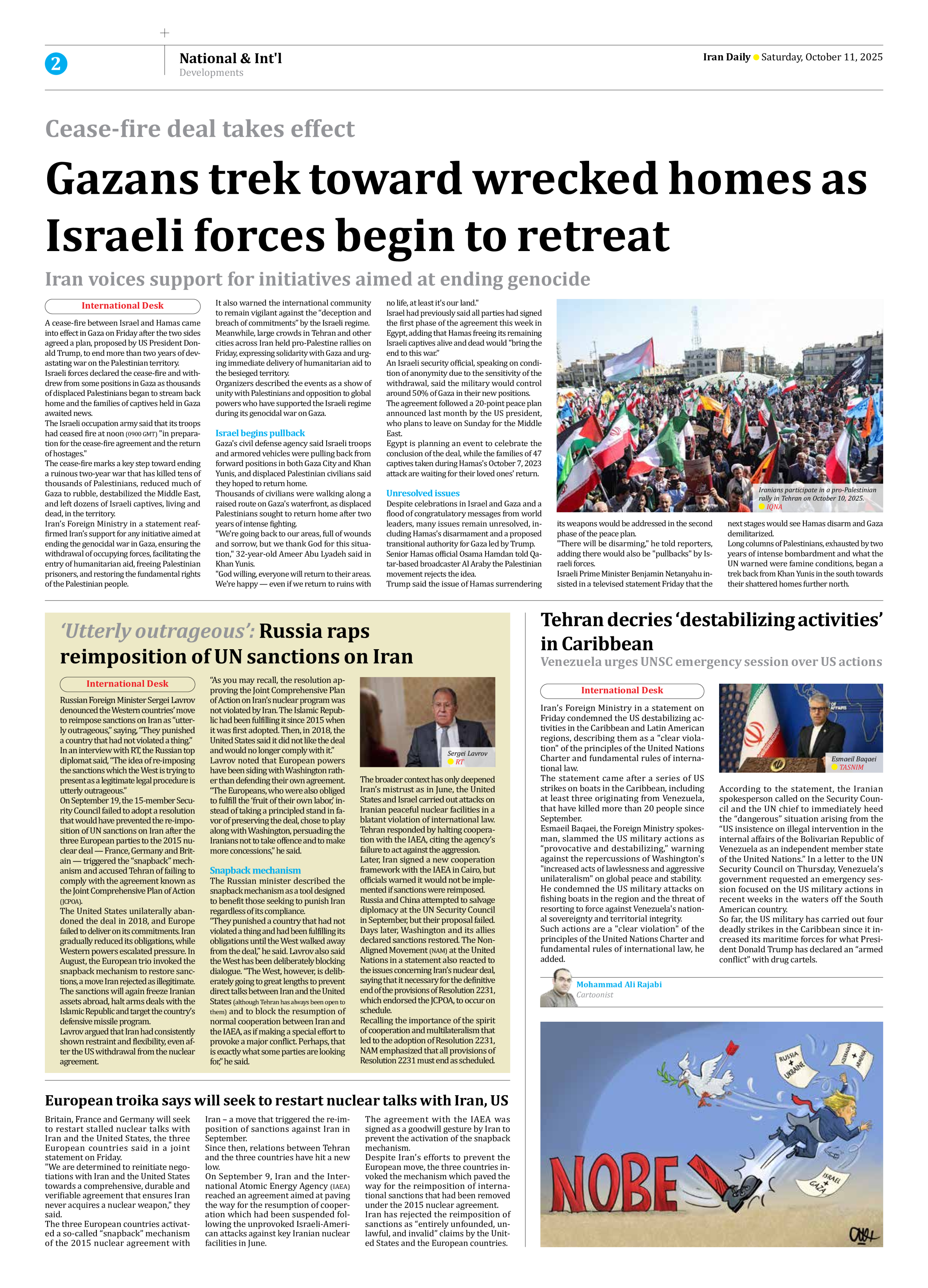
Russian Foreign Minister Sergei Lavrov denounced the Western countries’ move to reimpose sanctions on Iran as “utterly outrageous,” saying, “They punished a country that had not violated a thing.”
In an interview with RT, the Russian top diplomat said, “The idea of re-imposing the sanctions which the West is trying to present as a legitimate legal procedure is utterly outrageous.”
On September 19, the 15-member Security Council failed to adopt a resolution that would have prevented the re-imposition of UN sanctions on Iran after the three European parties to the 2015 nuclear deal — France, Germany and Britain — triggered the “snapback” mechanism and accused Tehran of failing to comply with the agreement known as the Joint Comprehensive Plan of Action (JCPOA).
The United States unilaterally abandoned the deal in 2018, and Europe failed to deliver on its commitments. Iran gradually reduced its obligations, while Western powers escalated pressure. In August, the European trio invoked the snapback mechanism to restore sanctions, a move Iran rejected as illegitimate.
The sanctions will again freeze Iranian assets abroad, halt arms deals with the Islamic Republic and target the country’s defensive missile program.
Lavrov argued that Iran had consistently shown restraint and flexibility, even after the US withdrawal from the nuclear agreement.
“As you may recall, the resolution approving the Joint Comprehensive Plan of Action on Iran’s nuclear program was not violated by Iran. The Islamic Republic had been fulfilling it since 2015 when it was first adopted. Then, in 2018, the United States said it did not like the deal and would no longer comply with it.”
Lavrov noted that European powers have been siding with Washington rather than defending their own agreement.
“The Europeans, who were also obliged to fulfill the ‘fruit of their own labor,’ instead of taking a principled stand in favor of preserving the deal, chose to play along with Washington, persuading the Iranians not to take offence and to make more concessions,” he said.
Snapback mechanism
The Russian minister described the snapback mechanism as a tool designed to benefit those seeking to punish Iran regardless of its compliance.
“They punished a country that had not violated a thing and had been fulfilling its obligations until the West walked away from the deal,” he said. Lavrov also said the West has been deliberately blocking dialogue. “The West, however, is deliberately going to great lengths to prevent direct talks between Iran and the United States (although Tehran has always been open to them) and to block the resumption of normal cooperation between Iran and the IAEA, as if making a special effort to provoke a major conflict. Perhaps, that is exactly what some parties are looking for,” he said.
The broader context has only deepened Iran’s mistrust as in June, the United States and Israel carried out attacks on Iranian peaceful nuclear facilities in a blatant violation of international law. Tehran responded by halting cooperation with the IAEA, citing the agency’s failure to act against the aggression.
Later, Iran signed a new cooperation framework with the IAEA in Cairo, but officials warned it would not be implemented if sanctions were reimposed.
Russia and China attempted to salvage diplomacy at the UN Security Council in September, but their proposal failed. Days later, Washington and its allies declared sanctions restored. The Non-Aligned Movement (NAM) at the United Nations in a statement also reacted to the issues concerning Iran’s nuclear deal, saying that it necessary for the definitive end of the provisions of Resolution 2231, which endorsed the JCPOA, to occur on schedule.
Recalling the importance of the spirit of cooperation and multilateralism that led to the adoption of Resolution 2231, NAM emphasized that all provisions of Resolution 2231 must end as scheduled.