







Why Europe’s snapback gamble against Iran will backfire
By Sina Toossi
Expert on international affairs
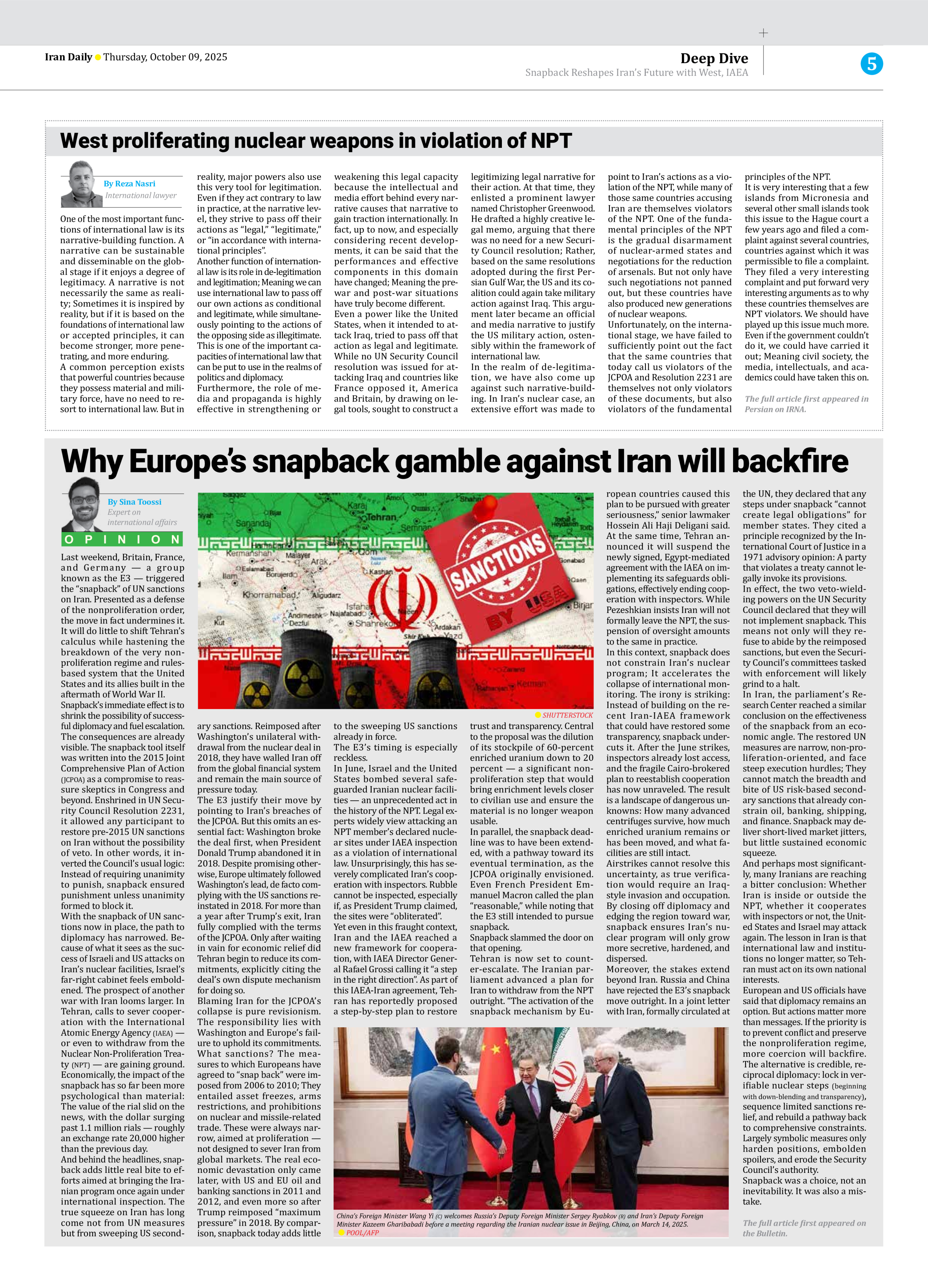
Last weekend, Britain, France, and Germany — a group known as the E3 — triggered the “snapback” of UN sanctions on Iran. Presented as a defense of the nonproliferation order, the move in fact undermines it. It will do little to shift Tehran’s calculus while hastening the breakdown of the very nonproliferation regime and rules-based system that the United States and its allies built in the aftermath of World War II.
Snapback’s immediate effect is to shrink the possibility of successful diplomacy and fuel escalation.
The consequences are already visible. The snapback tool itself was written into the 2015 Joint Comprehensive Plan of Action (JCPOA) as a compromise to reassure skeptics in Congress and beyond. Enshrined in UN Security Council Resolution 2231, it allowed any participant to restore pre-2015 UN sanctions on Iran without the possibility of veto. In other words, it inverted the Council’s usual logic: Instead of requiring unanimity to punish, snapback ensured punishment unless unanimity formed to block it.
With the snapback of UN sanctions now in place, the path to diplomacy has narrowed. Because of what it sees as the success of Israeli and US attacks on Iran’s nuclear facilities, Israel’s far-right cabinet feels emboldened. The prospect of another war with Iran looms larger. In Tehran, calls to sever cooperation with the International Atomic Energy Agency (IAEA) — or even to withdraw from the Nuclear Non-Proliferation Treaty (NPT) — are gaining ground. Economically, the impact of the snapback has so far been more psychological than material: The value of the rial slid on the news, with the dollar surging past 1.1 million rials — roughly an exchange rate 20,000 higher than the previous day.
And behind the headlines, snapback adds little real bite to efforts aimed at bringing the Iranian program once again under international inspection. The true squeeze on Iran has long come not from UN measures but from sweeping US secondary sanctions. Reimposed after Washington’s unilateral withdrawal from the nuclear deal in 2018, they have walled Iran off from the global financial system and remain the main source of pressure today.
The E3 justify their move by pointing to Iran’s breaches of the JCPOA. But this omits an essential fact: Washington broke the deal first, when President Donald Trump abandoned it in 2018. Despite promising otherwise, Europe ultimately followed Washington’s lead, de facto complying with the US sanctions reinstated in 2018. For more than a year after Trump’s exit, Iran fully complied with the terms of the JCPOA. Only after waiting in vain for economic relief did Tehran begin to reduce its commitments, explicitly citing the deal’s own dispute mechanism for doing so.
Blaming Iran for the JCPOA’s collapse is pure revisionism. The responsibility lies with Washington and Europe’s failure to uphold its commitments.
What sanctions? The measures to which Europeans have agreed to “snap back” were imposed from 2006 to 2010; They entailed asset freezes, arms restrictions, and prohibitions on nuclear and missile-related trade. These were always narrow, aimed at proliferation — not designed to sever Iran from global markets. The real economic devastation only came later, with US and EU oil and banking sanctions in 2011 and 2012, and even more so after Trump reimposed “maximum pressure” in 2018. By comparison, snapback today adds little to the sweeping US sanctions already in force.
The E3’s timing is especially reckless.
In June, Israel and the United States bombed several safeguarded Iranian nuclear facilities — an unprecedented act in the history of the NPT. Legal experts widely view attacking an NPT member’s declared nuclear sites under IAEA inspection as a violation of international law. Unsurprisingly, this has severely complicated Iran’s cooperation with inspectors. Rubble cannot be inspected, especially if, as President Trump claimed, the sites were “obliterated”.
Yet even in this fraught context, Iran and the IAEA reached a new framework for cooperation, with IAEA Director General Rafael Grossi calling it “a step in the right direction”. As part of this IAEA-Iran agreement, Tehran has reportedly proposed a step-by-step plan to restore trust and transparency. Central to the proposal was the dilution of its stockpile of 60-percent enriched uranium down to 20 percent — a significant nonproliferation step that would bring enrichment levels closer to civilian use and ensure the material is no longer weapon usable.
In parallel, the snapback deadline was to have been extended, with a pathway toward its eventual termination, as the JCPOA originally envisioned. Even French President Emmanuel Macron called the plan “reasonable,” while noting that the E3 still intended to pursue snapback.
Snapback slammed the door on that opening.
Tehran is now set to counter-escalate. The Iranian parliament advanced a plan for Iran to withdraw from the NPT outright. “The activation of the snapback mechanism by European countries caused this plan to be pursued with greater seriousness,” senior lawmaker Hossein Ali Haji Deligani said. At the same time, Tehran announced it will suspend the newly signed, Egypt-mediated agreement with the IAEA on implementing its safeguards obligations, effectively ending cooperation with inspectors. While Pezeshkian insists Iran will not formally leave the NPT, the suspension of oversight amounts to the same in practice.
In this context, snapback does not constrain Iran’s nuclear program; It accelerates the collapse of international monitoring. The irony is striking: Instead of building on the recent Iran-IAEA framework that could have restored some transparency, snapback undercuts it. After the June strikes, inspectors already lost access, and the fragile Cairo-brokered plan to reestablish cooperation has now unraveled. The result is a landscape of dangerous unknowns: How many advanced centrifuges survive, how much enriched uranium remains or has been moved, and what facilities are still intact.
Airstrikes cannot resolve this uncertainty, as true verification would require an Iraq-style invasion and occupation. By closing off diplomacy and edging the region toward war, snapback ensures Iran’s nuclear program will only grow more secretive, hardened, and dispersed.
Moreover, the stakes extend beyond Iran. Russia and China have rejected the E3’s snapback move outright. In a joint letter with Iran, formally circulated at the UN, they declared that any steps under snapback “cannot create legal obligations” for member states. They cited a principle recognized by the International Court of Justice in a 1971 advisory opinion: A party that violates a treaty cannot legally invoke its provisions.
In effect, the two veto-wielding powers on the UN Security Council declared that they will not implement snapback. This means not only will they refuse to abide by the reimposed sanctions, but even the Security Council’s committees tasked with enforcement will likely grind to a halt.
In Iran, the parliament’s Research Center reached a similar conclusion on the effectiveness of the snapback from an economic angle. The restored UN measures are narrow, non-proliferation-oriented, and face steep execution hurdles; They cannot match the breadth and bite of US risk-based secondary sanctions that already constrain oil, banking, shipping, and finance. Snapback may deliver short-lived market jitters, but little sustained economic squeeze.
And perhaps most significantly, many Iranians are reaching a bitter conclusion: Whether Iran is inside or outside the NPT, whether it cooperates with inspectors or not, the United States and Israel may attack again. The lesson in Iran is that international law and institutions no longer matter, so Tehran must act on its own national interests.
European and US officials have said that diplomacy remains an option. But actions matter more than messages. If the priority is to prevent conflict and preserve the nonproliferation regime, more coercion will backfire. The alternative is credible, reciprocal diplomacy: lock in verifiable nuclear steps (beginning with down-blending and transparency), sequence limited sanctions relief, and rebuild a pathway back to comprehensive constraints. Largely symbolic measures only harden positions, embolden spoilers, and erode the Security Council’s authority.
Snapback was a choice, not an inevitability. It was also a mistake.
The full article first appeared on the Bulletin.