







Experts: E3 applies double standard to Iran’s nuclear program
A seminar titled “Nuclear Rights in Peacetime, War, and Post-War” was held on October 5 at the University of Tehran’s Faculty of World Studies. The event featured professors of international relations and law and a senior diplomat from the Ministry of Foreign Affairs. During this seminar, these experts on international affairs weighed in on the implications of the implementation of the JCPOA’s snapback mechanism and spelled out the options on the table for Iran. A translated summary of their remarks follows below:
Another deal with IAEA on inspection inevitable under NPT
By Hamid Baeidinejad
Former Iranian ambassador to London
Islamic Republic of Iran officials, namely Foreign Minister Araghchi and Secretary of the Supreme National Security Council Larijani, clearly pointed out from the very beginning that the Cairo agreement was an attempt to allow us to live up to our commitments within the IAEA framework. Given the facts on the ground, we could not shut our eyes to the issue of military attack. Iran proceeded with the assumption that this could be a procedure to help delay and, in effect, prevent the implementation of the snapback and thus sought to secure this agreement with the IAEA.
But now that they have brought back the UN Security Council resolutions, I believe we are faced with two issues. Firstly, if Iran does not withdraw from the NPT — and it seems there is an appetite for that domestically — then according to Article 3 of the NPT, it ultimately has commitments regarding its agreement with the IAEA and access to its nuclear facilities.
In the current unprecedented situation, we might be able to make the IAEA demonstrate good faith and work on adapting its procedures to the new reality. This is an expectation we certainly have of the Agency; It must carry out this action and cannot tell us that everything remains as it was.
Today, the IAEA cannot tell us that all the commitments written on paper must be implemented exactly as before. It is a fact that we cannot overlook that a military aggression has taken place and they have attacked our primary facilities. We cannot give the same level of access and have the same information exchange with the IAEA as before. Naturally, these matters must be revisited and looked at in light of Iran’s political and security developments, so that an agreement suited to these conditions can be hammered out.
Securitization of Iran’s nuclear case reduces its global activism
By Sasan Karimi
Adjunct Professor at University of Tehran
The narrative that says, “Might is right” is certainly the most accurate, but it comes with a caveat: This might is not solely military might. It has many dimensions, including media might, military might, narrative-building might, legal might, and economic might; All of these constitute might.
Even the most powerful military entities, incidentally, pour the most effort into the semiotic and spiritual dimensions to increase their might and deploy relevant tactics. If it were unnecessary, they certainly would not shell out so much, and certainly, so many think tanks and pseudo-think tanks would not spring up in the US, think tanks that have traditionally been sponsored by Jewish groups and to which Arab sponsors have recently been added on. Therefore, we must push ahead with the various dimensions of might simultaneously. The might we deem decisive is not necessarily limited to material, military, economic, or population might, etc.; They must all be seen as a whole, and choosing between them is not the point.
Approximately three percent of the world’s primary nuclear activity facilities are located in Iran. Yet, over 20 percent of international nuclear industry inspections worldwide have focused on Iran — about seven times the global average. The crucial point is that this volume of inspections was not limited to one year or a specific period; Rather, for the past 21 to 22 years, Iran has been subjected to continuous, and even increasingly heavy, inspections. Despite this, no significant finding or serious violation has ever been reported by the inspectors. At most, issues of a “nuclear material accounting” nature have been raised — such as materials remaining in parts of equipment or pipes, which have sometimes led to nitpicking. Obviously, if a significant issue had existed, it certainly would not have been swept under the rug by international bodies.
Meanwhile, the securitization of nuclear rights itself creates limitations within the innermost scientific layers of the country, let alone the outer and external layers, including the commercial sectors that would otherwise be carrying on trade and economic exchange without such limitations. Many universities, faculties, professors, students, and researchers voluntarily steer clear of this field, and the reason is precisely this securitization. For optimizing activism, narrative-building, spotlighting, norm-setting, and enhancing multilateral activities at the international and global level, this state of securitization acts somewhat paradoxically. The more the country’s environment becomes closed off, whether due to sanctions or internal restrictions, the level of activism goes down. This reduction in activism, in turn, leads to isolation and the country’s voice being less heard in the global arena. In other words, excessive securitization, apart from creating internal limitations, has a negative knock-on effect on Iran’s capacity to exert influence and maintain an active presence on the international stage.
The three European countries (E3) did not have the legitimate right to bring back the six UN Security Council resolutions. A member or members of an international agreement cannot selectively pick and choose provisions of an agreement; That is, they cannot fail to live up to the parts that are binding for them, yet take advantage of the parts that seemingly benefit them or use the dispute resolution mechanism to effectively punish the other side. This happened before in the dispute between Namibia and South Africa, and the International Court of Justice’s advisory opinion shows that such selective use is not legitimate.
Engaging with global issues has one key point. Unlike governance within borders — and even that only in some cases — in the global environment, the equations resemble those of economy and society; If you don’t play the game, the game goes on. It is a bitter truth that if you don’t play, the game does not stop; you simply haven’t played. We often think that by not playing, we can stop the game. The game of the economy goes on, but we are left out.
West proliferating nuclear weapons in violation of NPT
By Reza Nasri
International lawyer
One of the most important functions of international law is its narrative-building function. A narrative can be sustainable and disseminable on the global stage if it enjoys a degree of legitimacy. A narrative is not necessarily the same as reality; Sometimes it is inspired by reality, but if it is based on the foundations of international law or accepted principles, it can become stronger, more penetrating, and more enduring.
A common perception exists that powerful countries because they possess material and military force, have no need to resort to international law. But in reality, major powers also use this very tool for legitimation. Even if they act contrary to law in practice, at the narrative level, they strive to pass off their actions as “legal,” “legitimate,” or “in accordance with international principles”.
Another function of international law is its role in de-legitimation and legitimation; Meaning we can use international law to pass off our own actions as conditional and legitimate, while simultaneously pointing to the actions of the opposing side as illegitimate. This is one of the important capacities of international law that can be put to use in the realms of politics and diplomacy.
Furthermore, the role of media and propaganda is highly effective in strengthening or weakening this legal capacity because the intellectual and media effort behind every narrative causes that narrative to gain traction internationally. In fact, up to now, and especially considering recent developments, it can be said that the performances and effective components in this domain have changed; Meaning the pre-war and post-war situations have truly become different.
Even a power like the United States, when it intended to attack Iraq, tried to pass off that action as legal and legitimate. While no UN Security Council resolution was issued for attacking Iraq and countries like France opposed it, America and Britain, by drawing on legal tools, sought to construct a legitimizing legal narrative for their action. At that time, they enlisted a prominent lawyer named Christopher Greenwood. He drafted a highly creative legal memo, arguing that there was no need for a new Security Council resolution; Rather, based on the same resolutions adopted during the first Persian Gulf War, the US and its coalition could again take military action against Iraq. This argument later became an official and media narrative to justify the US military action, ostensibly within the framework of international law.
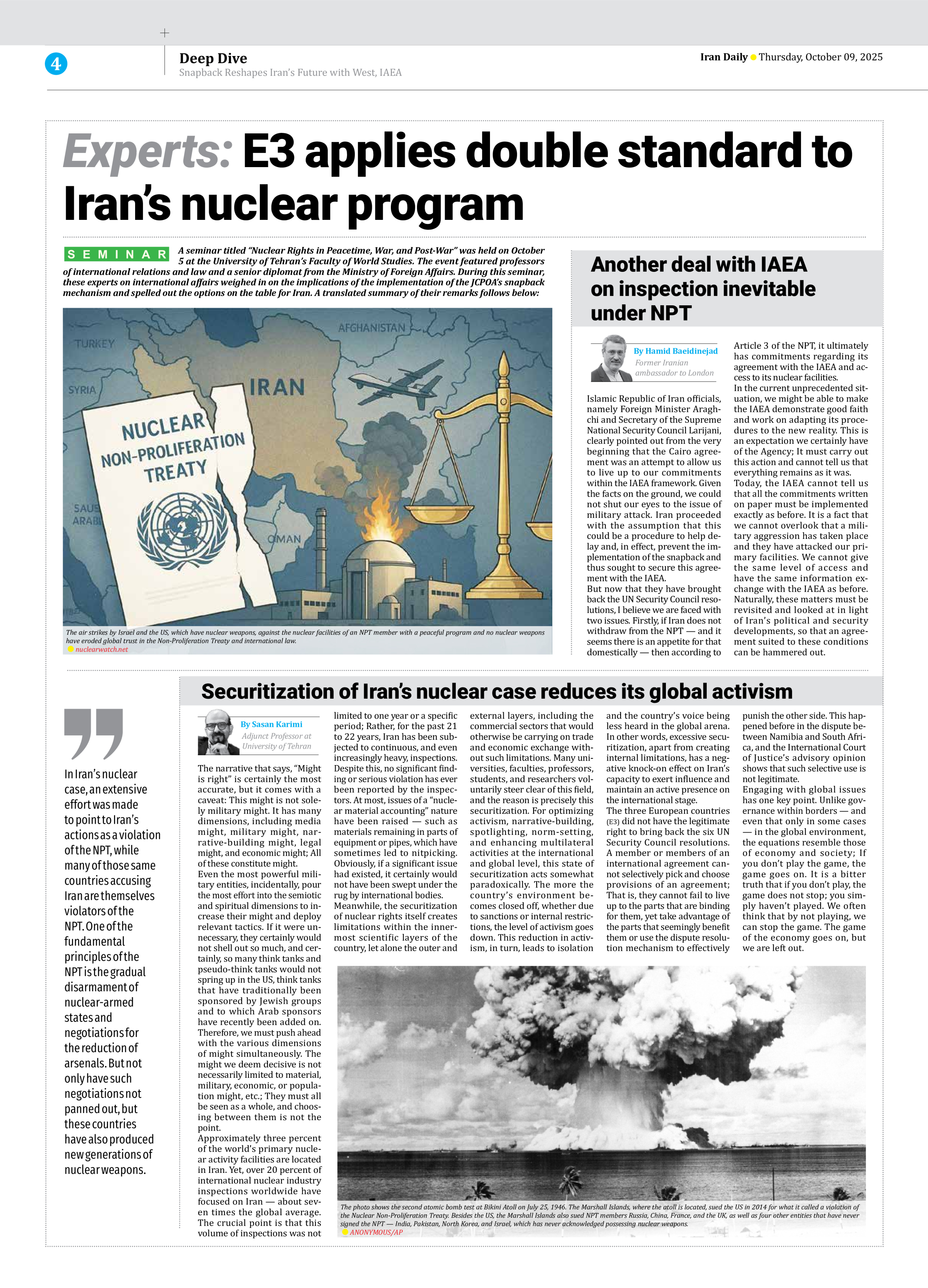
In the realm of de-legitimation, we have also come up against such narrative-building. In Iran’s nuclear case, an extensive effort was made to point to Iran’s actions as a violation of the NPT, while many of those same countries accusing Iran are themselves violators of the NPT. One of the fundamental principles of the NPT is the gradual disarmament of nuclear-armed states and negotiations for the reduction of arsenals. But not only have such negotiations not panned out, but these countries have also produced new generations of nuclear weapons.
Unfortunately, on the international stage, we have failed to sufficiently point out the fact that the same countries that today call us violators of the JCPOA and Resolution 2231 are themselves not only violators of these documents, but also violators of the fundamental principles of the NPT.
It is very interesting that a few islands from Micronesia and several other small islands took this issue to the Hague court a few years ago and filed a complaint against several countries, countries against which it was permissible to file a complaint. They filed a very interesting complaint and put forward very interesting arguments as to why these countries themselves are NPT violators. We should have played up this issue much more. Even if the government couldn’t do it, we could have carried it out; Meaning civil society, the media, intellectuals, and academics could have taken this on.
The full article first appeared in Persian on IRNA.