





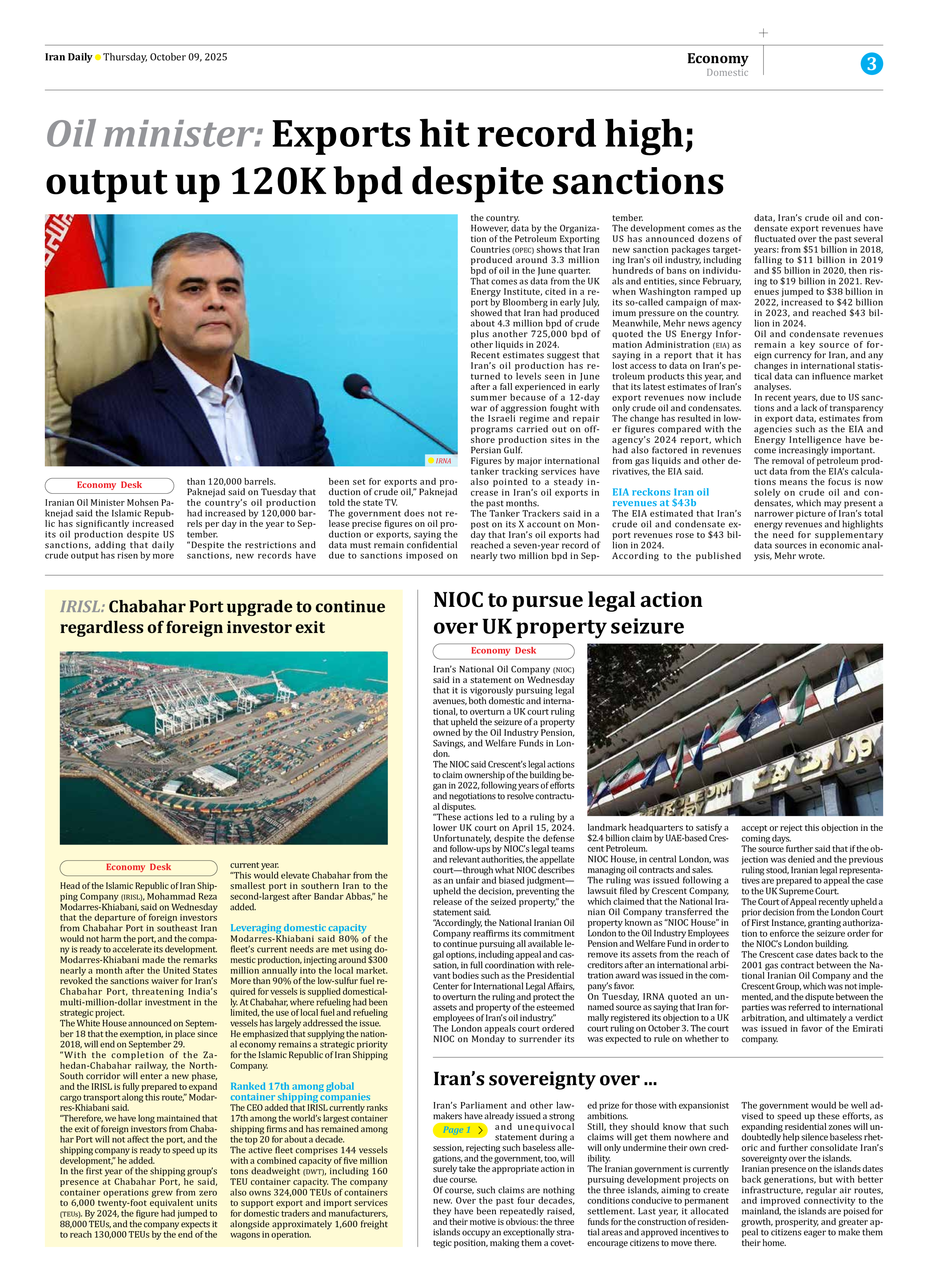


Oil minister: Exports hit record high; output up 120K bpd despite sanctions
Iranian Oil Minister Mohsen Paknejad said the Islamic Republic has significantly increased its oil production despite US sanctions, adding that daily crude output has risen by more than 120,000 barrels.
Paknejad said on Tuesday that the country’s oil production had increased by 120,000 barrels per day in the year to September.
“Despite the restrictions and sanctions, new records have been set for exports and production of crude oil,” Paknejad told the state TV.
The government does not release precise figures on oil production or exports, saying the data must remain confidential due to sanctions imposed on the country.
However, data by the Organization of the Petroleum Exporting Countries (OPEC) shows that Iran produced around 3.3 million bpd of oil in the June quarter.
That comes as data from the UK Energy Institute, cited in a report by Bloomberg in early July, showed that Iran had produced about 4.3 million bpd of crude plus another 725,000 bpd of other liquids in 2024.
Recent estimates suggest that Iran’s oil production has returned to levels seen in June after a fall experienced in early summer because of a 12-day war of aggression fought with the Israeli regime and repair programs carried out on offshore production sites in the Persian Gulf.
Figures by major international tanker tracking services have also pointed to a steady increase in Iran’s oil exports in the past months.
The Tanker Trackers said in a post on its X account on Monday that Iran’s oil exports had reached a seven-year record of nearly two million bpd in September.
The development comes as the US has announced dozens of new sanction packages targeting Iran's oil industry, including hundreds of bans on individuals and entities, since February, when Washington ramped up its so-called campaign of maximum pressure on the country.
Meanwhile, Mehr news agency quoted the US Energy Information Administration (EIA) as saying in a report that it has lost access to data on Iran’s petroleum products this year, and that its latest estimates of Iran’s export revenues now include only crude oil and condensates.
The change has resulted in lower figures compared with the agency’s 2024 report, which had also factored in revenues from gas liquids and other derivatives, the EIA said.
EIA reckons Iran oil revenues at $43b
The EIA estimated that Iran’s crude oil and condensate export revenues rose to $43 billion in 2024.
According to the published data, Iran’s crude oil and condensate export revenues have fluctuated over the past several years: from $51 billion in 2018, falling to $11 billion in 2019 and $5 billion in 2020, then rising to $19 billion in 2021. Revenues jumped to $38 billion in 2022, increased to $42 billion in 2023, and reached $43 billion in 2024.
Oil and condensate revenues remain a key source of foreign currency for Iran, and any changes in international statistical data can influence market analyses.
In recent years, due to US sanctions and a lack of transparency in export data, estimates from agencies such as the EIA and Energy Intelligence have become increasingly important.
The removal of petroleum product data from the EIA’s calculations means the focus is now solely on crude oil and condensates, which may present a narrower picture of Iran’s total energy revenues and highlights the need for supplementary data sources in economic analysis, Mehr wrote.