







Partnership Treaty Tehran-Moscow response to snapback
The Comprehensive Strategic Partnership Treaty is the most extensive agreement ever concluded between the Islamic Republic of Iran and the Russian Federation. It’s a 47-article accord covering nearly every aspect of bilateral relations and cooperation, the enforcement of which has been mandated by both governments from the morning of October 3, 2025. This 20-year pact, once put into action, could ease some of the burden imposed by Western sanctions on both countries and tighten the strategic closeness between Iran and Russia.
On the evening of October 2, 2025, the Iranian Ministry of Foreign Affairs officially announced the start of the Comprehensive Strategic Partnership Treaty’s implementation with Russia. According to the statement, this agreement underscores the determination and commitment of the leaders of both countries to deepen ties and strengthen relations across all areas of mutual interest. It marks a milestone in the history of bilateral relations and holds out the promise of elevating their level in various fields both sides have set their sights on.
As stated in the final clause of Iran’s Foreign Ministry release, the two countries, conscious of the fundamental importance of upholding the principles and objectives of the United Nations Charter to maintain international peace and security, will spare no effort to safeguard multilateralism and respect international law, including by stepping up cooperation within multilateral organizations and arrangements such as BRICS and the Shanghai Cooperation Organisation.
The start of this treaty’s enforcement is a midpoint on a journey that began decades ago between Iran and Russia. Iran previously signed a treaty with the Soviet Federative Socialist Republic in 1921, a trade and maritime treaty with the Soviet Union in 1940, and a treaty on the basis for mutual relations and the principles of cooperation with the Russian Federation in 2001.
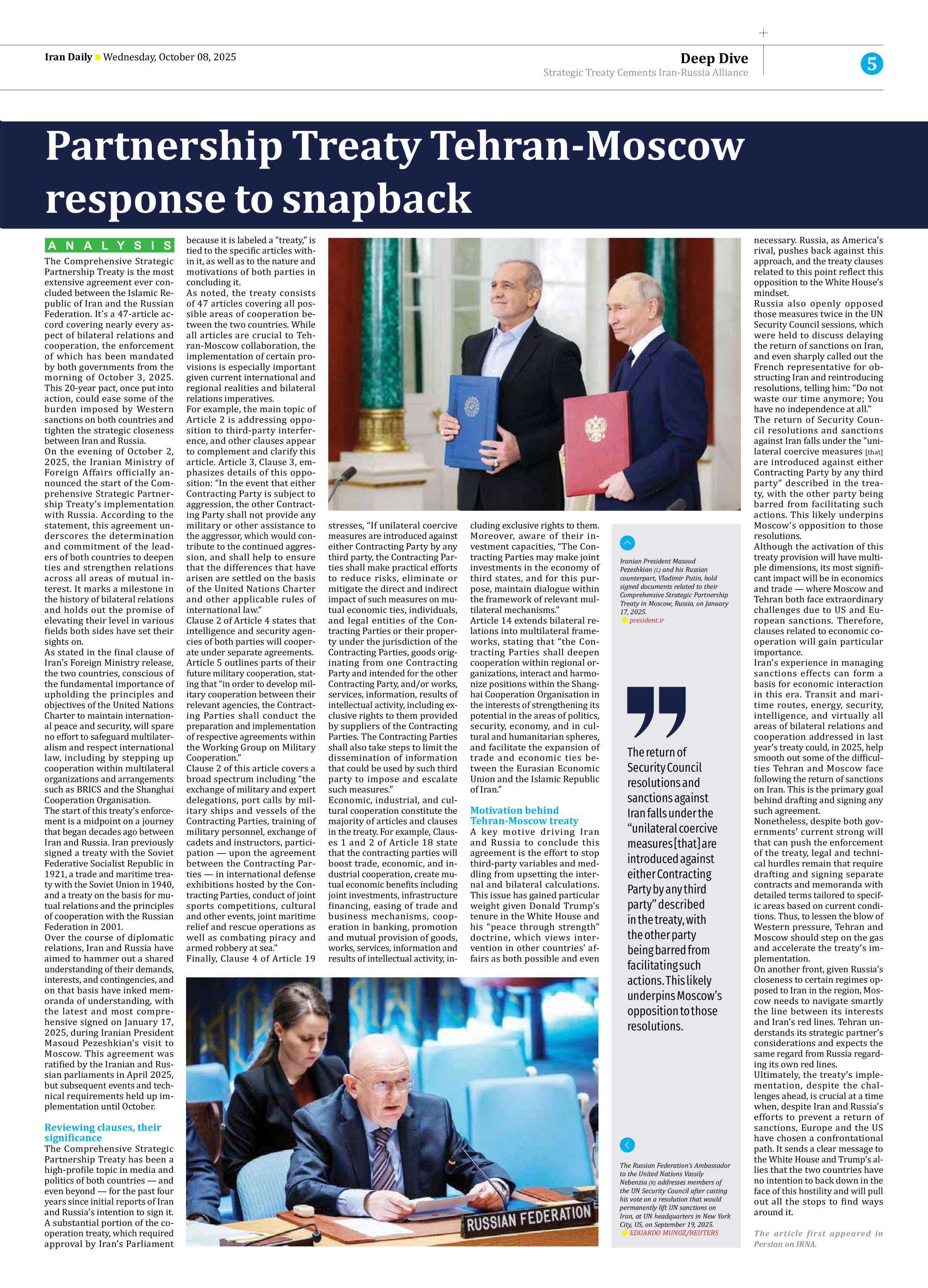
Over the course of diplomatic relations, Iran and Russia have aimed to hammer out a shared understanding of their demands, interests, and contingencies, and on that basis have inked memoranda of understanding, with the latest and most comprehensive signed on January 17, 2025, during Iranian President Masoud Pezeshkian’s visit to Moscow. This agreement was ratified by the Iranian and Russian parliaments in April 2025, but subsequent events and technical requirements held up implementation until October.
Reviewing clauses, their significance
The Comprehensive Strategic Partnership Treaty has been a high-profile topic in media and politics of both countries — and even beyond — for the past four years since initial reports of Iran and Russia’s intention to sign it. A substantial portion of the cooperation treaty, which required approval by Iran’s Parliament because it is labeled a “treaty,” is tied to the specific articles within it, as well as to the nature and motivations of both parties in concluding it.
As noted, the treaty consists of 47 articles covering all possible areas of cooperation between the two countries. While all articles are crucial to Tehran-Moscow collaboration, the implementation of certain provisions is especially important given current international and regional realities and bilateral relations imperatives.
For example, the main topic of Article 2 is addressing opposition to third-party interference, and other clauses appear to complement and clarify this article. Article 3, Clause 3, emphasizes details of this opposition: “In the event that either Contracting Party is subject to aggression, the other Contracting Party shall not provide any military or other assistance to the aggressor, which would contribute to the continued aggression, and shall help to ensure that the differences that have arisen are settled on the basis of the United Nations Charter and other applicable rules of international law.”
Clause 2 of Article 4 states that intelligence and security agencies of both parties will cooperate under separate agreements.
Article 5 outlines parts of their future military cooperation, stating that “in order to develop military cooperation between their relevant agencies, the Contracting Parties shall conduct the preparation and implementation of respective agreements within the Working Group on Military Cooperation.”
Clause 2 of this article covers a broad spectrum including “the exchange of military and expert delegations, port calls by military ships and vessels of the Contracting Parties, training of military personnel, exchange of cadets and instructors, participation — upon the agreement between the Contracting Parties — in international defense exhibitions hosted by the Contracting Parties, conduct of joint sports competitions, cultural and other events, joint maritime relief and rescue operations as well as combating piracy and armed robbery at sea.”
Finally, Clause 4 of Article 19 stresses, “If unilateral coercive measures are introduced against either Contracting Party by any third party, the Contracting Parties shall make practical efforts to reduce risks, eliminate or mitigate the direct and indirect impact of such measures on mutual economic ties, individuals, and legal entities of the Contracting Parties or their property under the jurisdiction of the Contracting Parties, goods originating from one Contracting Party and intended for the other Contracting Party, and/or works, services, information, results of intellectual activity, including exclusive rights to them provided by suppliers of the Contracting Parties. The Contracting Parties shall also take steps to limit the dissemination of information that could be used by such third party to impose and escalate such measures.”
Economic, industrial, and cultural cooperation constitute the majority of articles and clauses in the treaty. For example, Clauses 1 and 2 of Article 18 state that the contracting parties will boost trade, economic, and industrial cooperation, create mutual economic benefits including joint investments, infrastructure financing, easing of trade and business mechanisms, cooperation in banking, promotion and mutual provision of goods, works, services, information and results of intellectual activity, including exclusive rights to them.
Moreover, aware of their investment capacities, “The Contracting Parties may make joint investments in the economy of third states, and for this purpose, maintain dialogue within the framework of relevant multilateral mechanisms.”
Article 14 extends bilateral relations into multilateral frameworks, stating that “the Contracting Parties shall deepen cooperation within regional organizations, interact and harmonize positions within the Shanghai Cooperation Organisation in the interests of strengthening its potential in the areas of politics, security, economy, and in cultural and humanitarian spheres, and facilitate the expansion of trade and economic ties between the Eurasian Economic Union and the Islamic Republic of Iran.”
Motivation behind
Tehran-Moscow treaty
A key motive driving Iran and Russia to conclude this agreement is the effort to stop third-party variables and meddling from upsetting the internal and bilateral calculations. This issue has gained particular weight given Donald Trump’s tenure in the White House and his “peace through strength” doctrine, which views intervention in other countries’ affairs as both possible and even necessary. Russia, as America’s rival, pushes back against this approach, and the treaty clauses related to this point reflect this opposition to the White House’s mindset.
Russia also openly opposed those measures twice in the UN Security Council sessions, which were held to discuss delaying the return of sanctions on Iran, and even sharply called out the French representative for obstructing Iran and reintroducing resolutions, telling him: “Do not waste our time anymore; You have no independence at all.”
The return of Security Council resolutions and sanctions against Iran falls under the “unilateral coercive measures [that] are introduced against either Contracting Party by any third party” described in the treaty, with the other party being barred from facilitating such actions. This likely underpins Moscow’s opposition to those resolutions.
Although the activation of this treaty provision will have multiple dimensions, its most significant impact will be in economics and trade — where Moscow and Tehran both face extraordinary challenges due to US and European sanctions. Therefore, clauses related to economic cooperation will gain particular importance.
Iran’s experience in managing sanctions effects can form a basis for economic interaction in this era. Transit and maritime routes, energy, security, intelligence, and virtually all areas of bilateral relations and cooperation addressed in last year’s treaty could, in 2025, help smooth out some of the difficulties Tehran and Moscow face following the return of sanctions on Iran. This is the primary goal behind drafting and signing any such agreement.
Nonetheless, despite both governments’ current strong will that can push the enforcement of the treaty, legal and technical hurdles remain that require drafting and signing separate contracts and memoranda with detailed terms tailored to specific areas based on current conditions. Thus, to lessen the blow of Western pressure, Tehran and Moscow should step on the gas and accelerate the treaty’s implementation.
On another front, given Russia’s closeness to certain regimes opposed to Iran in the region, Moscow needs to navigate smartly the line between its interests and Iran’s red lines. Tehran understands its strategic partner’s considerations and expects the same regard from Russia regarding its own red lines.
Ultimately, the treaty’s implementation, despite the challenges ahead, is crucial at a time when, despite Iran and Russia’s efforts to prevent a return of sanctions, Europe and the US have chosen a confrontational path. It sends a clear message to the White House and Trump’s allies that the two countries have no intention to back down in the face of this hostility and will pull out all the stops to find ways around it.
The article first appeared in
Persian on IRNA.