





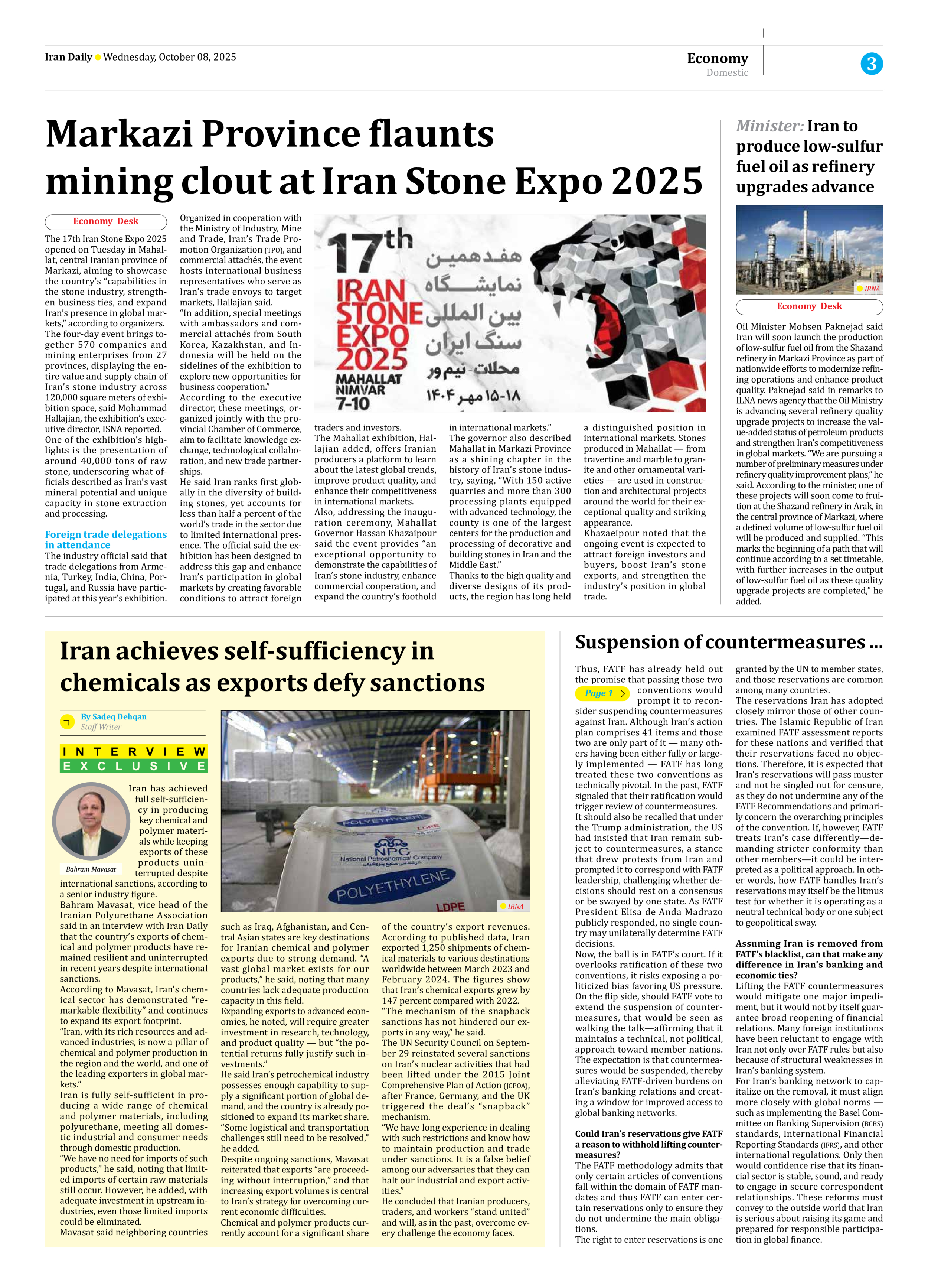


Iran achieves self-sufficiency in chemicals as exports defy sanctions
By Sadeq Dehqan
Staff Writer
Iran has achieved full self-sufficiency in producing key chemical and polymer materials while keeping exports of these products uninterrupted despite international sanctions, according to a senior industry figure.
Bahram Mavasat, vice head of the Iranian Polyurethane Association said in an interview with Iran Daily that the country’s exports of chemical and polymer products have remained resilient and uninterrupted in recent years despite international sanctions.
According to Mavasat, Iran’s chemical sector has demonstrated “remarkable flexibility” and continues to expand its export footprint.
“Iran, with its rich resources and advanced industries, is now a pillar of chemical and polymer production in the region and the world, and one of the leading exporters in global markets.”
Iran is fully self-sufficient in producing a wide range of chemical and polymer materials, including polyurethane, meeting all domestic industrial and consumer needs through domestic production.
“We have no need for imports of such products,” he said, noting that limited imports of certain raw materials still occur. However, he added, with adequate investment in upstream industries, even those limited imports could be eliminated.
Mavasat said neighboring countries such as Iraq, Afghanistan, and Central Asian states are key destinations for Iranian chemical and polymer exports due to strong demand. “A vast global market exists for our products,” he said, noting that many countries lack adequate production capacity in this field.
Expanding exports to advanced economies, he noted, will require greater investment in research, technology, and product quality — but “the potential returns fully justify such investments.”
He said Iran’s petrochemical industry possesses enough capability to supply a significant portion of global demand, and the country is already positioned to expand its market share. “Some logistical and transportation challenges still need to be resolved,” he added.
Despite ongoing sanctions, Mavasat reiterated that exports “are proceeding without interruption,” and that increasing export volumes is central to Iran’s strategy for overcoming current economic difficulties.
Chemical and polymer products currently account for a significant share of the country’s export revenues. According to published data, Iran exported 1,250 shipments of chemical materials to various destinations worldwide between March 2023 and February 2024. The figures show that Iran’s chemical exports grew by 147 percent compared with 2022.
“The mechanism of the snapback sanctions has not hindered our exports in any way,” he said.
The UN Security Council on September 29 reinstated several sanctions on Iran’s nuclear activities that had been lifted under the 2015 Joint Comprehensive Plan of Action (JCPOA), after France, Germany, and the UK triggered the deal’s “snapback” mechanism.
“We have long experience in dealing with such restrictions and know how to maintain production and trade under sanctions. It is a false belief among our adversaries that they can halt our industrial and export activities.”
He concluded that Iranian producers, traders, and workers “stand united” and will, as in the past, overcome every challenge the economy faces.