





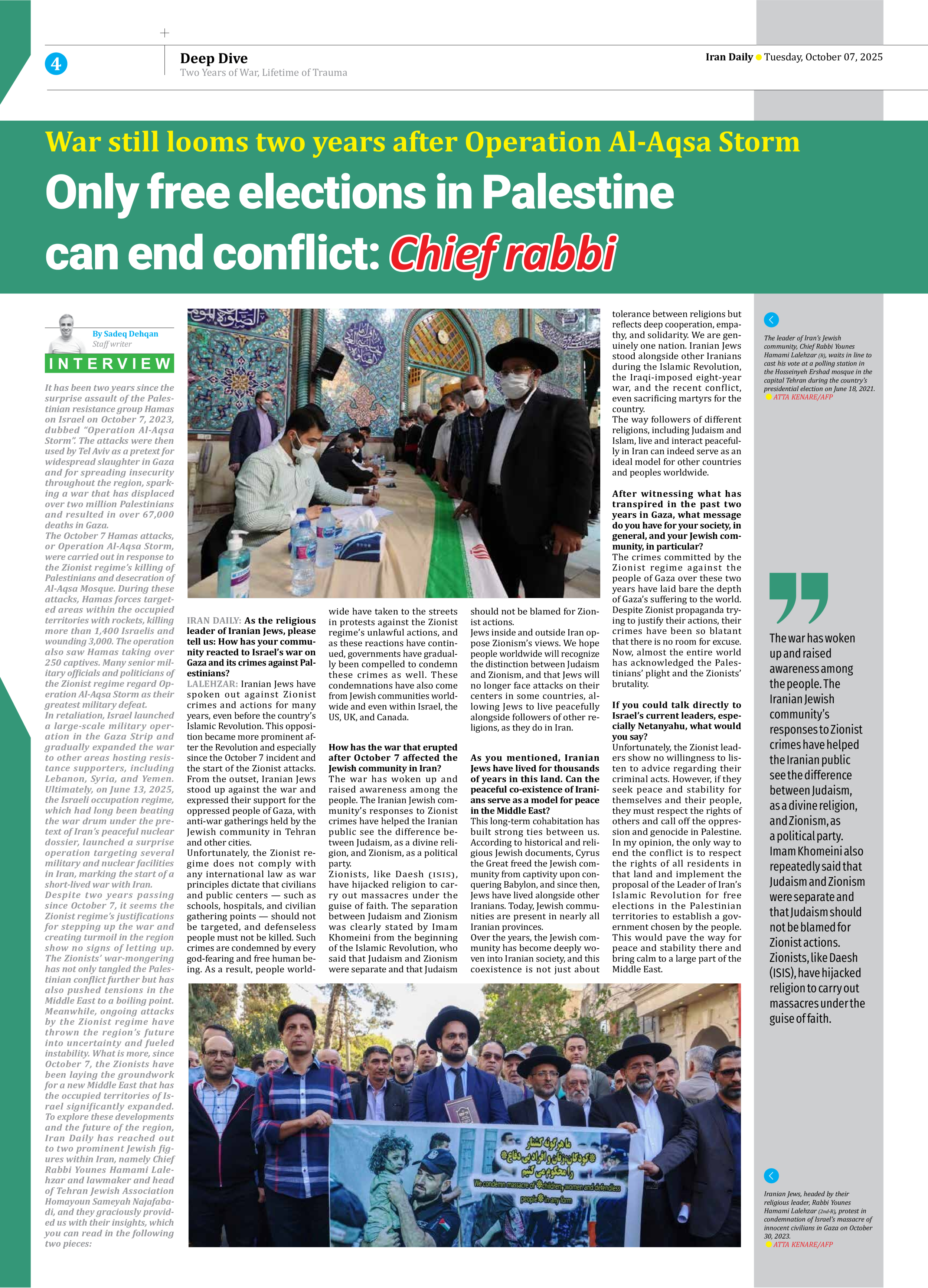


War still looms two years after Operation Al-Aqsa Storm
Only free elections in Palestine can end conflict: Chief rabbi
By Sadeq Dehqan
Staff writer
It has been two years since the surprise assault of the Palestinian resistance group Hamas on Israel on October 7, 2023, dubbed “Operation Al-Aqsa Storm”. The attacks were then used by Tel Aviv as a pretext for widespread slaughter in Gaza and for spreading insecurity throughout the region, sparking a war that has displaced over two million Palestinians and resulted in over 67,000 deaths in Gaza.
The October 7 Hamas attacks, or Operation Al-Aqsa Storm, were carried out in response to the Zionist regime’s killing of Palestinians and desecration of Al-Aqsa Mosque. During these attacks, Hamas forces targeted areas within the occupied territories with rockets, killing more than 1,400 Israelis and wounding 3,000. The operation also saw Hamas taking over 250 captives. Many senior military officials and politicians of the Zionist regime regard Operation Al-Aqsa Storm as their greatest military defeat.
In retaliation, Israel launched a large-scale military operation in the Gaza Strip and gradually expanded the war to other areas hosting resistance supporters, including Lebanon, Syria, and Yemen. Ultimately, on June 13, 2025, the Israeli occupation regime, which had long been beating the war drum under the pretext of Iran’s peaceful nuclear dossier, launched a surprise operation targeting several military and nuclear facilities in Iran, marking the start of a short-lived war with Iran.
Despite two years passing since October 7, it seems the Zionist regime’s justifications for stepping up the war and creating turmoil in the region show no signs of letting up. The Zionists’ war-mongering has not only tangled the Palestinian conflict further but has also pushed tensions in the Middle East to a boiling point. Meanwhile, ongoing attacks by the Zionist regime have thrown the region’s future into uncertainty and fueled instability. What is more, since October 7, the Zionists have been laying the groundwork for a new Middle East that has the occupied territories of Israel significantly expanded. To explore these developments and the future of the region, Iran Daily has reached out to two prominent Jewish figures within Iran, namely Chief Rabbi Younes Hamami Lalehzar and lawmaker and head of Tehran Jewish Association
Homayoun Sameyah Najafabadi, and they graciously provided us with their insights, which you can read in the following two pieces:
IRAN DAILY: As the religious leader of Iranian Jews, please tell us: How has your community reacted to Israel’s war on Gaza and its crimes against Palestinians?
LALEHZAR: Iranian Jews have spoken out against Zionist crimes and actions for many years, even before the country’s Islamic Revolution. This opposition became more prominent after the Revolution and especially since the October 7 incident and the start of the Zionist attacks. From the outset, Iranian Jews stood up against the war and expressed their support for the oppressed people of Gaza, with anti-war gatherings held by the Jewish community in Tehran and other cities.
Unfortunately, the Zionist regime does not comply with any international law as war principles dictate that civilians and public centers — such as schools, hospitals, and civilian gathering points — should not be targeted, and defenseless people must not be killed. Such crimes are condemned by every god-fearing and free human being. As a result, people worldwide have taken to the streets in protests against the Zionist regime’s unlawful actions, and as these reactions have continued, governments have gradually been compelled to condemn these crimes as well. These condemnations have also come from Jewish communities worldwide and even within Israel, the US, UK, and Canada.
How has the war that erupted after October 7 affected the Jewish community in Iran?
The war has woken up and raised awareness among the people. The Iranian Jewish community’s responses to Zionist crimes have helped the Iranian public see the difference between Judaism, as a divine religion, and Zionism, as a political party.
Zionists, like Daesh (ISIS), have hijacked religion to carry out massacres under the guise of faith. The separation between Judaism and Zionism was clearly stated by Imam Khomeini from the beginning of the Islamic Revolution, who said that Judaism and Zionism were separate and that Judaism should not be blamed for Zionist actions.
Jews inside and outside Iran oppose Zionism’s views. We hope people worldwide will recognize the distinction between Judaism and Zionism, and that Jews will no longer face attacks on their centers in some countries, allowing Jews to live peacefully alongside followers of other religions, as they do in Iran.
As you mentioned, Iranian Jews have lived for thousands of years in this land. Can the peaceful co-existence of Iranians serve as a model for peace in the Middle East?
This long-term cohabitation has built strong ties between us. According to historical and religious Jewish documents, Cyrus the Great freed the Jewish community from captivity upon conquering Babylon, and since then, Jews have lived alongside other Iranians. Today, Jewish communities are present in nearly all Iranian provinces.
Over the years, the Jewish community has become deeply woven into Iranian society, and this coexistence is not just about tolerance between religions but reflects deep cooperation, empathy, and solidarity. We are genuinely one nation. Iranian Jews stood alongside other Iranians during the Islamic Revolution, the Iraqi-imposed eight-year war, and the recent conflict, even sacrificing martyrs for the country.
The way followers of different religions, including Judaism and Islam, live and interact peacefully in Iran can indeed serve as an ideal model for other countries and peoples worldwide.
After witnessing what has transpired in the past two years in Gaza, what message do you have for your society, in general, and your Jewish community, in particular?
The crimes committed by the Zionist regime against the people of Gaza over these two years have laid bare the depth of Gaza’s suffering to the world. Despite Zionist propaganda trying to justify their actions, their crimes have been so blatant that there is no room for excuse. Now, almost the entire world has acknowledged the Palestinians’ plight and the Zionists’ brutality.
If you could talk directly to Israel’s current leaders, especially Netanyahu, what would you say?
Unfortunately, the Zionist leaders show no willingness to listen to advice regarding their criminal acts. However, if they seek peace and stability for themselves and their people, they must respect the rights of others and call off the oppression and genocide in Palestine. In my opinion, the only way to end the conflict is to respect the rights of all residents in that land and implement the proposal of the Leader of Iran’s Islamic Revolution for free elections in the Palestinian territories to establish a government chosen by the people. This would pave the way for peace and stability there and bring calm to a large part of the
Middle East.