







Heydarzadeh House reveals architectural heritage of Tabriz
Heydarzadeh House is a historic mansion located in the Maghsoudieh suburb of Tabriz, East Azarbajan Province, on the south side of the Tabriz Municipality building. Although there is no document confirming its construction date, studies indicate it was built around 1870 by Haji Habib Lak.
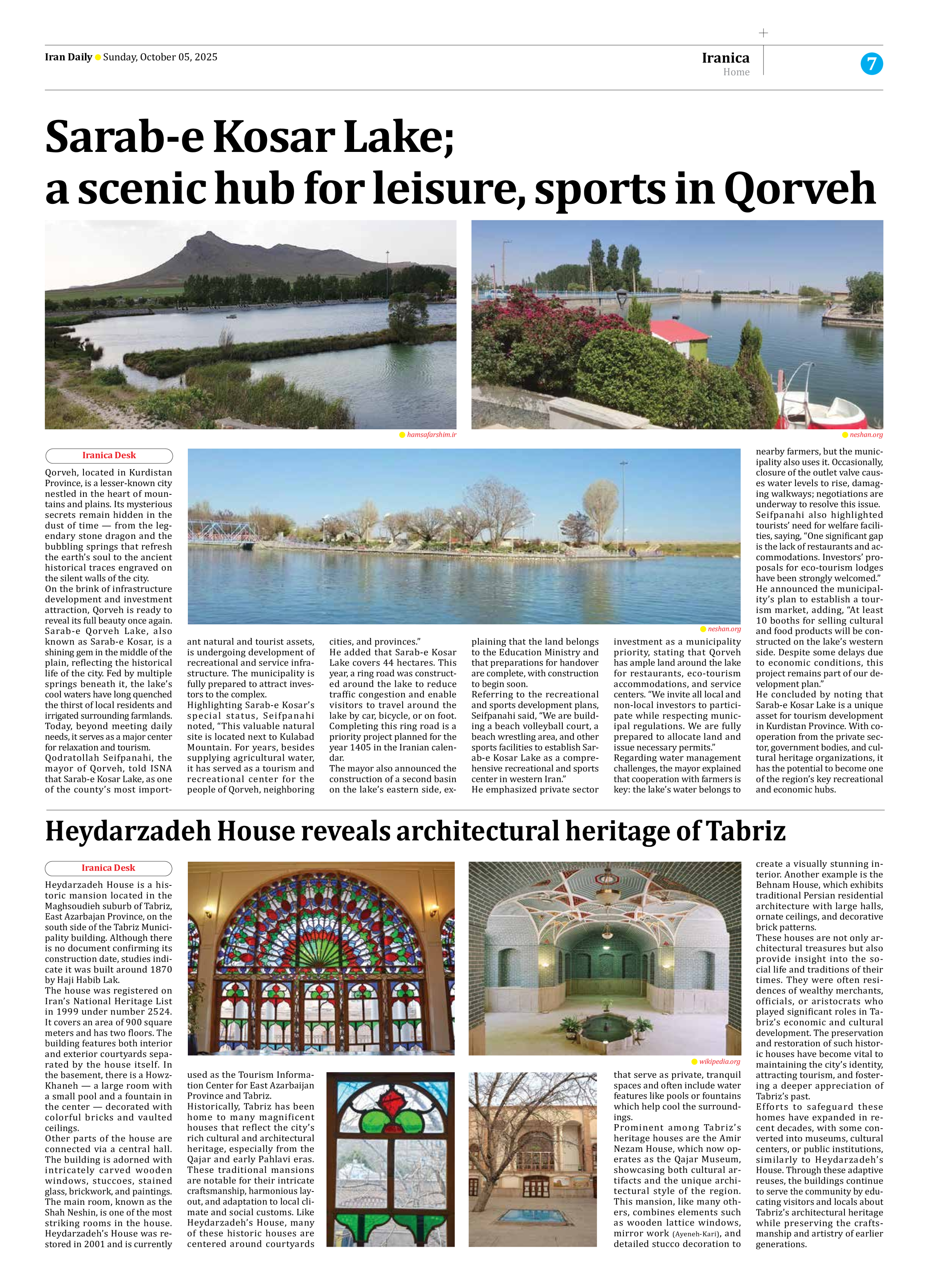
The house was registered on Iran’s National Heritage List in 1999 under number 2524. It covers an area of 900 square meters and has two floors. The building features both interior and exterior courtyards separated by the house itself. In the basement, there is a Howz-Khaneh — a large room with a small pool and a fountain in the center — decorated with colorful bricks and vaulted ceilings.
Other parts of the house are connected via a central hall. The building is adorned with intricately carved wooden windows, stuccoes, stained glass, brickwork, and paintings. The main room, known as the Shah Neshin, is one of the most striking rooms in the house. Heydarzadeh’s House was restored in 2001 and is currently used as the Tourism Information Center for East Azarbaijan Province and Tabriz.
Historically, Tabriz has been home to many magnificent houses that reflect the city’s rich cultural and architectural heritage, especially from the Qajar and early Pahlavi eras. These traditional mansions are notable for their intricate craftsmanship, harmonious layout, and adaptation to local climate and social customs. Like Heydarzadeh’s House, many of these historic houses are centered around courtyards that serve as private, tranquil spaces and often include water features like pools or fountains which help cool the surroundings.
Prominent among Tabriz’s heritage houses are the Amir Nezam House, which now operates as the Qajar Museum, showcasing both cultural artifacts and the unique architectural style of the region. This mansion, like many others, combines elements such as wooden lattice windows, mirror work (Ayeneh-Kari), and detailed stucco decoration to create a visually stunning interior. Another example is the Behnam House, which exhibits traditional Persian residential architecture with large halls, ornate ceilings, and decorative brick patterns.
These houses are not only architectural treasures but also provide insight into the social life and traditions of their times. They were often residences of wealthy merchants, officials, or aristocrats who played significant roles in Tabriz’s economic and cultural development. The preservation and restoration of such historic houses have become vital to maintaining the city’s identity, attracting tourism, and fostering a deeper appreciation of Tabriz’s past.
Efforts to safeguard these homes have expanded in recent decades, with some converted into museums, cultural centers, or public institutions, similarly to Heydarzadeh’s House. Through these adaptive reuses, the buildings continue to serve the community by educating visitors and locals about Tabriz’s architectural heritage while preserving the craftsmanship and artistry of earlier generations.