







Armed Forces ready for protracted war to defend Iran: Veteran
Daring pilots play key role in decisive operations of Sacred Defense
One of the most gripping parts of most stories of the Iraqi-imposed war (1980–1988), also known as the Sacred Defense, revolves around the bravery of the elite pilots of the Islamic Republic Air Force. These bold airmen, flying solo without any backup, would cut through the sky and push deep into enemy lines for kilometers. After carrying out their critical missions, they would make it back victorious to their bases. Carrying out these high-risk missions was not only a testament to the skill and courage of Iranian pilots but also showed their deep commitment to defending the homeland and national pride. These are stories that still take one’s breath away even years later. Second Brigadier General Pilot Vali Ovisi, born in 1954, is one of those elite pilots from the Sacred Defense era. He is among the rare aviators who flew both the F-5 and F-14 fighters in combat conditions. Throughout the war, he took part in numerous cross-border bombing missions and consistently had the infantry’s back during tough military operations. His service record also includes successfully shooting down two enemy fighters (including an advanced Iraqi Mirage) and launching the first air-to-air Hawk missiles (known as Sedjil) with the Tomcat aircraft. Below is the full transcript of an exclusive interview Iran Daily conducted with Second Brigadier General Pilot Vali Ovisi:
By Sadeq Dehqan
Staff writer
IRAN DAILY: First, please tell us, how did you end up joining the Air Force and becoming a pilot?
OVISI: In 1974, driven by a deep childhood passion for flying, I signed up for the pilot academy. I was about 20 at the time. I guess I joined the army a bit late because my father, an oil tanker driver, had a serious accident on duty. After that, I had to drop out of school to support the family by continuing his work. Once things had settled down, I went back to high school, earned my diploma, and then entered the aviation university.
Mastering English was the key to becoming a pilot, and because of my strong interest, I significantly elevated my language skills. A year after joining the army, I was sent to the US for advanced training. There, we first flew the T-41, then T-37, T-38, and so on. After completing the courses, I graduated with an aviation degree and a second lieutenant rank, and I came back to Iran to work at the First Tactical Fighter Base in Mehrabad. Over 35 years in the military, I served across the country, and interestingly, I retired in 2005 as the commander of Mehrabad’s airbase — now renamed Shahid Lashkari Air Base — the very place I began.
What was the state of the country’s defense readiness and the Air Force at the start of the Islamic Revolution and on the eve of the war?
When I came back from the US, I was supposed to fly the F-4, but midway through training, they told me to switch to the F-5 and sent me to Dezful city. Before the war broke out, due to the Revolutionary upheaval and the public mood, some people were talking down the planes, calling them junk and claiming we didn’t need such military equipment. There was even a push to sell off the F-14 planes — the deal with Canada was nearly done. Because of this emotional climate, they completely called us back to Tehran, saying, “We don’t need fighter pilots.” As a result, many were retired early, and other pilots were bought out or expelled. They told us, “Go to Tehran; We have enough pilots.” The situation was so discouraging that I almost gave up on my flying career, planning instead to get a professional driver’s license and follow in my father’s footsteps.
How was our Air Force at that time?
At the war’s start, we had the most powerful Air Force in the region, while Iraq held the upper hand on the ground. Our air fleet was formidable, operating a range of combat aircraft including F-4s, F-5s, and notably the F-14 — which was the most advanced fighter globally at the time. The F-14 was exclusively flown by Iran and the US; Even Israel did not have access to it. We had even signed a contract to buy F-16s before the Revolution, but after the Revolution, that deal was called off due to the political issues I mentioned.
What conditions did your forces face after the war started, and how were you deployed on air missions?
On the second day of the war, a comrade from Dezful sent word that the situation there was critical, with many fighters being martyred. That’s when five of us — Mostafa Tabatabae’i, the late Reza Nokhbe Zaeem, martyr Mansour Sabuti-pour, Afrasiab Qassemi, Ezzatollah Rahimi, and I — volunteered at Mehrabad to head out for the war. We were all lieutenants with limited flying experience, but we couldn’t just stand by and watch the situation worsen. No one officially asked us to deploy; It was our sense of duty that spurred us on.
We tried two or three times to fly out to Dezful aboard a C-130, but the city was under red alert and wouldn’t let us land. Finally, after a few days, our flight managed to touch down. The conditions in the city were dire. Families and troops were hiding under bridges. Pilots from the base were scattered everywhere. It was late October, and it got dark early, forcing us to strictly adhere to blackout rules. The city was under so much heavy bombardment and missile attacks that by 5 p.m., everyone would have had their dinner, and after that, not even a matchstick could be lit. Many were martyred in the war’s first days. We lost many friends. Because of this, many pilots stepped up and volunteered for combat.
So, even then, your presence wasn’t officially required or summoned?
At that critical juncture, everything was happening on a volunteer basis. Initially, the plan was to completely evacuate Dezful. Both civilians and fighters there were basically acting independently, making off-the-cuff decisions. Amid this chaos, the Air Force stepped in and bombarded the Iraqi positions, forcing them to fall back across the Karkheh River the next day. After that, the Army’s ground forces, the Revolution’s Guards Corps, and Basij joined forces with the defenders, and the tide began to turn.
Could you elaborate a bit more on the Air Force’s role in holding back the enemy’s advance into our country’s depth?
As I mentioned, in the early days of the war, the Air Force basically was doing the ground forces’ job. Given the situation back then, even if one of our planes managed to blow up a hundred enemy tanks but got taken out in the process, it was still a loss for us because we had no replacement for that aircraft. Yet, we had no choice, and our planes flew straight into enemy lines to stop the Iraqis from pushing forward. We had to shoot down their tanks to allow our ground troops to set up in the area and form a military line against the enemy.
As you know, on the very first day of the war and the day after, during Operation Kaman 99, 140 of our aircraft penetrated enemy territory and targeted military objectives, airfields, and army hangars belonging to the Iraqi forces. The operation was named Kaman 99 because the plan was 99 pages long, and the name “Kaman” (meaning bow) was inspired by the legendary archer “Arash Kamangir”.
Overall, the Air Force was present in all military operations throughout the Sacred Defense period since conducting reconnaissance before operations, destroying enemy military infrastructure before ground advances, and supporting infantry during operations were all the Air Force’s responsibilities.
You mentioned that many of your comrades were martyred in those first days — how did the Air Force bounce back and rebuild its combat power as the war went on?
During the war, we felt a shortage of skilled pilots and realized some replacements were necessary. So, we set up an aviation school mid-war and purchased PC-7 trainer aircraft specifically for this purpose. We also sent off some trainees to Pakistan for pilot training. These were individuals who had firsthand experience of the war and spared no effort or sacrifice in defending the homeland. Their skills were further honed back home on F-4, F-5, and F-14 aircraft, and they came in handy during the conflict. Among them were pilots who climbed up to the highest ranks in the Air Force, such as Brigadier General Hassan Shah Safi, the then-Air Force commander, and Brigadier General Aziz Nasirzadeh, the defense Minister, who joined the Air Force during the war.
Given that we received no foreign aid, how did the Air Force fleet make up for the shortage of weapons and equipment?
Those who rose through the ranks during the war played a crucial role in covering these gaps and implementing our military and operational strategies during the conflict. One key figure was the late Brigadier General Pilot Abbas Babaei, who was promoted from captain to colonel and appointed deputy operations commander of the Air Force. He was truly a military genius. His first move was to shift the F-14 fleet from the airbases in Isfahan and Shiraz to Bushehr, significantly cutting down aircraft flight hours. As you know, the more hours a plane logs, the more it requires servicing and parts replacement. According to our initial contract with the Americans, we weren’t allowed to move the F-14s from Shiraz and Isfahan, and the infrastructure to support such a transfer wasn’t in place. But he went ahead and violated that contract, transferring the F-14s despite the difficulty of supporting them at the new base.
On the other hand, Brigadier General Babaei, aware of our missile shortages, urged caution with missile use and advised us not to fire them off freely, even though his orders didn’t sit well with the pilots. His rationale was that if we blew through our missiles now and the war dragged on, we’d run out of supply. Meanwhile, Iraq was rapidly stocking up its military equipment from various countries. He said, “Let’s assume this war stretches for 20 years and we have to stretch out what we have until the end.” Therefore, we kept flying the F-14s mostly as a deterrent. Enemy pilots would beat a retreat as soon as they spotted an F-14 approaching.
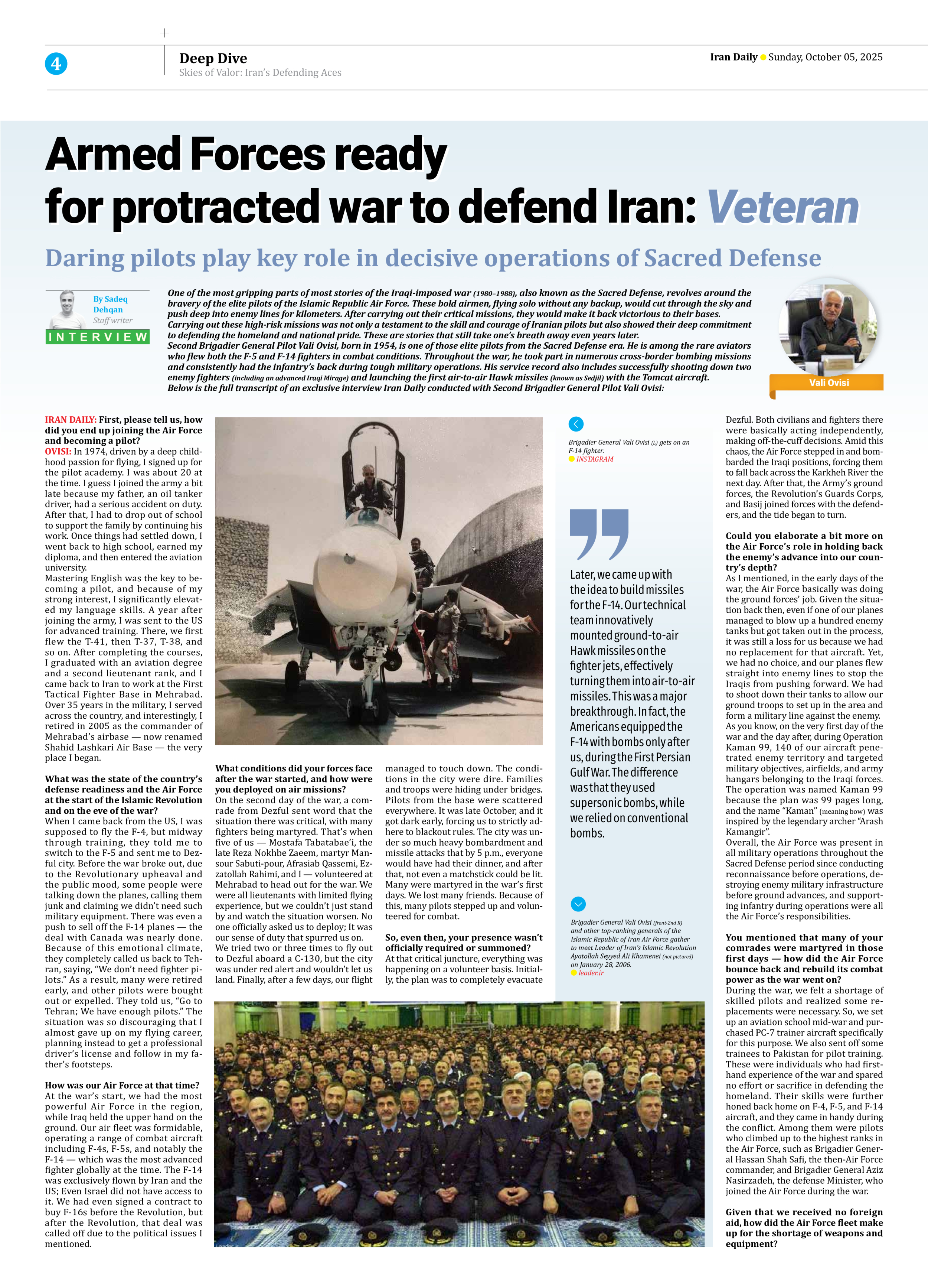
Later, we came up with the idea to build missiles for the F-14. Our technical team innovatively mounted ground-to-air Hawk missiles on the fighter jets, effectively turning them into air-to-air missiles. This was a major breakthrough. The initial test was carried out by Fereidoun Ali-Mazandarani, and I conducted the operational test over the Persian Gulf against Iraqi Mirage jets. The planning for this innovation was done by the late Brigadier General Babaei. Even though the Americans hadn’t yet handed us the F-14 air-to-ground bombing manual, he and the late Mostafa Ardestani and Shahram Rostami came up with the plan.
In fact, the Americans equipped the F-14 with bombs only after us, during the First Persian Gulf War. The difference was that they used supersonic bombs, while we relied on conventional bombs.
As someone who participated in the entire eight-year war and witnessed its ups and downs firsthand, what is your take on the war’s outcome?
Despite all the hardships and shortages, and despite the full backing that dozens of countries gave to Saddam Hussein’s regime, we managed to hold off the enemy’s aggression and didn’t give up even an inch of our soil. However, we must face the war’s realities and draw lessons from the eight-year Sacred Defense for the future. You may recall that after liberating Khorramshahr and pushing Iraq out, we used to chant “War, war until victory,” and another slogan was “Even if the war lasts 20 years, we stand firm.”
Yet, victory in a war expected to drag on for 20 years requires precise, calculated planning from the start. We should have laid out our strategy for a prolonged war beforehand so we wouldn’t reach a point after eight years where our officials would advise the late founder of Iran’s Islamic Revolution Imam Khomeini in a way that made him see accepting Resolution 598 as “drinking from the poisoned chalice”. They told him our defense and logistical capacity were such that accepting the cease-fire then was in the country’s best interest, but had we been prepared for a 20-year conflict and had a solid plan, we wouldn’t have let things get to that point.
Of course, the army always has contingency plans for war and crises, but this must be managed at a higher level as well. We have to know in advance how much budget, weapons, and equipment we need for a long, grinding war and how to keep the country afloat over 10 or 20 years of conflict. Now, this plan exists — not because we welcome war, but as a necessity for when it’s needed.
Had we gone in with a 20-year strategy, we would have stayed in the fight until final victory because if the outcome had met Imam Khomeini’s expectations, he wouldn’t have used the phrase “drinking from the poisoned chalice” to describe accepting the cease-fire and ending the war.