





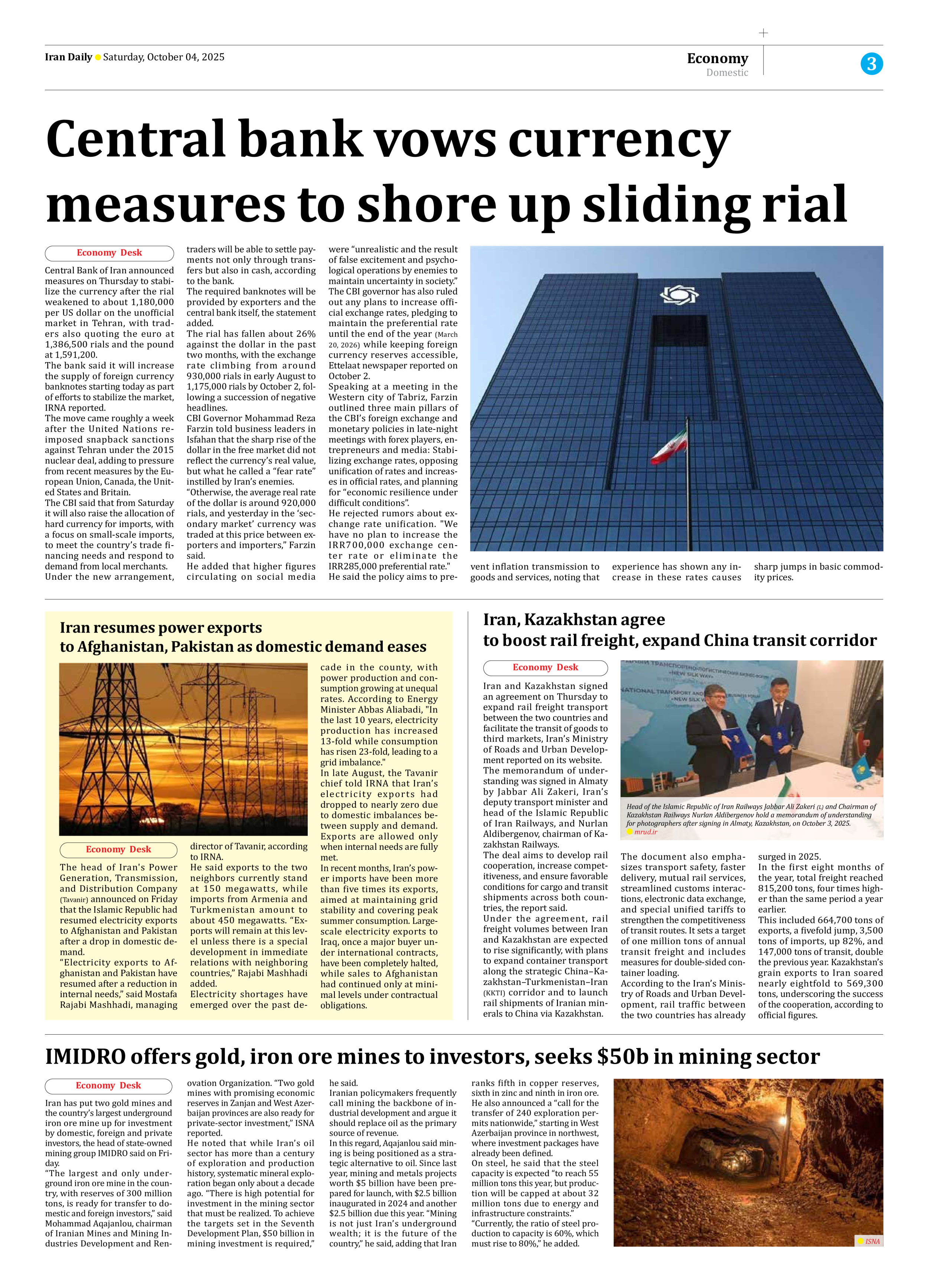


Central bank vows currency measures to shore up sliding rial
Central Bank of Iran announced measures on Thursday to stabilize the currency after the rial weakened to about 1,180,000 per US dollar on the unofficial market in Tehran, with traders also quoting the euro at 1,386,500 rials and the pound at 1,591,200.
The bank said it will increase the supply of foreign currency banknotes starting today as part of efforts to stabilize the market, IRNA reported.
The move came roughly a week after the United Nations reimposed snapback sanctions against Tehran under the 2015 nuclear deal, adding to pressure from recent measures by the European Union, Canada, the United States and Britain.
The CBI said that from Saturday it will also raise the allocation of hard currency for imports, with a focus on small-scale imports, to meet the country’s trade financing needs and respond to demand from local merchants.
Under the new arrangement, traders will be able to settle payments not only through transfers but also in cash, according to the bank.
The required banknotes will be provided by exporters and the central bank itself, the statement added.
The rial has fallen about 26% against the dollar in the past two months, with the exchange rate climbing from around 930,000 rials in early August to 1,175,000 rials by October 2, following a succession of negative headlines.
CBI Governor Mohammad Reza Farzin told business leaders in Isfahan that the sharp rise of the dollar in the free market did not reflect the currency’s real value, but what he called a “fear rate” instilled by Iran’s enemies.
“Otherwise, the average real rate of the dollar is around 920,000 rials, and yesterday in the ‘secondary market’ currency was traded at this price between exporters and importers,” Farzin said.
He added that higher figures circulating on social media were “unrealistic and the result of false excitement and psychological operations by enemies to maintain uncertainty in society.”
The CBI governor has also ruled out any plans to increase official exchange rates, pledging to maintain the preferential rate until the end of the year (March 20, 2026) while keeping foreign currency reserves accessible, Ettelaat newspaper reported on October 2.
Speaking at a meeting in the Western city of Tabriz, Farzin outlined three main pillars of the CBI’s foreign exchange and monetary policies in late-night meetings with forex players, entrepreneurs and media: Stabilizing exchange rates, opposing unification of rates and increases in official rates, and planning for “economic resilience under difficult conditions”.
He rejected rumors about exchange rate unification. "We have no plan to increase the IRR700,000 exchange center rate or eliminate the IRR285,000 preferential rate."
He said the policy aims to prevent inflation transmission to goods and services, noting that experience has shown any increase in these rates causes sharp jumps in basic commodity prices.