







Implementing snapback to legitimize unlawful actions to come: President
Iran will neutralize malicious plans through broad ties with neighbors, Muslims
Every session of the General Debate at the United Nations General Assembly is an opportunity for heads of state and governments to raise important topics for their countries on the global stage, but for Iran, it has always been doubly important. Since the time is short for Iranian presidents to make a much-needed detailed speech, they have to pack their schedules with meetings with other delegations. Although there’s so much that the other heads of state do not know about the false anti-Iran narrative that has been circulating for far too long, the same does not apply to the general public. This is why in recent years, Iranian presidents have sat down with journalists from various media outlets, and Masoud Pezeshkian was no exception. This year, Mr. Pezeshkian gave momentous interviews with the American NBC News and the Qatari Al Araby TV during the General Assembly. What follows next is our English translation of the most important parts of those interviews:
AL ARABY: The UN Security Council is set to rubber-stamp the implementation of the snapback mechanism in the next few hours based on a prearranged schedule. Does approving this mechanism mean the 2015 deal is doomed forever?
PEZESHKIAN: What’s going down today at the Security Council is not grounded in existing laws; It’s the result of pressure and power plays that the US and European countries are cranking up both regionally and internationally. The truth is, we’ve stuck to the signed 2015 agreement, but it was the US that tore it up. The Europeans failed to hold up their end of the bargain as well. After Trump ditched the agreement, most European and other foreign companies in Iran packed up and left out of fear of the US, and Europe didn’t keep any of its promises. Now, those who broke the rules are trying to pin the blame on us as if we’re the ones who broke the deal. This is the law of the jungle they want to impose worldwide, and they’re using the same playbook against Iran.
Are you prepared to call back your previous proposal to Europe to suspend the snapback activation, or might you come up with a new, different offer?
Their previous proposal was really ineffective. They said, “Hand over your enriched uranium, and we’ll give you three months to sort out other issues.” But why should we hand over our uranium? If there’s going to be dialogue, it should be about the whole issue, not us giving up our assets and then waiting around. If they’re honest and want to ensure Iran does not pursue nuclear weapons, we have no such intent either. We can talk it through, prove it, and act according to assessments. If their intention is genuine, so is ours, and we’re open to all kinds of verification. But we believe that’s not their aim.
The main culprit behind unrest, tension, war, and bloodshed in the region is the Zionist regime. Iran has never gone down that road, nor will it. We’ve reached out in friendship to all regional countries, and today, many neighbors see that we truly act on the principle of Islamic brotherhood. But the problem is, they don’t want peace in the region; Chaos suits their interests better than stability.
You consistently stress that the Islamic Republic of Iran is ready for talks with the US, yet also say the US pulled out and ripped up the deal. The Americans claim the opposite — that Iran refuses to negotiate. If both claim readiness, what’s stopping these talks from getting off the ground?
Do you really think the US wants this? While we were hashing things out with the US in Oman, that same country was effectively giving the green light to the Zionists to strike Iran. They first claimed ignorance, but it soon came out that they were part of it, targeting our nuclear sites.
The Zionist regime didn’t just bomb nuclear facilities but scientists, neighborhoods, and civilians as well, acting as if no international law applies to them. How can a country that ignores human principles and its words can’t be trusted claim to be ready for talks? If their real aim is to prevent Iran from getting nuclear weapons, the path is clear: The IAEA can oversee it. We’ve been ready to cooperate fully in this regard. So, there’s no reason to let this continue, for sanctions to tighten day by day while they claim, “We want to talk.” Actually, they mean to say, “You accept whatever we demand, then maybe we talk; If not, we’ll pull the plug.” That’s not dialogue; It’s surrender, and the Iranian nation will never bow down to such conditions. We have no trust in them.
Iran has faced pressure from successive US administrations, especially the current one that came to power in January. With snapback implementation imminent, to what extent can Iran ride out these pressures and come through them?
What snapback will bring back mainly concerns support or equipment pertaining to nuclear weapons or related tech. But the sanctions the US has slapped on us go far beyond that. The sanctions imposed by the US and allies are much broader and tougher than those snapback aims to roll back; Thus, nothing new will be added.
Their real goal is to stage an international legitimacy for their unlawful actions. This approach is not accepted by China or Russia — key Security Council members — nor by many freedom-loving countries that see through it. Everyone in the region knows this is just a pressure tactic against Iran to push through their malicious agenda. Still, I believe with domestic unity and cooperation, plus strong ties with neighbors and other nations, we will work out our problems and make headway, God willing.
Regarding Iran’s nuclear file, who is the final decision-maker given the moves by the US and Europe? Even they question this internally.
The country’s overarching policies are set by the Leader of Iran’s Islamic Revolution, based on consultations with the Supreme National Security Council and the body of statesmen. But per the constitution, the Leader makes the final call. Naturally, as the country’s top figure, after gathering expert opinions from councils, parliament, and specialists, he decides how to move forward with the file.
Given the setbacks the Resistance Axis has faced regionally, will this delay or slow down Iran’s open-door policy toward neighbors, including Saudi Arabia?
Before and after I took office, I’ve acted based on conviction: Muslims are brothers. The Prophet’s message on the day of Mecca’s conquest was clear: “A Muslim is a brother of another Muslim,” and “Together they are one hand against others.” If Muslims in the region unite, accept that they are brothers, and set aside differences, the Zionists won’t dare attack Gaza, Lebanon, Syria, Iran, Qatar, Yemen, or any Muslim country — and no one could stop the Muslims.
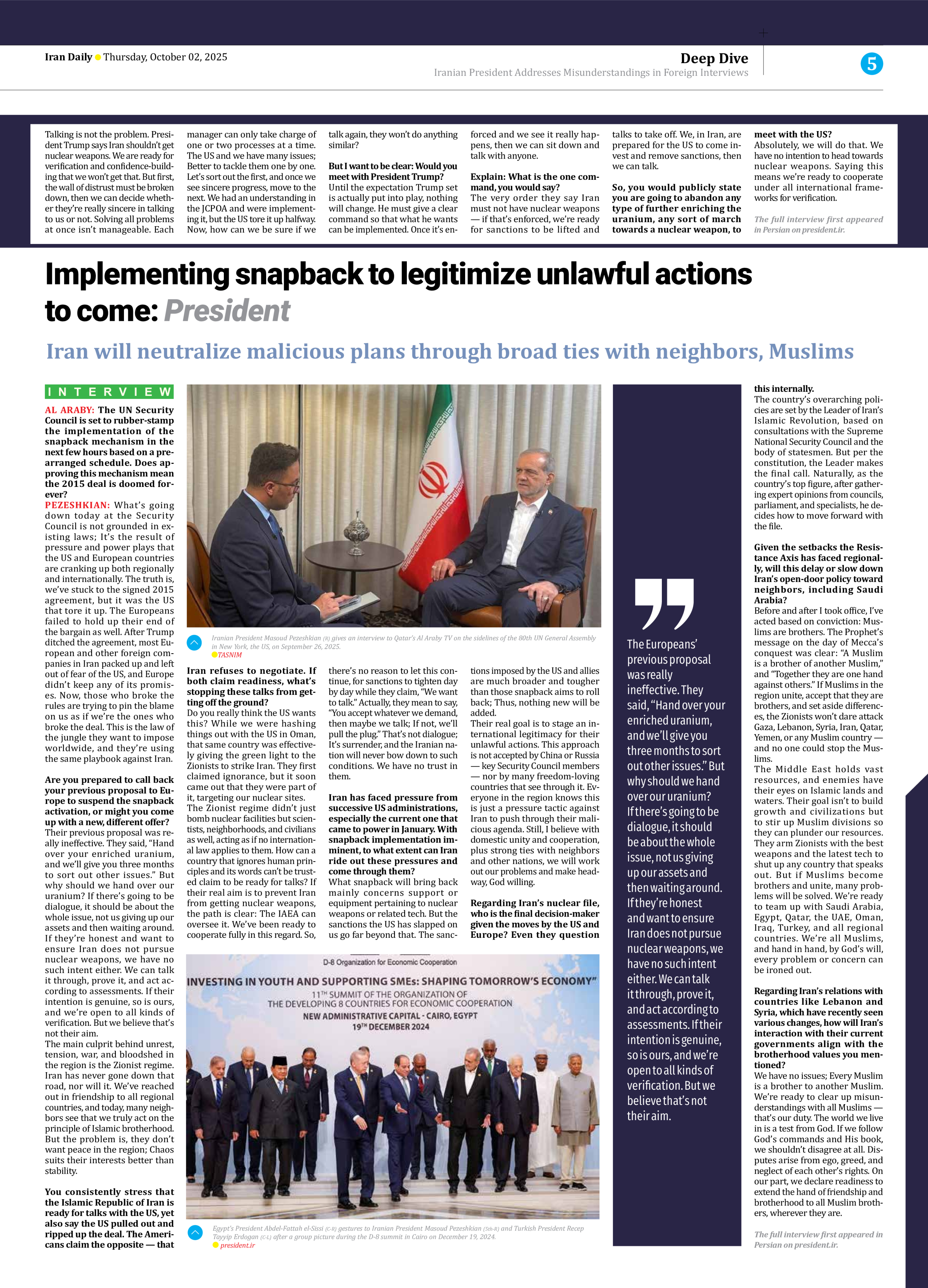
The Middle East holds vast resources, and enemies have their eyes on Islamic lands and waters. Their goal isn’t to build growth and civilizations but to stir up Muslim divisions so they can plunder our resources. They arm Zionists with the best weapons and the latest tech to shut up any country that speaks out. But if Muslims become brothers and unite, many problems will be solved. We’re ready to team up with Saudi Arabia, Egypt, Qatar, the UAE, Oman, Iraq, Turkey, and all regional countries. We’re all Muslims, and hand in hand, by God’s will, every problem or concern can be ironed out.
Regarding Iran’s relations with countries like Lebanon and Syria, which have recently seen various changes, how will Iran’s interaction with their current governments align with the brotherhood values you mentioned?
We have no issues; Every Muslim is a brother to another Muslim. We’re ready to clear up misunderstandings with all Muslims — that’s our duty. The world we live in is a test from God. If we follow God’s commands and His book, we shouldn’t disagree at all. Disputes arise from ego, greed, and neglect of each other’s rights. On our part, we declare readiness to extend the hand of friendship and brotherhood to all Muslim brothers, wherever they are.
The full interview first appeared in Persian on president.ir.