





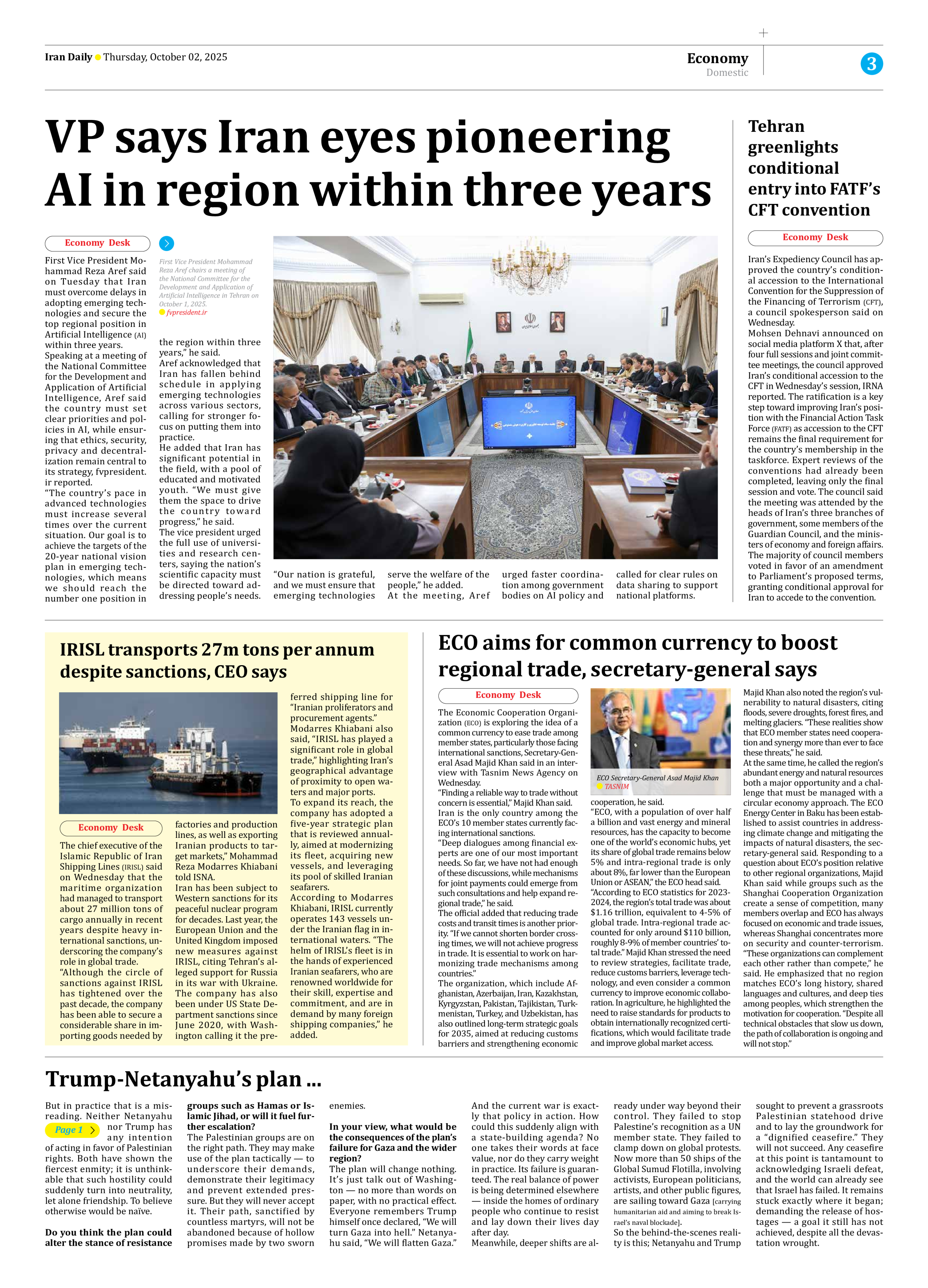


ECO aims for common currency to boost regional trade, secretary-general says
The Economic Cooperation Organization (ECO) is exploring the idea of a common currency to ease trade among member states, particularly those facing international sanctions, Secretary-General Asad Majid Khan said in an interview with Tasnim News Agency on Wednesday.
“Finding a reliable way to trade without concern is essential,” Majid Khan said.
Iran is the only country among the ECO’s 10 member states currently facing international sanctions.
“Deep dialogues among financial experts are one of our most important needs. So far, we have not had enough of these discussions, while mechanisms for joint payments could emerge from such consultations and help expand regional trade,” he said.
The official added that reducing trade costs and transit times is another priority. “If we cannot shorten border crossing times, we will not achieve progress in trade. It is essential to work on harmonizing trade mechanisms among countries.”
The organization, which include Afghanistan, Azerbaijan, Iran, Kazakhstan, Kyrgyzstan, Pakistan, Tajikistan, Turkmenistan, Turkey, and Uzbekistan, has also outlined long-term strategic goals for 2035, aimed at reducing customs barriers and strengthening economic cooperation, he said.
“ECO, with a population of over half a billion and vast energy and mineral resources, has the capacity to become one of the world’s economic hubs, yet its share of global trade remains below 5% and intra-regional trade is only about 8%, far lower than the European Union or ASEAN,” the ECO head said.
“According to ECO statistics for 2023-2024, the region’s total trade was about $1.16 trillion, equivalent to 4-5% of global trade. Intra-regional trade accounted for only around $110 billion, roughly 8-9% of member countries’ total trade.” Majid Khan stressed the need to review strategies, facilitate trade, reduce customs barriers, leverage technology, and even consider a common currency to improve economic collaboration. In agriculture, he highlighted the need to raise standards for products to obtain internationally recognized certifications, which would facilitate trade and improve global market access.
Majid Khan also noted the region’s vulnerability to natural disasters, citing floods, severe droughts, forest fires, and melting glaciers. “These realities show that ECO member states need cooperation and synergy more than ever to face these threats,” he said.
At the same time, he called the region’s abundant energy and natural resources both a major opportunity and a challenge that must be managed with a circular economy approach. The ECO Energy Center in Baku has been established to assist countries in addressing climate change and mitigating the impacts of natural disasters, the secretary-general said. Responding to a question about ECO’s position relative to other regional organizations, Majid Khan said while groups such as the Shanghai Cooperation Organization create a sense of competition, many members overlap and ECO has always focused on economic and trade issues, whereas Shanghai concentrates more on security and counter-terrorism. “These organizations can complement each other rather than compete,” he said. He emphasized that no region matches ECO’s long history, shared languages and cultures, and deep ties among peoples, which strengthen the motivation for cooperation. “Despite all technical obstacles that slow us down, the path of collaboration is ongoing and will not stop.”