







Netanyahu’s show for empty seats
By Mohammad Mohsen Fayezi
Expert on
Palestinian affairs
In recent years, Netanyahu has put on shows, with props, graphics, and calculated stunts during his speeches at the United Nations General Assembly. These moves have clearly played up his media team’s focus on digital diplomacy, and despite becoming a laughing stock, they have etched lasting images of his speeches into the public mind.
So, some of the images of Netanyahu that have stuck with you are from those sessions. For instance, one can recall the cartoonish sketch of a bomb with a red line at the top, or the moment he held up a Persian-language book by the Leader of Iran’s Islamic Revolution on Palestine.
This year’s UN speech by Netanyahu was no different; it was once again full of theatrics. In fact, given Israel’s unprecedented political situation in global public opinion — especially in Europe — and with the surge of momentum after the recognition of Palestine as a state, one of the knock-on effects of October 7, Netanyahu had prepared even more elaborate stunts.
One such spectacle, which even caught the eye of Hebrew media, took place before the speech began. Netanyahu’s office issued several statements, declaring that as part of Israel’s public diplomacy, Netanyahu has instructed that loudspeakers be installed in Gaza to broadcast “the prime minister’s historic UN speech”. Hebrew outlets also quoted the army saying that thousands in the Gaza Strip would receive Netanyahu’s address directly to their cellphones. During his talk, Netanyahu underlined that his words were broadcast in Gaza, saying, “Free the hostages! All of them. The whole 48. Free the hostages now! If you do, you will live. If you don’t, Israel will hunt you down.”
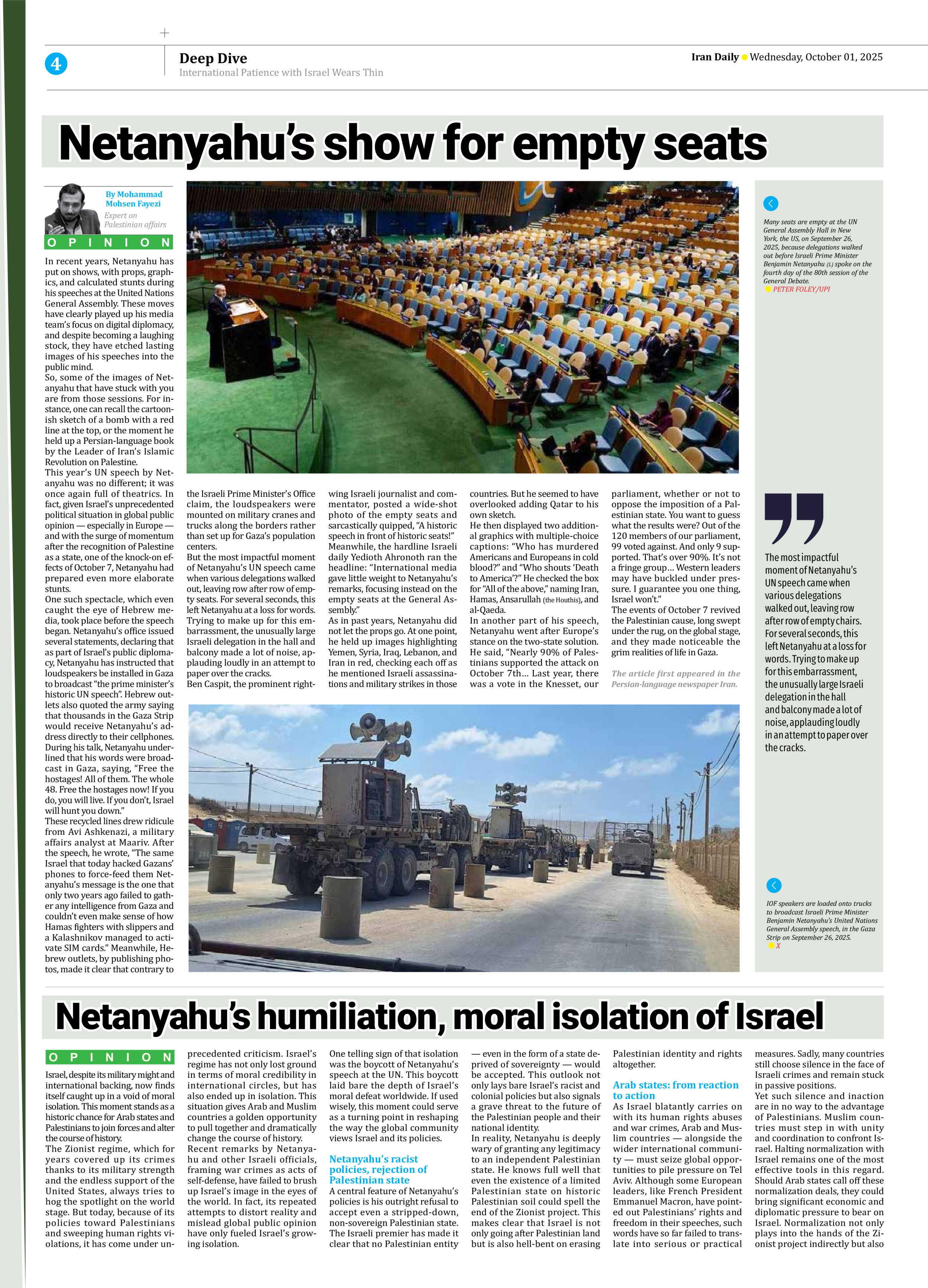
These recycled lines drew ridicule from Avi Ashkenazi, a military affairs analyst at Maariv. After the speech, he wrote, “The same Israel that today hacked Gazans’ phones to force-feed them Netanyahu’s message is the one that only two years ago failed to gather any intelligence from Gaza and couldn’t even make sense of how Hamas fighters with slippers and a Kalashnikov managed to activate SIM cards.” Meanwhile, Hebrew outlets, by publishing photos, made it clear that contrary to the Israeli Prime Minister’s Office claim, the loudspeakers were mounted on military cranes and trucks along the borders rather than set up for Gaza’s population centers.
But the most impactful moment of Netanyahu’s UN speech came when various delegations walked out, leaving row after row of empty seats. For several seconds, this left Netanyahu at a loss for words. Trying to make up for this embarrassment, the unusually large Israeli delegation in the hall and balcony made a lot of noise, applauding loudly in an attempt to paper over the cracks.
Ben Caspit, the prominent right-wing Israeli journalist and commentator, posted a wide-shot photo of the empty seats and sarcastically quipped, “A historic speech in front of historic seats!”
Meanwhile, the hardline Israeli daily Yedioth Ahronoth ran the headline: “International media gave little weight to Netanyahu’s remarks, focusing instead on the empty seats at the General Assembly.”
As in past years, Netanyahu did not let the props go. At one point, he held up images highlighting Yemen, Syria, Iraq, Lebanon, and Iran in red, checking each off as he mentioned Israeli assassinations and military strikes in those countries. But he seemed to have overlooked adding Qatar to his own sketch.
He then displayed two additional graphics with multiple-choice captions: “Who has murdered Americans and Europeans in cold blood?” and “Who shouts ‘Death to America’?” He checked the box for “All of the above,” naming Iran, Hamas, Ansarullah (the Houthis), and al-Qaeda.
In another part of his speech, Netanyahu went after Europe’s stance on the two-state solution. He said, “Nearly 90% of Palestinians supported the attack on October 7th… Last year, there was a vote in the Knesset, our parliament, whether or not to oppose the imposition of a Palestinian state. You want to guess what the results were? Out of the 120 members of our parliament, 99 voted against. And only 9 supported. That’s over 90%. It’s not a fringe group… Western leaders may have buckled under pressure. I guarantee you one thing, Israel won’t.”
The events of October 7 revived the Palestinian cause, long swept under the rug, on the global stage, and they made noticeable the grim realities of life in Gaza.
The article first appeared in the
Persian-language newspaper Iran.