







Copy in clipboard...
Tehran says no legal action taken to restore past UN resolutions
FM calls US, E3 claims over return of sanctions ‘invalid’
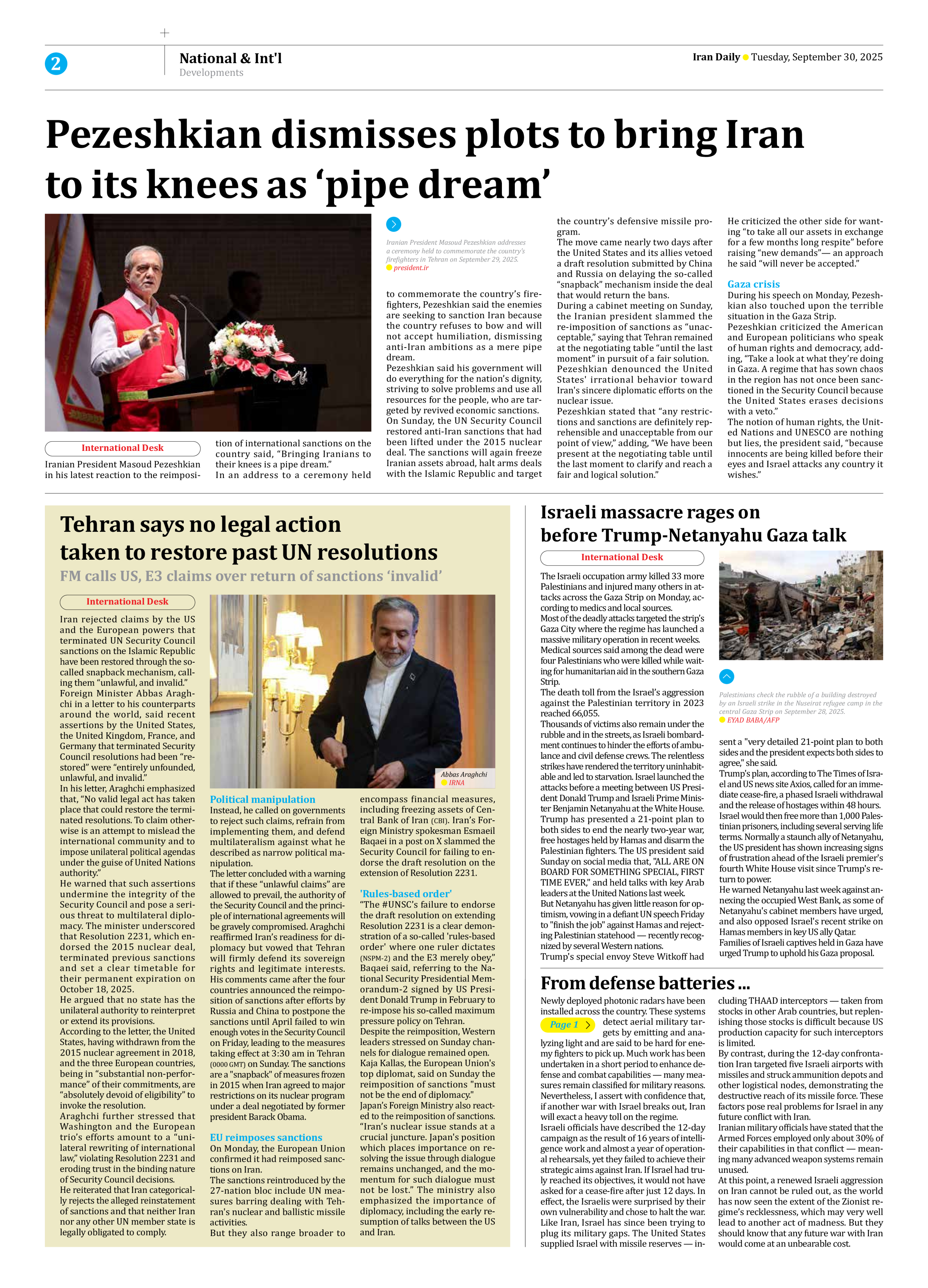
Iran rejected claims by the US and the European powers that terminated UN Security Council sanctions on the Islamic Republic have been restored through the so-called snapback mechanism, calling them “unlawful, and invalid.”
Foreign Minister Abbas Araghchi in a letter to his counterparts around the world, said recent assertions by the United States, the United Kingdom, France, and Germany that terminated Security Council resolutions had been “restored” were “entirely unfounded, unlawful, and invalid.”
In his letter, Araghchi emphasized that, “No valid legal act has taken place that could restore the terminated resolutions. To claim otherwise is an attempt to mislead the international community and to impose unilateral political agendas under the guise of United Nations authority.”
He warned that such assertions undermine the integrity of the Security Council and pose a serious threat to multilateral diplomacy. The minister underscored that Resolution 2231, which endorsed the 2015 nuclear deal, terminated previous sanctions and set a clear timetable for their permanent expiration on October 18, 2025.
He argued that no state has the unilateral authority to reinterpret or extend its provisions.
According to the letter, the United States, having withdrawn from the 2015 nuclear agreement in 2018, and the three European countries, being in “substantial non-performance” of their commitments, are “absolutely devoid of eligibility” to invoke the resolution.
Araghchi further stressed that Washington and the European trio’s efforts amount to a “unilateral rewriting of international law,” violating Resolution 2231 and eroding trust in the binding nature of Security Council decisions.
He reiterated that Iran categorically rejects the alleged reinstatement of sanctions and that neither Iran nor any other UN member state is legally obligated to comply.
Political manipulation
Instead, he called on governments to reject such claims, refrain from implementing them, and defend multilateralism against what he described as narrow political manipulation.
The letter concluded with a warning that if these “unlawful claims” are allowed to prevail, the authority of the Security Council and the principle of international agreements will be gravely compromised. Araghchi reaffirmed Iran’s readiness for diplomacy but vowed that Tehran will firmly defend its sovereign rights and legitimate interests. His comments came after the four countries announced the reimposition of sanctions after efforts by Russia and China to postpone the sanctions until April failed to win enough votes in the Security Council on Friday, leading to the measures taking effect at 3:30 am in Tehran (0000 GMT) on Sunday. The sanctions are a "snapback" of measures frozen in 2015 when Iran agreed to major restrictions on its nuclear program under a deal negotiated by former president Barack Obama.
EU reimposes sanctions
On Monday, the European Union confirmed it had reimposed sanctions on Iran.
The sanctions reintroduced by the 27-nation bloc include UN measures barring dealing with Tehran's nuclear and ballistic missile activities.
But they also range broader to encompass financial measures, including freezing assets of Central Bank of Iran (CBI). Iran’s Foreign Ministry spokesman Esmaeil Baqaei in a post on X slammed the Security Council for failing to endorse the draft resolution on the extension of Resolution 2231.
'Rules-based order'
“The #UNSC’s failure to endorse the draft resolution on extending Resolution 2231 is a clear demonstration of a so-called 'rules-based order' where one ruler dictates (NSPM-2) and the E3 merely obey,” Baqaei said, referring to the National Security Presidential Memorandum-2 signed by US President Donald Trump in February to re-impose his so-called maximum pressure policy on Tehran.
Despite the reimposition, Western leaders stressed on Sunday channels for dialogue remained open.
Kaja Kallas, the European Union's top diplomat, said on Sunday the reimposition of sanctions "must not be the end of diplomacy."
Japan’s Foreign Ministry also reacted to the reimposition of sanctions.
“Iran’s nuclear issue stands at a crucial juncture. Japan's position which places importance on resolving the issue through dialogue remains unchanged, and the momentum for such dialogue must not be lost.” The ministry also emphasized the importance of diplomacy, including the early resumption of talks between the US and Iran.