







From Cairo Agreement to New York’s push
All of Iran’s moves to keep diplomacy afloat
As the clock struck midnight on September 27, with the simultaneous return of UN Security Council sanctions against Iran, the JCPOA — one of the most promising deals between Iran and the West — came to an end. The reinstatement of these sanctions will represent one of the biggest obstacles for diplomacy in the weeks and months ahead. Amid the uproar over the sanctions’ return, what deserves attention is that Tehran has gone the extra mile to avoid such a deadlock and keep diplomacy moving forward with minimal friction, yet Europe, working under the shadow of the US, failed to back it up properly.
Why did we get to snapback?
The spark that set off the snapback mechanism, or the reactivation of the Security Council sanctions, was lit about three years ago around this time (late summer 2022), when negotiations between Iran and the European trio slowed down. A series of developments on the international stage threw a wrench into diplomacy’s gears. After this turning point, Germany, the UK, and France — who, despite their unfulfilled commitments under the JCPOA, still saw themselves as party to the deal — started floating the idea of snapback and sanction reinstatement in various meetings and forums.
Gradually, this issue took on more weight during Security Council sessions. These three European countries, rather than addressing why Iran had stepped away from some JCPOA obligations, pointed to increased enrichment, use of next-generation centrifuges, and the end of some supra-safeguards inspections as signs of Iran’s failure to stick to the deal, and laid down threats accordingly.
This was while the US exit from the JCPOA and Europe’s disregard for its 11 commitments were the main reasons for the deal’s violation. These stances were reiterated in Security Council meetings concerning Resolution 2231 on different dates. Eventually, during the last session held on September 19, under pressure from the trio and with US backing, the resolution to extend the sanction waivers against Iran failed to pass, making the reinstatement of sanctions likely from September 27 onward.
Europe, however, rolled out a range of claims to tear down the agreement it once hailed as the “deal of the century”, from human rights concerns linked to events inside Iran to Iran’s cooperation with Russia in the war against Ukraine. What stood out more than ever was the trio’s heavy focus on Washington, where Donald Trump had returned to the White House and was ready to shake up many established rules and norms in relations with the EU at his whim.
For Europe, the Ukraine war was the top priority that Trump had to handle and resolve. As a result, their need for his support was greater than ever, and Trump’s unpredictable personality meant his backing came only with complete obedience.
In this context, as the Iranian foreign minister put it, this messy situation didn’t just pop up overnight. “For years, the U.S. and the E3 misrepresented Iran’s peaceful program. The United States has betrayed diplomacy, but it is the E3 which have buried it,” he said.
Foreign Ministry, all paths taken to prevent snapback trigger
Standing firm against the strange logic of the European trio was one of Iran’s key foreign policy priorities as the whispers of returning sanctions grew louder over the past year. The Foreign Ministry worked on multiple fronts and at various stages, deploying different tools to warn off the West from a path leading diplomacy into a dead-end.
Regardless of their effectiveness, these efforts can be divided into three phases: before the Israeli military strike against Iran, during the 12-day war, and after. The outcome of Iran’s actions has depended on many direct and indirect factors. Thus, any assessment of these moves against the return of sanctions without considering these factors would be neither rational nor fair. This text focuses on reviewing the policies, decisions, and actions that Iran’s Foreign Ministry — as the country’s chief diplomacy executor — has carried out and continues to pursue.
The red line Iran drew in recent years regarding talks with the US never extended to Europe, and the three European JCPOA members have always been Tehran’s negotiating partners. After the Pezeshkian government took office, diplomatic discussions with Europe were redefined, and before the conflict with Iran escalated, four rounds of talks with the deputy foreign ministers of France, the UK, and Germany were arranged and held.
Talks with these three nations to hammer out a rational resolution to disputes carried on even amid Israeli attacks on Iran. In the last three months, despite the illegal bombing of Iran’s nuclear facilities by Israel and the US, and the role of the resolutions of the International Atomic Energy Agency (IAEA) and its director general in that bombing while the agency remained silent in support of the attacks, the three European countries asked Iran to resume cooperation with the IAEA. Iran’s response to this request was a question: How and under what protocol should peaceful nuclear sites that cooperated with the IAEA before the bombing be inspected?
To get an answer despite all the illegal actions, Tehran agreed to hash out a new cooperation framework with the IAEA in Cairo to fulfill one of the trio’s three conditions for sanction suspension. Ali Larijani, the secretary of Iran’s Supreme National Security Council, described this phase of Iran-Europe interaction, “Europeans said if you come up with a new design for working with the agency, we’ll call off the snapback request. For example, France, through the IAEA director general, sent a message that if you reach certain arrangements with the agency, we will withdraw the snapback request. The Iran-IAEA agreement in Cairo was made with this goal and was generally acceptable, yet those who said they’d pull back snapback if an agreement happened did not do so. Nevertheless, we stated that, provided security and safety conditions allow, inspections of nuclear sites would be permitted with conditions.”
The Iranian foreign minister also referenced the Cairo agreement in his September 27 speech at the UN Security Council, saying, “On September 9, in Cairo, I signed a memorandum with the IAEA director general. The measure was welcomed by the agency and the wider international community. Yet it was immediately met with unconstructive approaches from the United States and the E3.”
Within the one-month window between snapback activation and the return of sanctions, other proposals surfaced. According to the Supreme National Security Council secretary, “Russians proposed a six-month delay in snapback activation to give negotiations a chance — we accepted. Europeans came back with another proposal that had some conditions that weren’t very reasonable, including one that required reaching an agreement with the IAEA.”
During this time, Iran even looked into negotiating with the US, something Larijani mentioned, “Another condition was to negotiate with the US, which is interesting in itself — the Europeans conditioned their demands on our talks with the Americans, showing the weight of these countries. Our reply was that if talks are under the 5+1 framework, we have no problem including the US. So, we even accepted talks including America within that framework.”
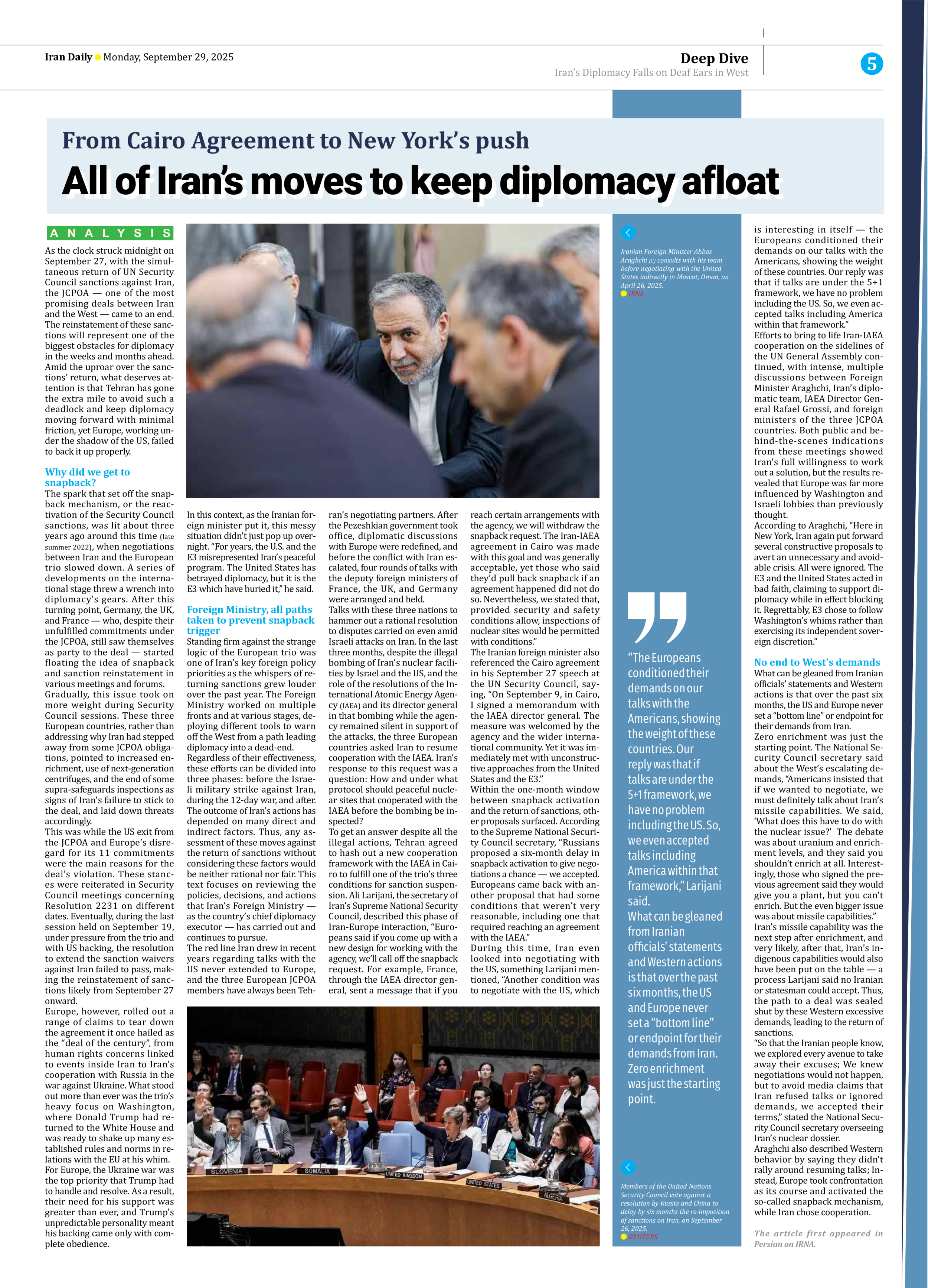
Efforts to bring to life Iran-IAEA cooperation on the sidelines of the UN General Assembly continued, with intense, multiple discussions between Foreign Minister Araghchi, Iran’s diplomatic team, IAEA Director General Rafael Grossi, and foreign ministers of the three JCPOA countries. Both public and behind-the-scenes indications from these meetings showed Iran’s full willingness to work out a solution, but the results revealed that Europe was far more influenced by Washington and Israeli lobbies than previously thought.
According to Araghchi, “Here in New York, Iran again put forward several constructive proposals to avert an unnecessary and avoidable crisis. All were ignored. The E3 and the United States acted in bad faith, claiming to support diplomacy while in effect blocking it. Regrettably, E3 chose to follow Washington’s whims rather than exercising its independent sovereign discretion.”
No end to West’s demands
What can be gleaned from Iranian officials’ statements and Western actions is that over the past six months, the US and Europe never set a “bottom line” or endpoint for their demands from Iran.
Zero enrichment was just the starting point. The National Security Council secretary said about the West’s escalating demands, “Americans insisted that if we wanted to negotiate, we must definitely talk about Iran’s missile capabilities. We said, ‘What does this have to do with the nuclear issue?’ The debate was about uranium and enrichment levels, and they said you shouldn’t enrich at all. Interestingly, those who signed the previous agreement said they would give you a plant, but you can’t enrich. But the even bigger issue was about missile capabilities.”
Iran’s missile capability was the next step after enrichment, and very likely, after that, Iran’s indigenous capabilities would also have been put on the table — a process Larijani said no Iranian or statesman could accept. Thus, the path to a deal was sealed shut by these Western excessive demands, leading to the return of sanctions.
“So that the Iranian people know, we explored every avenue to take away their excuses; We knew negotiations would not happen, but to avoid media claims that Iran refused talks or ignored demands, we accepted their terms,” stated the National Security Council secretary overseeing Iran’s nuclear dossier.
Araghchi also described Western behavior by saying they didn’t rally around resuming talks; Instead, Europe took confrontation as its course and activated the so-called snapback mechanism, while Iran chose cooperation.
The article first appeared in
Persian on IRNA.