







Snapback & continuation of strategic ambiguity
By Ebrahim Motaghi
Scholar, expert on political affairs
We can point to the “snapback mechanism” as Iran’s most crucial strategic issue in September. Throughout this process, we have witnessed signs of a flurry of activity in Iran’s nuclear diplomacy. Although negotiations between Iran and the European countries and the United States carried on intermittently from May through the end of September, their outcome can be summed up as a tactical surprise, an imposed 12-day war, and the snapback taking effect on September 27, 2025.
That is why the Leader of Iran’s Islamic Revolution pointed out in his televised message that the US and Europe have used diplomacy as a tool to keep Iran strategically off guard, and while the US and Europe impose “diplomatic preconditions,” such negotiations will hardly have any significant impact on Iran’s economy or national security.
Snapback, erosion of power balance
Any political and strategic move hinges on the power equation. Actors pursue their political goals only when they or their allies hold certain leverage in the power balance. The increasing pressure from the European Troika against Iran through the snapback mechanism amounts to a new form of power balancing. The political rhetoric and approaches of the European Troika leaders, even within the UN diplomatic arena, have lacked a constructive nature. This stems from the West’s coercive diplomacy and threat politics aimed at Iran.
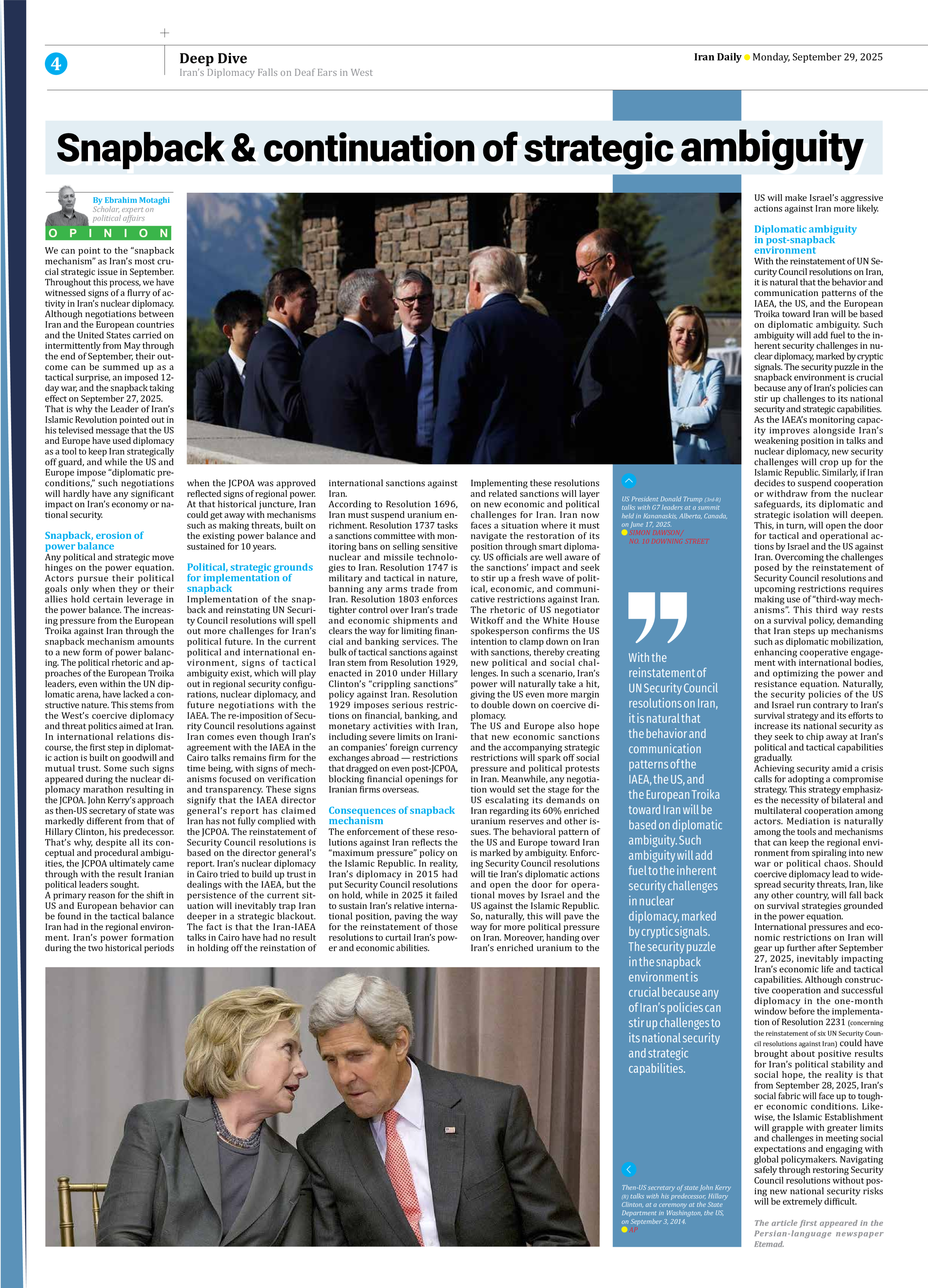
In international relations discourse, the first step in diplomatic action is built on goodwill and mutual trust. Some such signs appeared during the nuclear diplomacy marathon resulting in the JCPOA. John Kerry’s approach as then-US secretary of state was markedly different from that of Hillary Clinton, his predecessor. That’s why, despite all its conceptual and procedural ambiguities, the JCPOA ultimately came through with the result Iranian political leaders sought.
A primary reason for the shift in US and European behavior can be found in the tactical balance Iran had in the regional environment. Iran’s power formation during the two historical periods when the JCPOA was approved reflected signs of regional power. At that historical juncture, Iran could get away with mechanisms such as making threats, built on the existing power balance and sustained for 10 years.
Political, strategic grounds for implementation of snapback
Implementation of the snapback and reinstating UN Security Council resolutions will spell out more challenges for Iran’s political future. In the current political and international environment, signs of tactical ambiguity exist, which will play out in regional security configurations, nuclear diplomacy, and future negotiations with the IAEA. The re-imposition of Security Council resolutions against Iran comes even though Iran’s agreement with the IAEA in the Cairo talks remains firm for the time being, with signs of mechanisms focused on verification and transparency. These signs signify that the IAEA director general’s report has claimed Iran has not fully complied with the JCPOA. The reinstatement of Security Council resolutions is based on the director general’s report. Iran’s nuclear diplomacy in Cairo tried to build up trust in dealings with the IAEA, but the persistence of the current situation will inevitably trap Iran deeper in a strategic blackout. The fact is that the Iran-IAEA talks in Cairo have had no result in holding off the reinstation of international sanctions against Iran.
According to Resolution 1696, Iran must suspend uranium enrichment. Resolution 1737 tasks a sanctions committee with monitoring bans on selling sensitive nuclear and missile technologies to Iran. Resolution 1747 is military and tactical in nature, banning any arms trade from Iran. Resolution 1803 enforces tighter control over Iran’s trade and economic shipments and clears the way for limiting financial and banking services. The bulk of tactical sanctions against Iran stem from Resolution 1929, enacted in 2010 under Hillary Clinton’s “crippling sanctions” policy against Iran. Resolution 1929 imposes serious restrictions on financial, banking, and monetary activities with Iran, including severe limits on Iranian companies’ foreign currency exchanges abroad — restrictions that dragged on even post-JCPOA, blocking financial openings for Iranian firms overseas.
Consequences of snapback mechanism
The enforcement of these resolutions against Iran reflects the “maximum pressure” policy on the Islamic Republic. In reality, Iran’s diplomacy in 2015 had put Security Council resolutions on hold, while in 2025 it failed to sustain Iran’s relative international position, paving the way for the reinstatement of those resolutions to curtail Iran’s power and economic abilities.
Implementing these resolutions and related sanctions will layer on new economic and political challenges for Iran. Iran now faces a situation where it must navigate the restoration of its position through smart diplomacy. US officials are well aware of the sanctions’ impact and seek to stir up a fresh wave of political, economic, and communicative restrictions against Iran. The rhetoric of US negotiator Witkoff and the White House spokesperson confirms the US intention to clamp down on Iran with sanctions, thereby creating new political and social challenges. In such a scenario, Iran’s power will naturally take a hit, giving the US even more margin to double down on coercive diplomacy.
The US and Europe also hope that new economic sanctions and the accompanying strategic restrictions will spark off social pressure and political protests in Iran. Meanwhile, any negotiation would set the stage for the US escalating its demands on Iran regarding its 60% enriched uranium reserves and other issues. The behavioral pattern of the US and Europe toward Iran is marked by ambiguity. Enforcing Security Council resolutions will tie Iran’s diplomatic actions and open the door for operational moves by Israel and the US against the Islamic Republic. So, naturally, this will pave the way for more political pressure on Iran. Moreover, handing over Iran’s enriched uranium to the US will make Israel’s aggressive actions against Iran more likely.
Diplomatic ambiguity in post-snapback environment
With the reinstatement of UN Security Council resolutions on Iran, it is natural that the behavior and communication patterns of the IAEA, the US, and the European Troika toward Iran will be based on diplomatic ambiguity. Such ambiguity will add fuel to the inherent security challenges in nuclear diplomacy, marked by cryptic signals. The security puzzle in the snapback environment is crucial because any of Iran’s policies can stir up challenges to its national security and strategic capabilities.
As the IAEA’s monitoring capacity improves alongside Iran’s weakening position in talks and nuclear diplomacy, new security challenges will crop up for the Islamic Republic. Similarly, if Iran decides to suspend cooperation or withdraw from the nuclear safeguards, its diplomatic and strategic isolation will deepen. This, in turn, will open the door for tactical and operational actions by Israel and the US against Iran. Overcoming the challenges posed by the reinstatement of Security Council resolutions and upcoming restrictions requires making use of “third-way mechanisms”. This third way rests on a survival policy, demanding that Iran steps up mechanisms such as diplomatic mobilization, enhancing cooperative engagement with international bodies, and optimizing the power and resistance equation. Naturally, the security policies of the US and Israel run contrary to Iran’s survival strategy and its efforts to increase its national security as they seek to chip away at Iran’s political and tactical capabilities gradually.
Achieving security amid a crisis calls for adopting a compromise strategy. This strategy emphasizes the necessity of bilateral and multilateral cooperation among actors. Mediation is naturally among the tools and mechanisms that can keep the regional environment from spiraling into new war or political chaos. Should coercive diplomacy lead to widespread security threats, Iran, like any other country, will fall back on survival strategies grounded in the power equation.
International pressures and economic restrictions on Iran will gear up further after September 27, 2025, inevitably impacting Iran’s economic life and tactical capabilities. Although constructive cooperation and successful diplomacy in the one-month window before the implementation of Resolution 2231 (concerning the reinstatement of six UN Security Council resolutions against Iran) could have brought about positive results for Iran’s political stability and social hope, the reality is that from September 28, 2025, Iran’s social fabric will face up to tougher economic conditions. Likewise, the Islamic Establishment will grapple with greater limits and challenges in meeting social expectations and engaging with global policymakers. Navigating safely through restoring Security Council resolutions without posing new national security risks will be extremely difficult.
The article first appeared in the Persian-language newspaper
Etemad.