







Iran eyes tourism as ‘engine of sustainable change’
Iran’s Minister of Cultural Heritage, Tourism and Handicrafts, Reza Salehi-Amiri, marked World Tourism Day on September 27, by calling the sector an “engine of sustainable change” and a bridge between nations.
In a message written on the day, the minister said tourism for Iran was more than an economic pursuit, describing it as a “national strategy” and a “global responsibility”.
He linked the industry to cultural diplomacy, economic diversification and dialogue among civilizations, setting out how government reforms and financial incentives were designed to place the country on what he termed the “global orbit” of tourism.
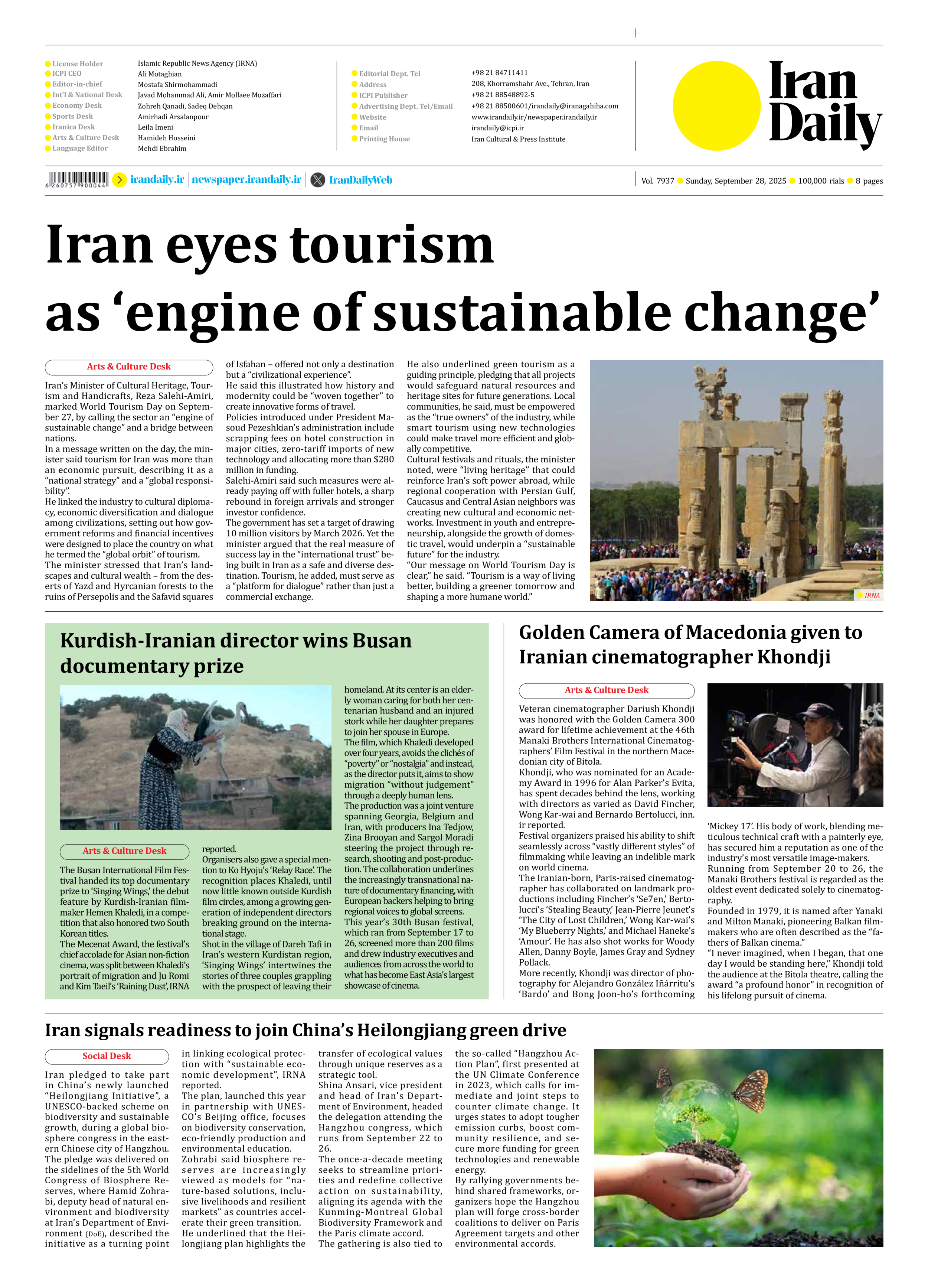
The minister stressed that Iran’s landscapes and cultural wealth – from the deserts of Yazd and Hyrcanian forests to the ruins of Persepolis and the Safavid squares of Isfahan – offered not only a destination but a “civilizational experience”.
He said this illustrated how history and modernity could be “woven together” to create innovative forms of travel.
Policies introduced under President Masoud Pezeshkian’s administration include scrapping fees on hotel construction in major cities, zero-tariff imports of new technology and allocating more than $280 million in funding.
Salehi-Amiri said such measures were already paying off with fuller hotels, a sharp rebound in foreign arrivals and stronger investor confidence.
The government has set a target of drawing 10 million visitors by March 2026. Yet the minister argued that the real measure of success lay in the “international trust” being built in Iran as a safe and diverse destination. Tourism, he added, must serve as a “platform for dialogue” rather than just a commercial exchange.
He also underlined green tourism as a guiding principle, pledging that all projects would safeguard natural resources and heritage sites for future generations. Local communities, he said, must be empowered as the “true owners” of the industry, while smart tourism using new technologies could make travel more efficient and globally competitive.
Cultural festivals and rituals, the minister noted, were “living heritage” that could reinforce Iran’s soft power abroad, while regional cooperation with Persian Gulf, Caucasus and Central Asian neighbors was creating new cultural and economic networks. Investment in youth and entrepreneurship, alongside the growth of domestic travel, would underpin a “sustainable future” for the industry.
“Our message on World Tourism Day is clear,” he said. “Tourism is a way of living better, building a greener tomorrow and shaping a more humane world.”