







Barak weaving preserves ancient craftsmanship in South Khorasan Province
Also known as Kurki weaving and Kurgin weaving, Barak weaving is the process of producing a handmade thick fabric native to South Khorasan Province. This craft’s history dates back to the Seljuk period. Barak is woven using camel wool or the hair of goats (known locally as Kork, i.e., mohair) and commonly features simple or checkered patterns; the fabric’s name is directly derived from its characteristic colors.
In the Arabian language, Barak is called Barrakan and usually appears in natural, self-colored shades such as brown, black, white, milk white, and gray. The first step in weaving Barak involves pouring lime over the sheep to easily separate the wool from the fine underwool. Afterward, the raw wool is sorted by color, combed, straightened, and spun using a drop spindle to create yarn. The yarn then undergoes processes like starching, webbing, sizing, and anchoring threads together before moving on to warping and pirn feeding; following these steps, the actual weaving begins.
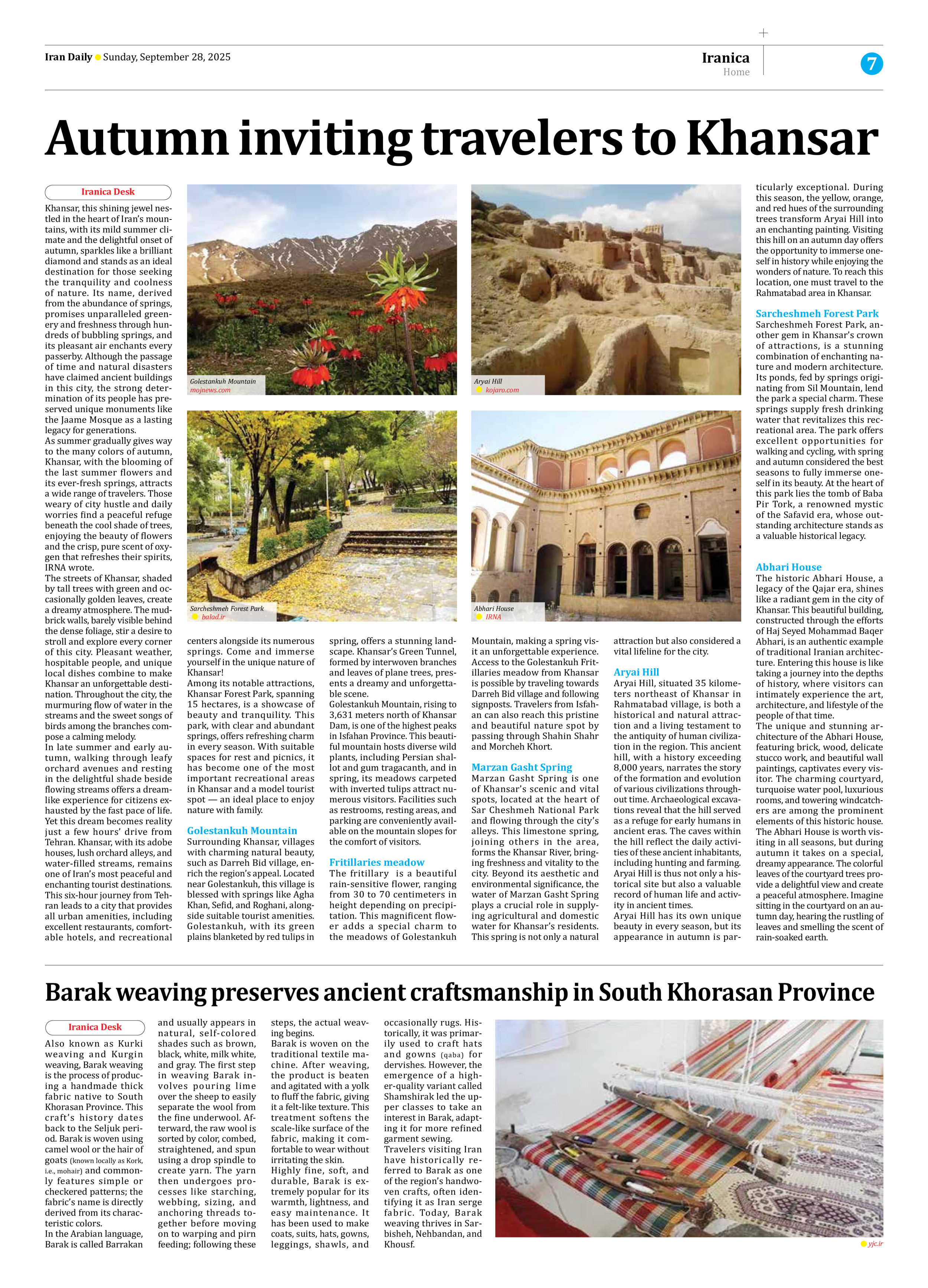
Barak is woven on the traditional textile machine. After weaving, the product is beaten and agitated with a yolk to fluff the fabric, giving it a felt-like texture. This treatment softens the scale-like surface of the fabric, making it comfortable to wear without irritating the skin.
Highly fine, soft, and durable, Barak is extremely popular for its warmth, lightness, and easy maintenance. It has been used to make coats, suits, hats, gowns, leggings, shawls, and occasionally rugs. Historically, it was primarily used to craft hats and gowns (qaba) for dervishes. However, the emergence of a higher-quality variant called Shamshirak led the upper classes to take an interest in Barak, adapting it for more refined garment sewing.
Travelers visiting Iran have historically referred to Barak as one of the region’s handwoven crafts, often identifying it as Iran serge fabric. Today, Barak weaving thrives in Sarbisheh, Nehbandan, and Khousf.