







Handing over weapons by Hezbollah would be nothing short of ‘suicide’
It has been a year since Sayyed Hassan Nasrallah, the charismatic leader of Lebanon’s Shia community, was assassinated in an Israeli airstrike on Beirut. Over the past year, Hezbollah has come under mounting pressure to lay down its arms and hand them over to the Lebanese army — pressure that stems largely from external powers.
But Nasrallah’s successor, his deputy Sheikh Naim Qassem, has refused to bow to such demands, warning that disarming Hezbollah would mean the end of life in Lebanon. On the anniversary of Nasrallah’s martyrdom, Majid Safataj, a Middle East affair expert, told Iran Daily that handing over Hezbollah’s weapons would amount to “suicide in every sense,” a step the group will never take.
IRAN DAILY: How do you see Lebanon’s political situation on the first anniversary of Nasrallah’s assassination, and what is Hezbollah’s current standing in the country’s politics?
SAFATAJ: The political climate in Lebanon today has reached a point where, at least on the surface and under the influence of Western and some Arab media outlets, it is being portrayed as though the Resistance Front has been defeated. Key pillars of this front — led by the Islamic Republic of Iran — have been declared broken, including Syria, Hezbollah in Lebanon, Hamas and Islamic Jihad in Palestine, Ansarallah in Yemen, as well as Iraqi groups and even the Iraqi state itself.
But once you dig deeper and examine the recent developments against the objectives pursued by the Zionists and the Americans, the picture changes. Their goal has always been to topple the Islamic Republic, to fragment Iran, and to crush the Resistance movements and their allies. Yet they have not succeeded.
Yes, senior Hezbollah commanders have been assassinated — just as leaders in Palestine and Iran have been targeted. The adversaries believed that by striking at the leadership of the Resistance, they could bring the entire front crashing down. They imagined that by eliminating the top of Hezbollah’s pyramid of power, they could weaken, sideline, and eventually dismantle the movement’s role in Lebanese politics.
This was why, immediately after Nasrallah, they assassinated Hashem Safieddine, who was being floated as his successor. But Hezbollah’s organizational structure, much like that of the Islamic Republic, is not dependent on individuals. Iran itself survived the 1981 bombing of the Islamic Republican Party headquarters, which killed many senior officials, and just months later endured the assassinations of both its president and prime minister. Yet the system endured.
Hezbollah, with full awareness of this dynamic, and drawing on the strength of Shia identity and the community’s collective existence in Lebanon, has remained resilient. The group enjoys both social cohesion and organizational depth. Moreover, given Israel’s long-standing plots against it, Hezbollah has systematically built layers of backup leadership. Even after the assassinations of Nasrallah, Safieddine, and other senior and mid-ranking commanders, this grassroots movement has not collapsed.
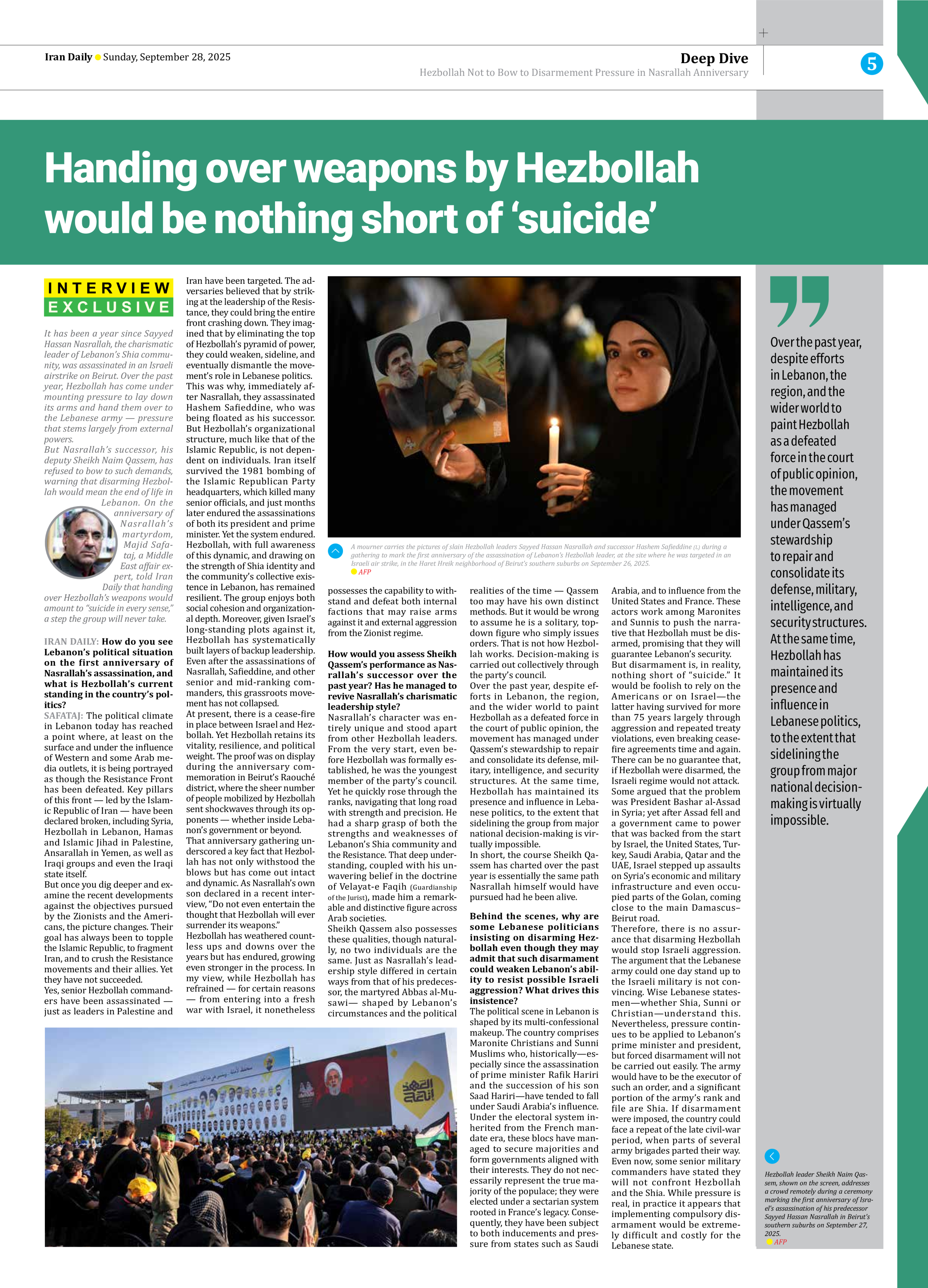
At present, there is a cease-fire in place between Israel and Hezbollah. Yet Hezbollah retains its vitality, resilience, and political weight. The proof was on display during the anniversary commemoration in Beirut’s Raouché district, where the sheer number of people mobilized by Hezbollah sent shockwaves through its opponents — whether inside Lebanon’s government or beyond.
That anniversary gathering underscored a key fact that Hezbollah has not only withstood the blows but has come out intact and dynamic. As Nasrallah’s own son declared in a recent interview, “Do not even entertain the thought that Hezbollah will ever surrender its weapons.”
Hezbollah has weathered countless ups and downs over the years but has endured, growing even stronger in the process. In my view, while Hezbollah has refrained — for certain reasons — from entering into a fresh war with Israel, it nonetheless possesses the capability to withstand and defeat both internal factions that may raise arms against it and external aggression from the Zionist regime.
How would you assess Sheikh Qassem’s performance as Nasrallah’s successor over the past year? Has he managed to revive Nasrallah’s charismatic leadership style?
Nasrallah’s character was entirely unique and stood apart from other Hezbollah leaders. From the very start, even before Hezbollah was formally established, he was the youngest member of the party’s council. Yet he quickly rose through the ranks, navigating that long road with strength and precision. He had a sharp grasp of both the strengths and weaknesses of Lebanon’s Shia community and the Resistance. That deep understanding, coupled with his unwavering belief in the doctrine of Velayat-e Faqih (Guardianship of the Jurist), made him a remarkable and distinctive figure across Arab societies.
Sheikh Qassem also possesses these qualities, though naturally, no two individuals are the same. Just as Nasrallah’s leadership style differed in certain ways from that of his predecessor, the martyred Abbas al-Musawi— shaped by Lebanon’s circumstances and the political realities of the time — Qassem too may have his own distinct methods. But it would be wrong to assume he is a solitary, top-down figure who simply issues orders. That is not how Hezbollah works. Decision-making is carried out collectively through the party’s council.
Over the past year, despite efforts in Lebanon, the region, and the wider world to paint Hezbollah as a defeated force in the court of public opinion, the movement has managed under Qassem’s stewardship to repair and consolidate its defense, military, intelligence, and security structures. At the same time, Hezbollah has maintained its presence and influence in Lebanese politics, to the extent that sidelining the group from major national decision-making is virtually impossible.
In short, the course Sheikh Qassem has charted over the past year is essentially the same path Nasrallah himself would have pursued had he been alive.
Behind the scenes, why are some Lebanese politicians insisting on disarming Hezbollah even though they may admit that such disarmament could weaken Lebanon’s ability to resist possible Israeli aggression? What drives this
insistence?
The political scene in Lebanon is shaped by its multi-confessional makeup. The country comprises Maronite Christians and Sunni Muslims who, historically—especially since the assassination of prime minister Rafik Hariri and the succession of his son Saad Hariri—have tended to fall under Saudi Arabia’s influence. Under the electoral system inherited from the French mandate era, these blocs have managed to secure majorities and form governments aligned with their interests. They do not necessarily represent the true majority of the populace; they were elected under a sectarian system rooted in France’s legacy. Consequently, they have been subject to both inducements and pressure from states such as Saudi Arabia, and to influence from the United States and France. These actors work among Maronites and Sunnis to push the narrative that Hezbollah must be disarmed, promising that they will guarantee Lebanon’s security.
But disarmament is, in reality, nothing short of “suicide.” It would be foolish to rely on the Americans or on Israel—the latter having survived for more than 75 years largely through aggression and repeated treaty violations, even breaking cease-fire agreements time and again. There can be no guarantee that, if Hezbollah were disarmed, the Israeli regime would not attack.
Some argued that the problem was President Bashar al-Assad in Syria; yet after Assad fell and a government came to power that was backed from the start by Israel, the United States, Turkey, Saudi Arabia, Qatar and the UAE, Israel stepped up assaults on Syria’s economic and military infrastructure and even occupied parts of the Golan, coming close to the main Damascus–Beirut road.
Therefore, there is no assurance that disarming Hezbollah would stop Israeli aggression. The argument that the Lebanese army could one day stand up to the Israeli military is not convincing. Wise Lebanese statesmen—whether Shia, Sunni or Christian—understand this. Nevertheless, pressure continues to be applied to Lebanon’s prime minister and president, but forced disarmament will not be carried out easily. The army would have to be the executor of such an order, and a significant portion of the army’s rank and file are Shia. If disarmament were imposed, the country could face a repeat of the late civil-war period, when parts of several army brigades parted their way.
Even now, some senior military commanders have stated they will not confront Hezbollah and the Shia. While pressure is real, in practice it appears that implementing compulsory disarmament would be extremely difficult and costly for the
Lebanese state.