







A year after Sayyed Hassan Nasrallahʼs martyrdom
Lebanese army yet unfit to replace resistance
Hezbollahʼs arsenal necessary deterrent, not tool for political leverage
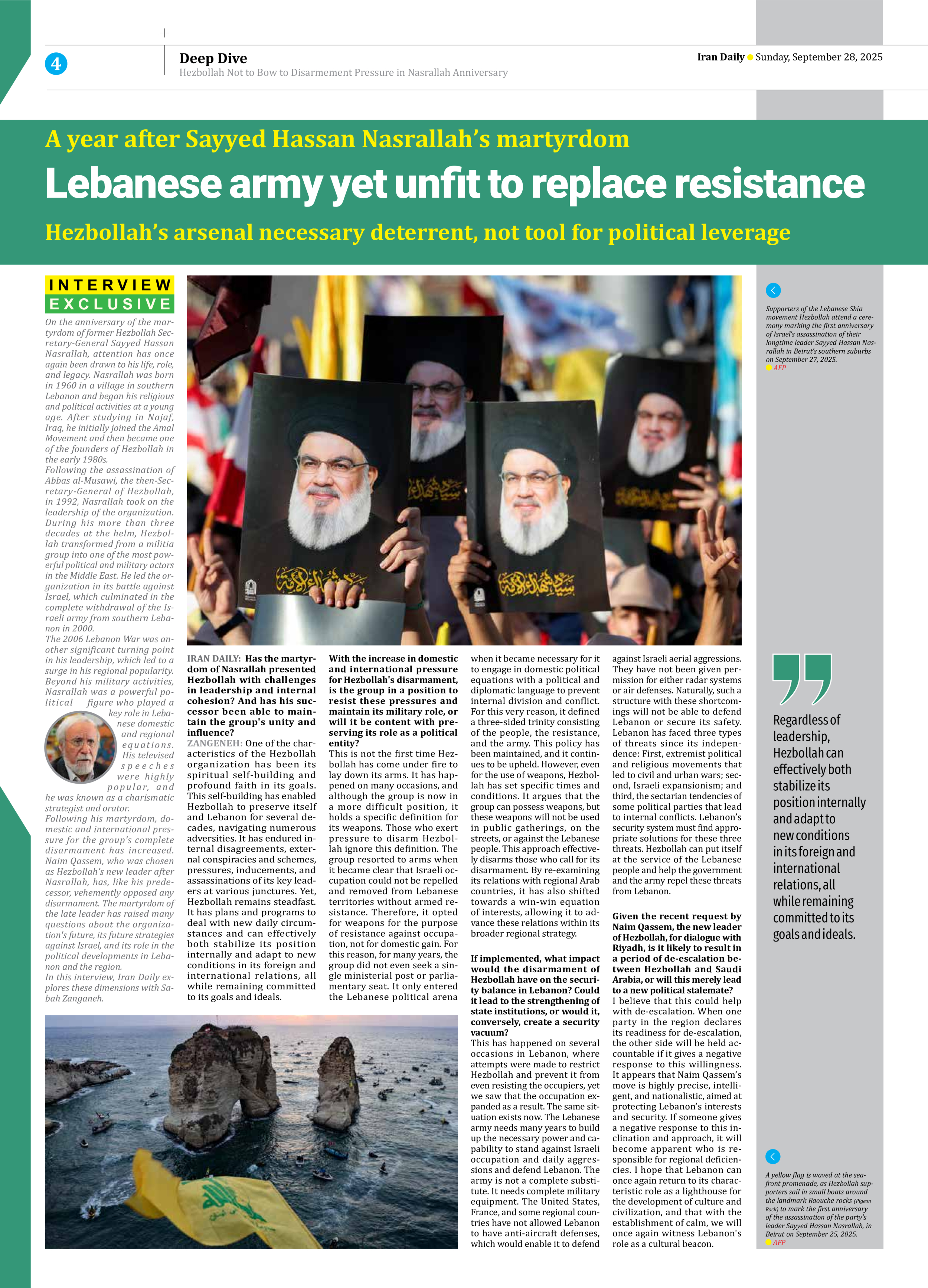
On the anniversary of the martyrdom of former Hezbollah Secretary-General Sayyed Hassan Nasrallah, attention has once again been drawn to his life, role, and legacy. Nasrallah was born in 1960 in a village in southern Lebanon and began his religious and political activities at a young age. After studying in Najaf, Iraq, he initially joined the Amal Movement and then became one of the founders of Hezbollah in the early 1980s.
Following the assassination of Abbas al-Musawi, the then-Secretary-General of Hezbollah, in 1992, Nasrallah took on the leadership of the organization. During his more than three decades at the helm, Hezbollah transformed from a militia group into one of the most powerful political and military actors in the Middle East. He led the organization in its battle against Israel, which culminated in the complete withdrawal of the Israeli army from southern Lebanon in 2000.
The 2006 Lebanon War was another significant turning point in his leadership, which led to a surge in his regional popularity. Beyond his military activities, Nasrallah was a powerful political figure who played a key role in Lebanese domestic and regional equations. His televised speeches were highly popular, and he was known as a charismatic strategist and orator.
Following his martyrdom, domestic and international pressure for the group's complete disarmament has increased. Naim Qassem, who was chosen as Hezbollah’s new leader after Nasrallah, has, like his predecessor, vehemently opposed any disarmament. The martyrdom of the late leader has raised many questions about the organization's future, its future strategies against Israel, and its role in the political developments in Lebanon and the region.
In this interview, Iran Daily explores these dimensions with Sabah Zanganeh.
IRAN DAILY: Has the martyrdom of Nasrallah presented Hezbollah with challenges in leadership and internal cohesion? And has his successor been able to maintain the group's unity and
influence?
ZANGENEH: One of the characteristics of the Hezbollah organization has been its spiritual self-building and profound faith in its goals. This self-building has enabled Hezbollah to preserve itself and Lebanon for several decades, navigating numerous adversities. It has endured internal disagreements, external conspiracies and schemes, pressures, inducements, and assassinations of its key leaders at various junctures. Yet, Hezbollah remains steadfast. It has plans and programs to deal with new daily circumstances and can effectively both stabilize its position internally and adapt to new conditions in its foreign and international relations, all while remaining committed to its goals and ideals.
With the increase in domestic and international pressure for Hezbollah's disarmament, is the group in a position to resist these pressures and maintain its military role, or will it be content with preserving its role as a political entity?
This is not the first time Hezbollah has come under fire to lay down its arms. It has happened on many occasions, and although the group is now in a more difficult position, it holds a specific definition for its weapons. Those who exert pressure to disarm Hezbollah ignore this definition. The group resorted to arms when it became clear that Israeli occupation could not be repelled and removed from Lebanese territories without armed resistance. Therefore, it opted for weapons for the purpose of resistance against occupation, not for domestic gain. For this reason, for many years, the group did not even seek a single ministerial post or parliamentary seat. It only entered the Lebanese political arena when it became necessary for it to engage in domestic political equations with a political and diplomatic language to prevent internal division and conflict. For this very reason, it defined a three-sided trinity consisting of the people, the resistance, and the army. This policy has been maintained, and it continues to be upheld. However, even for the use of weapons, Hezbollah has set specific times and conditions. It argues that the group can possess weapons, but these weapons will not be used in public gatherings, on the streets, or against the Lebanese people. This approach effectively disarms those who call for its disarmament. By re-examining its relations with regional Arab countries, it has also shifted towards a win-win equation of interests, allowing it to advance these relations within its
broader regional strategy.
If implemented, what impact would the disarmament of Hezbollah have on the security balance in Lebanon? Could it lead to the strengthening of state institutions, or would it, conversely, create a security vacuum?
This has happened on several occasions in Lebanon, where attempts were made to restrict Hezbollah and prevent it from even resisting the occupiers, yet we saw that the occupation expanded as a result. The same situation exists now. The Lebanese army needs many years to build up the necessary power and capability to stand against Israeli occupation and daily aggressions and defend Lebanon. The army is not a complete substitute. It needs complete military equipment. The United States, France, and some regional countries have not allowed Lebanon to have anti-aircraft defenses, which would enable it to defend against Israeli aerial aggressions. They have not been given permission for either radar systems or air defenses. Naturally, such a structure with these shortcomings will not be able to defend Lebanon or secure its safety. Lebanon has faced three types of threats since its independence: First, extremist political and religious movements that led to civil and urban wars; second, Israeli expansionism; and third, the sectarian tendencies of some political parties that lead to internal conflicts. Lebanon’s security system must find appropriate solutions for these three threats. Hezbollah can put itself at the service of the Lebanese people and help the government and the army repel these threats from Lebanon.
Given the recent request by Naim Qassem, the new leader of Hezbollah, for dialogue with Riyadh, is it likely to result in a period of de-escalation between Hezbollah and Saudi Arabia, or will this merely lead to a new political stalemate?
I believe that this could help with de-escalation. When one party in the region declares its readiness for de-escalation, the other side will be held accountable if it gives a negative response to this willingness. It appears that Naim Qassem’s move is highly precise, intelligent, and nationalistic, aimed at protecting Lebanon’s interests and security. If someone gives a negative response to this inclination and approach, it will become apparent who is responsible for regional deficiencies. I hope that Lebanon can once again return to its characteristic role as a lighthouse for the development of culture and civilization, and that with the establishment of calm, we will once again witness Lebanon's role as a cultural beacon.