







BRICS okays nuclear platform strategy at Moscow summit with Iran participation
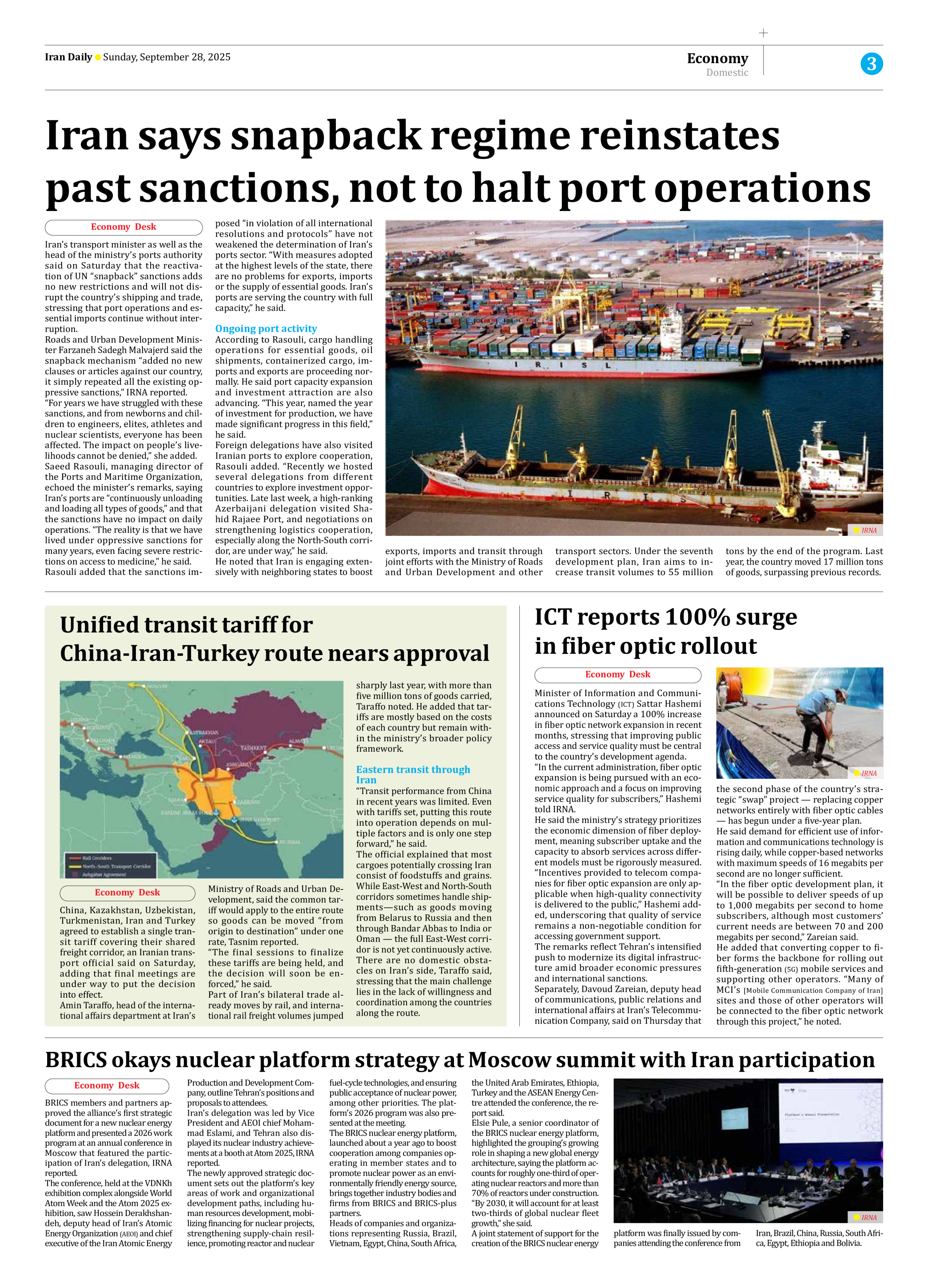
BRICS members and partners approved the alliance’s first strategic document for a new nuclear energy platform and presented a 2026 work program at an annual conference in Moscow that featured the participation of Iran’s delegation, IRNA reported.
The conference, held at the VDNKh exhibition complex alongside World Atom Week and the Atom 2025 exhibition, saw Hossein Derakhshandeh, deputy head of Iran’s Atomic Energy Organization (AEOI) and chief executive of the Iran Atomic Energy Production and Development Company, outline Tehran’s positions and proposals to attendees.
Iran’s delegation was led by Vice President and AEOI chief Mohammad Eslami, and Tehran also displayed its nuclear industry achievements at a booth at Atom 2025, IRNA reported.
The newly approved strategic document sets out the platform’s key areas of work and organizational development paths, including human resources development, mobilizing financing for nuclear projects, strengthening supply-chain resilience, promoting reactor and nuclear fuel-cycle technologies, and ensuring public acceptance of nuclear power, among other priorities. The platform’s 2026 program was also presented at the meeting.
The BRICS nuclear energy platform, launched about a year ago to boost cooperation among companies operating in member states and to promote nuclear power as an environmentally friendly energy source, brings together industry bodies and firms from BRICS and BRICS-plus partners.
Heads of companies and organizations representing Russia, Brazil, Vietnam, Egypt, China, South Africa, the United Arab Emirates, Ethiopia, Turkey and the ASEAN Energy Centre attended the conference, the report said.
Elsie Pule, a senior coordinator of the BRICS nuclear energy platform, highlighted the grouping’s growing role in shaping a new global energy architecture, saying the platform accounts for roughly one-third of operating nuclear reactors and more than 70% of reactors under construction. “By 2030, it will account for at least two-thirds of global nuclear fleet growth,” she said.
A joint statement of support for the creation of the BRICS nuclear energy platform was finally issued by companies attending the conference from Iran, Brazil, China, Russia, South Africa, Egypt, Ethiopia and Bolivia.