







From petrodollars to nuclear shield
Birth of new security axis in Asia
By Hoda Yousefi
Mideast affairs expert
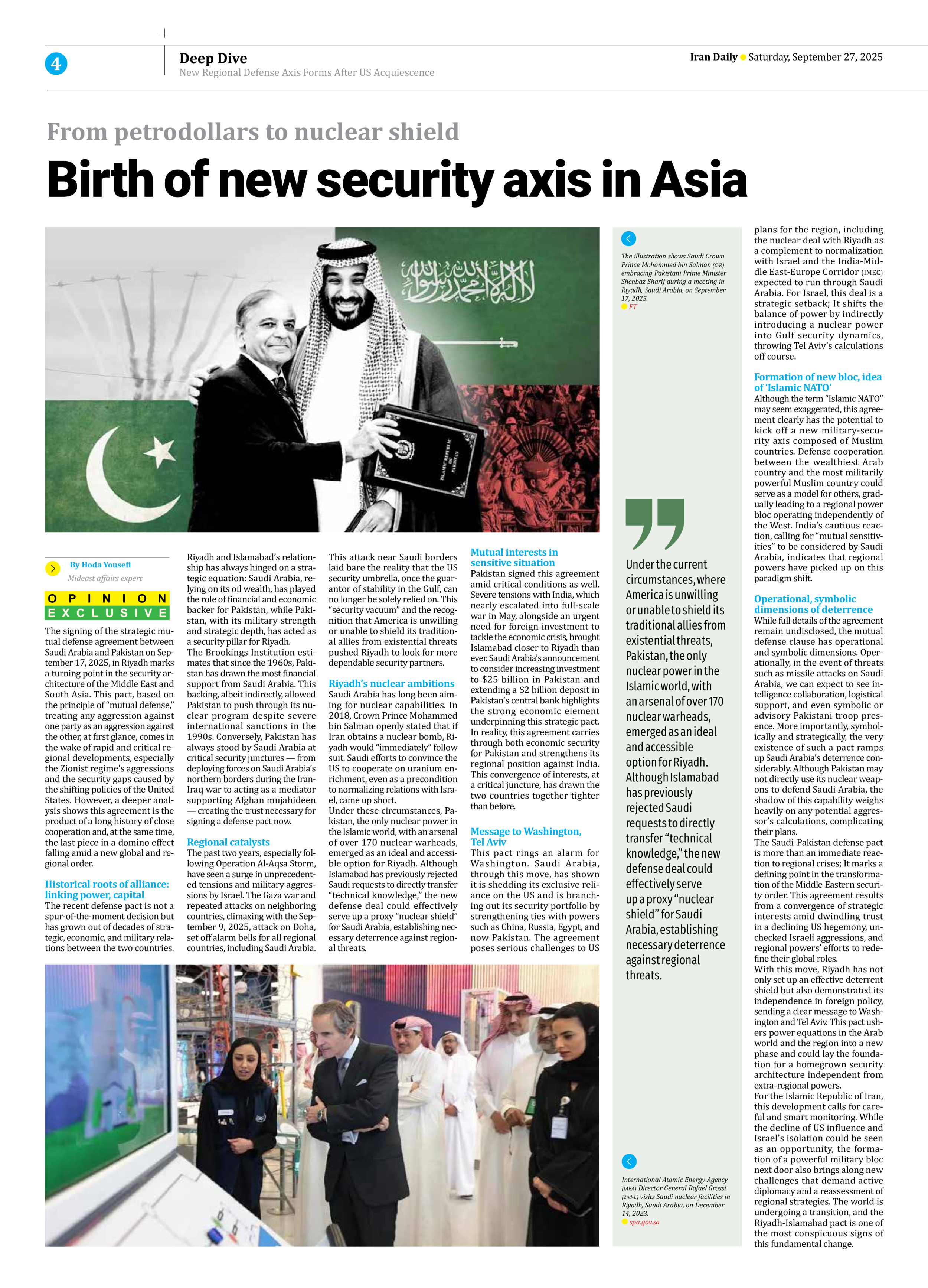
The signing of the strategic mutual defense agreement between Saudi Arabia and Pakistan on September 17, 2025, in Riyadh marks a turning point in the security architecture of the Middle East and South Asia. This pact, based on the principle of “mutual defense,” treating any aggression against one party as an aggression against the other, at first glance, comes in the wake of rapid and critical regional developments, especially the Zionist regime’s aggressions and the security gaps caused by the shifting policies of the United States. However, a deeper analysis shows this agreement is the product of a long history of close cooperation and, at the same time, the last piece in a domino effect falling amid a new global and regional order.
Historical roots of alliance: linking power, capital
The recent defense pact is not a spur-of-the-moment decision but has grown out of decades of strategic, economic, and military relations between the two countries. Riyadh and Islamabad’s relationship has always hinged on a strategic equation: Saudi Arabia, relying on its oil wealth, has played the role of financial and economic backer for Pakistan, while Pakistan, with its military strength and strategic depth, has acted as a security pillar for Riyadh.
The Brookings Institution estimates that since the 1960s, Pakistan has drawn the most financial support from Saudi Arabia. This backing, albeit indirectly, allowed Pakistan to push through its nuclear program despite severe international sanctions in the 1990s. Conversely, Pakistan has always stood by Saudi Arabia at critical security junctures — from deploying forces on Saudi Arabia’s northern borders during the Iran-Iraq war to acting as a mediator supporting Afghan mujahideen — creating the trust necessary for signing a defense pact now.
Regional catalysts
The past two years, especially following Operation Al-Aqsa Storm, have seen a surge in unprecedented tensions and military aggressions by Israel. The Gaza war and repeated attacks on neighboring countries, climaxing with the September 9, 2025, attack on Doha, set off alarm bells for all regional countries, including Saudi Arabia. This attack near Saudi borders laid bare the reality that the US security umbrella, once the guarantor of stability in the Gulf, can no longer be solely relied on. This “security vacuum” and the recognition that America is unwilling or unable to shield its traditional allies from existential threats pushed Riyadh to look for more dependable security partners.
Riyadh’s nuclear ambitions
Saudi Arabia has long been aiming for nuclear capabilities. In 2018, Crown Prince Mohammed bin Salman openly stated that if Iran obtains a nuclear bomb, Riyadh would “immediately” follow suit. Saudi efforts to convince the US to cooperate on uranium enrichment, even as a precondition to normalizing relations with Israel, came up short.
Under these circumstances, Pakistan, the only nuclear power in the Islamic world, with an arsenal of over 170 nuclear warheads, emerged as an ideal and accessible option for Riyadh. Although Islamabad has previously rejected Saudi requests to directly transfer “technical knowledge,” the new defense deal could effectively serve up a proxy “nuclear shield” for Saudi Arabia, establishing necessary deterrence against regional threats.
Mutual interests in sensitive situation
Pakistan signed this agreement amid critical conditions as well. Severe tensions with India, which nearly escalated into full-scale war in May, alongside an urgent need for foreign investment to tackle the economic crisis, brought Islamabad closer to Riyadh than ever. Saudi Arabia’s announcement to consider increasing investment to $25 billion in Pakistan and extending a $2 billion deposit in Pakistan’s central bank highlights the strong economic element underpinning this strategic pact. In reality, this agreement carries through both economic security for Pakistan and strengthens its regional position against India. This convergence of interests, at a critical juncture, has drawn the two countries together tighter than before.
Message to Washington,
Tel Aviv
This pact rings an alarm for Washington. Saudi Arabia, through this move, has shown it is shedding its exclusive reliance on the US and is branching out its security portfolio by strengthening ties with powers such as China, Russia, Egypt, and now Pakistan. The agreement poses serious challenges to US plans for the region, including the nuclear deal with Riyadh as a complement to normalization with Israel and the India-Middle East-Europe Corridor (IMEC) expected to run through Saudi Arabia. For Israel, this deal is a strategic setback; It shifts the balance of power by indirectly introducing a nuclear power into Gulf security dynamics, throwing Tel Aviv’s calculations off course.
Formation of new bloc, idea of ‘Islamic NATO’
Although the term “Islamic NATO” may seem exaggerated, this agreement clearly has the potential to kick off a new military-security axis composed of Muslim countries. Defense cooperation between the wealthiest Arab country and the most militarily powerful Muslim country could serve as a model for others, gradually leading to a regional power bloc operating independently of the West. India’s cautious reaction, calling for “mutual sensitivities” to be considered by Saudi Arabia, indicates that regional powers have picked up on this paradigm shift.
Operational, symbolic dimensions of deterrence
While full details of the agreement remain undisclosed, the mutual defense clause has operational and symbolic dimensions. Operationally, in the event of threats such as missile attacks on Saudi Arabia, we can expect to see intelligence collaboration, logistical support, and even symbolic or advisory Pakistani troop presence. More importantly, symbolically and strategically, the very existence of such a pact ramps up Saudi Arabia’s deterrence considerably. Although Pakistan may not directly use its nuclear weapons to defend Saudi Arabia, the shadow of this capability weighs heavily on any potential aggressor’s calculations, complicating their plans.
The Saudi-Pakistan defense pact is more than an immediate reaction to regional crises; It marks a defining point in the transformation of the Middle Eastern security order. This agreement results from a convergence of strategic interests amid dwindling trust in a declining US hegemony, unchecked Israeli aggressions, and regional powers’ efforts to redefine their global roles.
With this move, Riyadh has not only set up an effective deterrent shield but also demonstrated its independence in foreign policy, sending a clear message to Washington and Tel Aviv. This pact ushers power equations in the Arab world and the region into a new phase and could lay the foundation for a homegrown security architecture independent from extra-regional powers.
For the Islamic Republic of Iran, this development calls for careful and smart monitoring. While the decline of US influence and Israel’s isolation could be seen as an opportunity, the formation of a powerful military bloc next door also brings along new challenges that demand active diplomacy and a reassessment of regional strategies. The world is undergoing a transition, and the Riyadh-Islamabad pact is one of the most conspicuous signs of this fundamental change.