





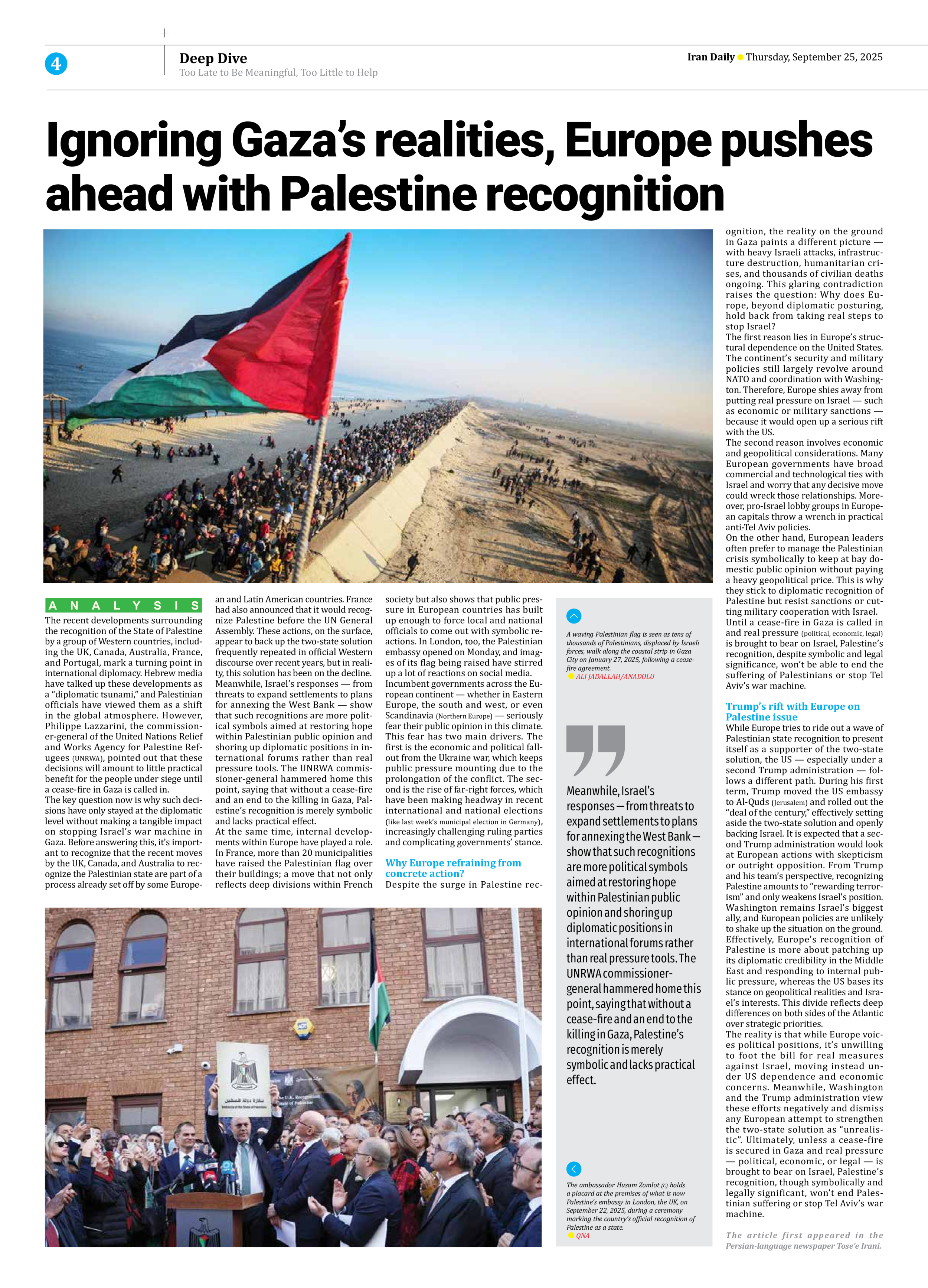


Ignoring Gaza’s realities, Europe pushes ahead with Palestine recognition
The recent developments surrounding the recognition of the State of Palestine by a group of Western countries, including the UK, Canada, Australia, France, and Portugal, mark a turning point in international diplomacy. Hebrew media have talked up these developments as a “diplomatic tsunami,” and Palestinian officials have viewed them as a shift in the global atmosphere. However, Philippe Lazzarini, the commissioner-general of the United Nations Relief and Works Agency for Palestine Refugees (UNRWA), pointed out that these decisions will amount to little practical benefit for the people under siege until a cease-fire in Gaza is called in.
The key question now is why such decisions have only stayed at the diplomatic level without making a tangible impact on stopping Israel’s war machine in Gaza. Before answering this, it’s important to recognize that the recent moves by the UK, Canada, and Australia to recognize the Palestinian state are part of a process already set off by some European and Latin American countries. France had also announced that it would recognize Palestine before the UN General Assembly. These actions, on the surface, appear to back up the two-state solution frequently repeated in official Western discourse over recent years, but in reality, this solution has been on the decline.
Meanwhile, Israel’s responses — from threats to expand settlements to plans for annexing the West Bank — show that such recognitions are more political symbols aimed at restoring hope within Palestinian public opinion and shoring up diplomatic positions in international forums rather than real pressure tools. The UNRWA commissioner-general hammered home this point, saying that without a cease-fire and an end to the killing in Gaza, Palestine’s recognition is merely symbolic and lacks practical effect.
At the same time, internal developments within Europe have played a role. In France, more than 20 municipalities have raised the Palestinian flag over their buildings; a move that not only reflects deep divisions within French society but also shows that public pressure in European countries has built up enough to force local and national officials to come out with symbolic reactions. In London, too, the Palestinian embassy opened on Monday, and images of its flag being raised have stirred up a lot of reactions on social media.
Incumbent governments across the European continent — whether in Eastern Europe, the south and west, or even Scandinavia (Northern Europe) — seriously fear their public opinion in this climate. This fear has two main drivers. The first is the economic and political fallout from the Ukraine war, which keeps public pressure mounting due to the prolongation of the conflict. The second is the rise of far-right forces, which have been making headway in recent international and national elections (like last week’s municipal election in Germany), increasingly challenging ruling parties and complicating governments’ stance.
Why Europe refraining from concrete action?
Despite the surge in Palestine recognition, the reality on the ground in Gaza paints a different picture — with heavy Israeli attacks, infrastructure destruction, humanitarian crises, and thousands of civilian deaths ongoing. This glaring contradiction raises the question: Why does Europe, beyond diplomatic posturing, hold back from taking real steps to stop Israel?
The first reason lies in Europe’s structural dependence on the United States. The continent’s security and military policies still largely revolve around NATO and coordination with Washington. Therefore, Europe shies away from putting real pressure on Israel — such as economic or military sanctions — because it would open up a serious rift with the US.
The second reason involves economic and geopolitical considerations. Many European governments have broad commercial and technological ties with Israel and worry that any decisive move could wreck those relationships. Moreover, pro-Israel lobby groups in European capitals throw a wrench in practical anti-Tel Aviv policies.
On the other hand, European leaders often prefer to manage the Palestinian crisis symbolically to keep at bay domestic public opinion without paying a heavy geopolitical price. This is why they stick to diplomatic recognition of Palestine but resist sanctions or cutting military cooperation with Israel.
Until a cease-fire in Gaza is called in and real pressure (political, economic, legal) is brought to bear on Israel, Palestine’s recognition, despite symbolic and legal significance, won’t be able to end the suffering of Palestinians or stop Tel Aviv’s war machine.
Trump’s rift with Europe on Palestine issue
While Europe tries to ride out a wave of Palestinian state recognition to present itself as a supporter of the two-state solution, the US — especially under a second Trump administration — follows a different path. During his first term, Trump moved the US embassy to Al-Quds (Jerusalem) and rolled out the “deal of the century,” effectively setting aside the two-state solution and openly backing Israel. It is expected that a second Trump administration would look at European actions with skepticism or outright opposition. From Trump and his team’s perspective, recognizing Palestine amounts to “rewarding terrorism” and only weakens Israel’s position. Washington remains Israel’s biggest ally, and European policies are unlikely to shake up the situation on the ground.
Effectively, Europe’s recognition of Palestine is more about patching up its diplomatic credibility in the Middle East and responding to internal public pressure, whereas the US bases its stance on geopolitical realities and Israel’s interests. This divide reflects deep differences on both sides of the Atlantic over strategic priorities.
The reality is that while Europe voices political positions, it’s unwilling to foot the bill for real measures against Israel, moving instead under US dependence and economic concerns. Meanwhile, Washington and the Trump administration view these efforts negatively and dismiss any European attempt to strengthen the two-state solution as “unrealistic”. Ultimately, unless a cease-fire is secured in Gaza and real pressure — political, economic, or legal — is brought to bear on Israel, Palestine’s recognition, though symbolically and legally significant, won’t end Palestinian suffering or stop Tel Aviv’s war machine.
The article first appeared in the
Persian-language newspaper Tose’e Irani.