







Restoration, tradition draw visitors to Davaran village
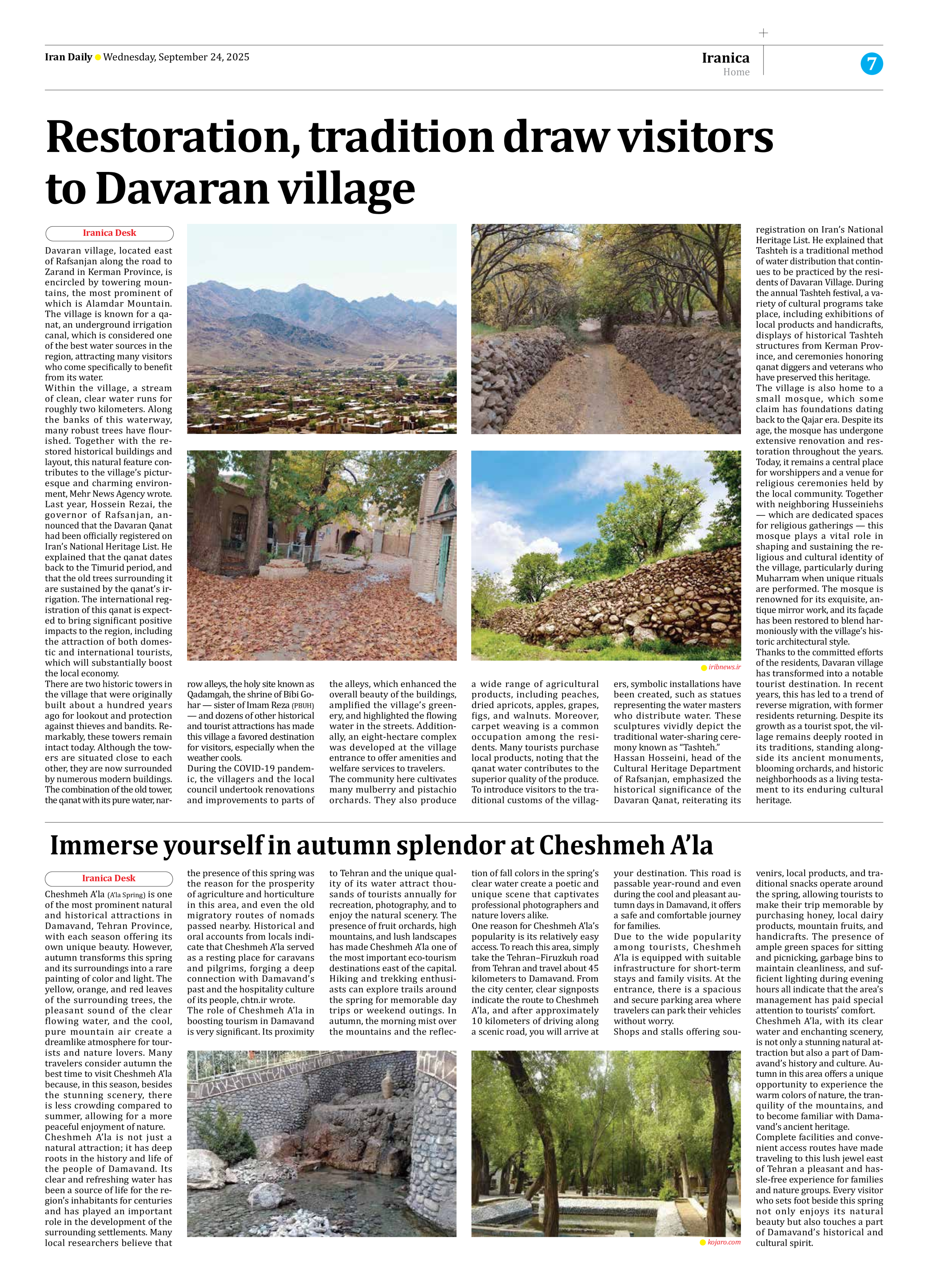
Davaran village, located east of Rafsanjan along the road to Zarand in Kerman Province, is encircled by towering mountains, the most prominent of which is Alamdar Mountain. The village is known for a qanat, an underground irrigation canal, which is considered one of the best water sources in the region, attracting many visitors who come specifically to benefit from its water.
Within the village, a stream of clean, clear water runs for roughly two kilometers. Along the banks of this waterway, many robust trees have flourished. Together with the restored historical buildings and layout, this natural feature contributes to the village’s picturesque and charming environment, Mehr News Agency wrote.
Last year, Hossein Rezai, the governor of Rafsanjan, announced that the Davaran Qanat had been officially registered on Iran’s National Heritage List. He explained that the qanat dates back to the Timurid period, and that the old trees surrounding it are sustained by the qanat’s irrigation. The international registration of this qanat is expected to bring significant positive impacts to the region, including the attraction of both domestic and international tourists, which will substantially boost the local economy.
There are two historic towers in the village that were originally built about a hundred years ago for lookout and protection against thieves and bandits. Remarkably, these towers remain intact today. Although the towers are situated close to each other, they are now surrounded by numerous modern buildings.
The combination of the old tower, the qanat with its pure water, narrow alleys, the holy site known as Qadamgah, the shrine of Bibi Gohar — sister of Imam Reza (PBUH) — and dozens of other historical and tourist attractions has made this village a favored destination for visitors, especially when the weather cools.
During the COVID-19 pandemic, the villagers and the local council undertook renovations and improvements to parts of the alleys, which enhanced the overall beauty of the buildings, amplified the village’s greenery, and highlighted the flowing water in the streets. Additionally, an eight-hectare complex was developed at the village entrance to offer amenities and welfare services to travelers.
The community here cultivates many mulberry and pistachio orchards. They also produce a wide range of agricultural products, including peaches, dried apricots, apples, grapes, figs, and walnuts. Moreover, carpet weaving is a common occupation among the residents. Many tourists purchase local products, noting that the qanat water contributes to the superior quality of the produce. To introduce visitors to the traditional customs of the villagers, symbolic installations have been created, such as statues representing the water masters who distribute water. These sculptures vividly depict the traditional water-sharing ceremony known as “Tashteh.”
Hassan Hosseini, head of the Cultural Heritage Department of Rafsanjan, emphasized the historical significance of the Davaran Qanat, reiterating its registration on Iran’s National Heritage List. He explained that Tashteh is a traditional method of water distribution that continues to be practiced by the residents of Davaran Village. During the annual Tashteh festival, a variety of cultural programs take place, including exhibitions of local products and handicrafts, displays of historical Tashteh structures from Kerman Province, and ceremonies honoring qanat diggers and veterans who have preserved this heritage.
The village is also home to a small mosque, which some claim has foundations dating back to the Qajar era. Despite its age, the mosque has undergone extensive renovation and restoration throughout the years. Today, it remains a central place for worshippers and a venue for religious ceremonies held by the local community. Together with neighboring Husseiniehs — which are dedicated spaces for religious gatherings — this mosque plays a vital role in shaping and sustaining the religious and cultural identity of the village, particularly during Muharram when unique rituals are performed. The mosque is renowned for its exquisite, antique mirror work, and its façade has been restored to blend harmoniously with the village’s historic architectural style.
Thanks to the committed efforts of the residents, Davaran village has transformed into a notable tourist destination. In recent years, this has led to a trend of reverse migration, with former residents returning. Despite its growth as a tourist spot, the village remains deeply rooted in its traditions, standing alongside its ancient monuments, blooming orchards, and historic neighborhoods as a living testament to its enduring cultural heritage.