





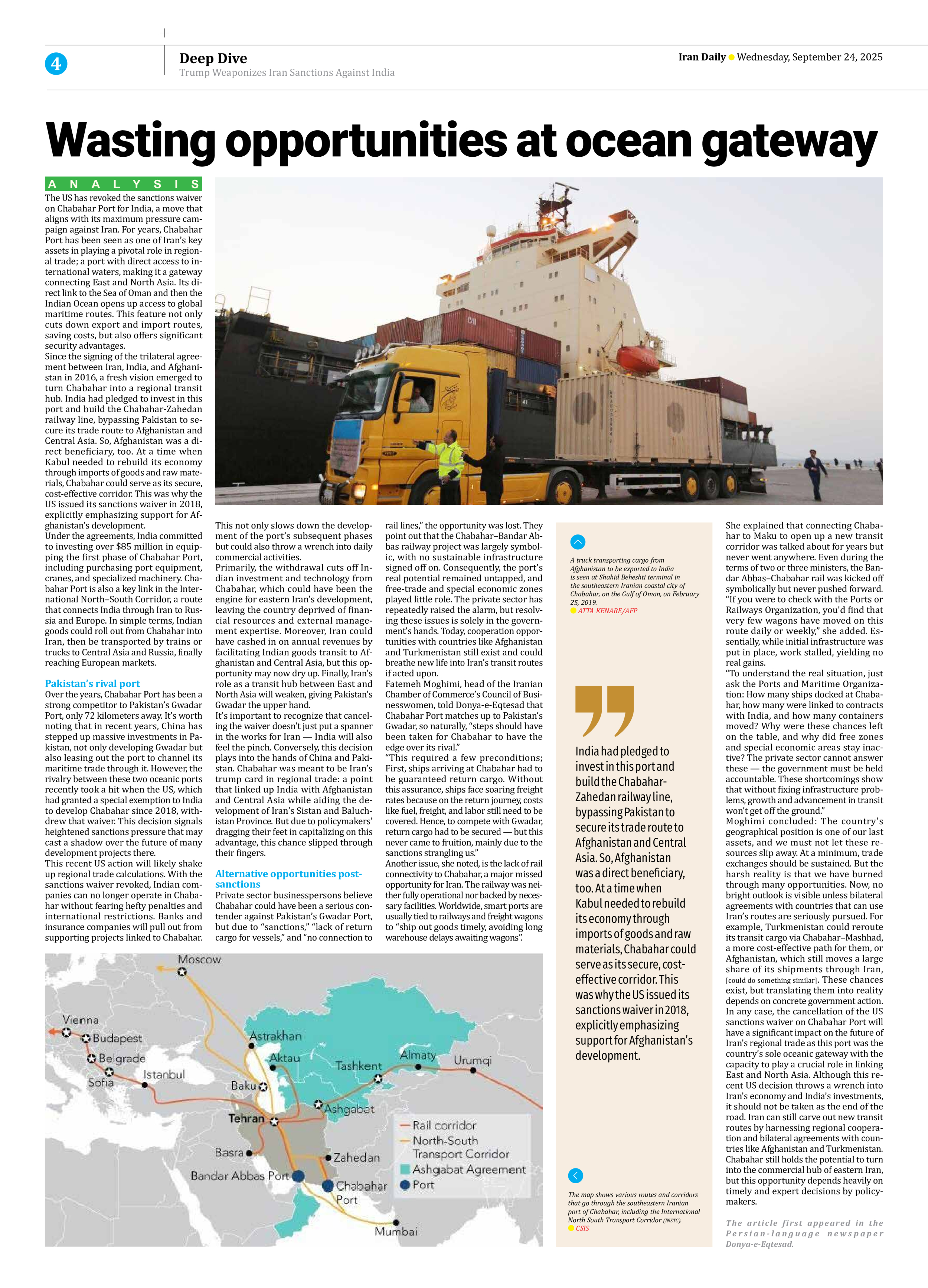


Wasting opportunities at ocean gateway
The US has revoked the sanctions waiver on Chabahar Port for India, a move that aligns with its maximum pressure campaign against Iran. For years, Chabahar Port has been seen as one of Iran’s key assets in playing a pivotal role in regional trade; a port with direct access to international waters, making it a gateway connecting East and North Asia. Its direct link to the Sea of Oman and then the Indian Ocean opens up access to global maritime routes. This feature not only cuts down export and import routes, saving costs, but also offers significant security advantages.
Since the signing of the trilateral agreement between Iran, India, and Afghanistan in 2016, a fresh vision emerged to turn Chabahar into a regional transit hub. India had pledged to invest in this port and build the Chabahar-Zahedan railway line, bypassing Pakistan to secure its trade route to Afghanistan and Central Asia. So, Afghanistan was a direct beneficiary, too. At a time when Kabul needed to rebuild its economy through imports of goods and raw materials, Chabahar could serve as its secure, cost-effective corridor. This was why the US issued its sanctions waiver in 2018, explicitly emphasizing support for Afghanistan’s development.
Under the agreements, India committed to investing over $85 million in equipping the first phase of Chabahar Port, including purchasing port equipment, cranes, and specialized machinery. Chabahar Port is also a key link in the International North–South Corridor, a route that connects India through Iran to Russia and Europe. In simple terms, Indian goods could roll out from Chabahar into Iran, then be transported by trains or trucks to Central Asia and Russia, finally reaching European markets.
Pakistan’s rival port
Over the years, Chabahar Port has been a strong competitor to Pakistan’s Gwadar Port, only 72 kilometers away. It’s worth noting that in recent years, China has stepped up massive investments in Pakistan, not only developing Gwadar but also leasing out the port to channel its maritime trade through it. However, the rivalry between these two oceanic ports recently took a hit when the US, which had granted a special exemption to India to develop Chabahar since 2018, withdrew that waiver. This decision signals heightened sanctions pressure that may cast a shadow over the future of many development projects there.
This recent US action will likely shake up regional trade calculations. With the sanctions waiver revoked, Indian companies can no longer operate in Chabahar without fearing hefty penalties and international restrictions. Banks and insurance companies will pull out from supporting projects linked to Chabahar. This not only slows down the development of the port’s subsequent phases but could also throw a wrench into daily commercial activities.
Primarily, the withdrawal cuts off Indian investment and technology from Chabahar, which could have been the engine for eastern Iran’s development, leaving the country deprived of financial resources and external management expertise. Moreover, Iran could have cashed in on annual revenues by facilitating Indian goods transit to Afghanistan and Central Asia, but this opportunity may now dry up. Finally, Iran’s role as a transit hub between East and North Asia will weaken, giving Pakistan’s Gwadar the upper hand.
It’s important to recognize that canceling the waiver doesn’t just put a spanner in the works for Iran — India will also feel the pinch. Conversely, this decision plays into the hands of China and Pakistan. Chabahar was meant to be Iran’s trump card in regional trade: a point that linked up India with Afghanistan and Central Asia while aiding the development of Iran’s Sistan and Baluchistan Province. But due to policymakers’ dragging their feet in capitalizing on this advantage, this chance slipped through their fingers.
Alternative opportunities post-sanctions
Private sector businesspersons believe Chabahar could have been a serious contender against Pakistan’s Gwadar Port, but due to “sanctions,” “lack of return cargo for vessels,” and “no connection to rail lines,” the opportunity was lost. They point out that the Chabahar–Bandar Abbas railway project was largely symbolic, with no sustainable infrastructure signed off on. Consequently, the port’s real potential remained untapped, and free-trade and special economic zones played little role. The private sector has repeatedly raised the alarm, but resolving these issues is solely in the government’s hands. Today, cooperation opportunities with countries like Afghanistan and Turkmenistan still exist and could breathe new life into Iran’s transit routes if acted upon.
Fatemeh Moghimi, head of the Iranian Chamber of Commerce’s Council of Businesswomen, told Donya-e-Eqtesad that Chabahar Port matches up to Pakistan’s Gwadar, so naturally, “steps should have been taken for Chabahar to have the edge over its rival.”
“This required a few preconditions; First, ships arriving at Chabahar had to be guaranteed return cargo. Without this assurance, ships face soaring freight rates because on the return journey, costs like fuel, freight, and labor still need to be covered. Hence, to compete with Gwadar, return cargo had to be secured — but this never came to fruition, mainly due to the sanctions strangling us.”
Another issue, she noted, is the lack of rail connectivity to Chabahar, a major missed opportunity for Iran. The railway was neither fully operational nor backed by necessary facilities. Worldwide, smart ports are usually tied to railways and freight wagons to “ship out goods timely, avoiding long warehouse delays awaiting wagons”.
She explained that connecting Chabahar to Maku to open up a new transit corridor was talked about for years but never went anywhere. Even during the terms of two or three ministers, the Bandar Abbas–Chabahar rail was kicked off symbolically but never pushed forward. “If you were to check with the Ports or Railways Organization, you’d find that very few wagons have moved on this route daily or weekly,” she added. Essentially, while initial infrastructure was put in place, work stalled, yielding no real gains.
“To understand the real situation, just ask the Ports and Maritime Organization: How many ships docked at Chabahar, how many were linked to contracts with India, and how many containers moved? Why were these chances left on the table, and why did free zones and special economic areas stay inactive? The private sector cannot answer these — the government must be held accountable. These shortcomings show that without fixing infrastructure problems, growth and advancement in transit won’t get off the ground.”
Moghimi concluded: The country’s geographical position is one of our last assets, and we must not let these resources slip away. At a minimum, trade exchanges should be sustained. But the harsh reality is that we have burned through many opportunities. Now, no bright outlook is visible unless bilateral agreements with countries that can use Iran’s routes are seriously pursued. For example, Turkmenistan could reroute its transit cargo via Chabahar–Mashhad, a more cost-effective path for them, or Afghanistan, which still moves a large share of its shipments through Iran, [could do something similar]. These chances exist, but translating them into reality depends on concrete government action.
In any case, the cancellation of the US sanctions waiver on Chabahar Port will have a significant impact on the future of Iran’s regional trade as this port was the country’s sole oceanic gateway with the capacity to play a crucial role in linking East and North Asia. Although this recent US decision throws a wrench into Iran’s economy and India’s investments, it should not be taken as the end of the road. Iran can still carve out new transit routes by harnessing regional cooperation and bilateral agreements with countries like Afghanistan and Turkmenistan. Chabahar still holds the potential to turn into the commercial hub of eastern Iran, but this opportunity depends heavily on timely and expert decisions by policymakers.
The article first appeared in the
Persian-language newspaper
Donya-e-Eqtesad.