





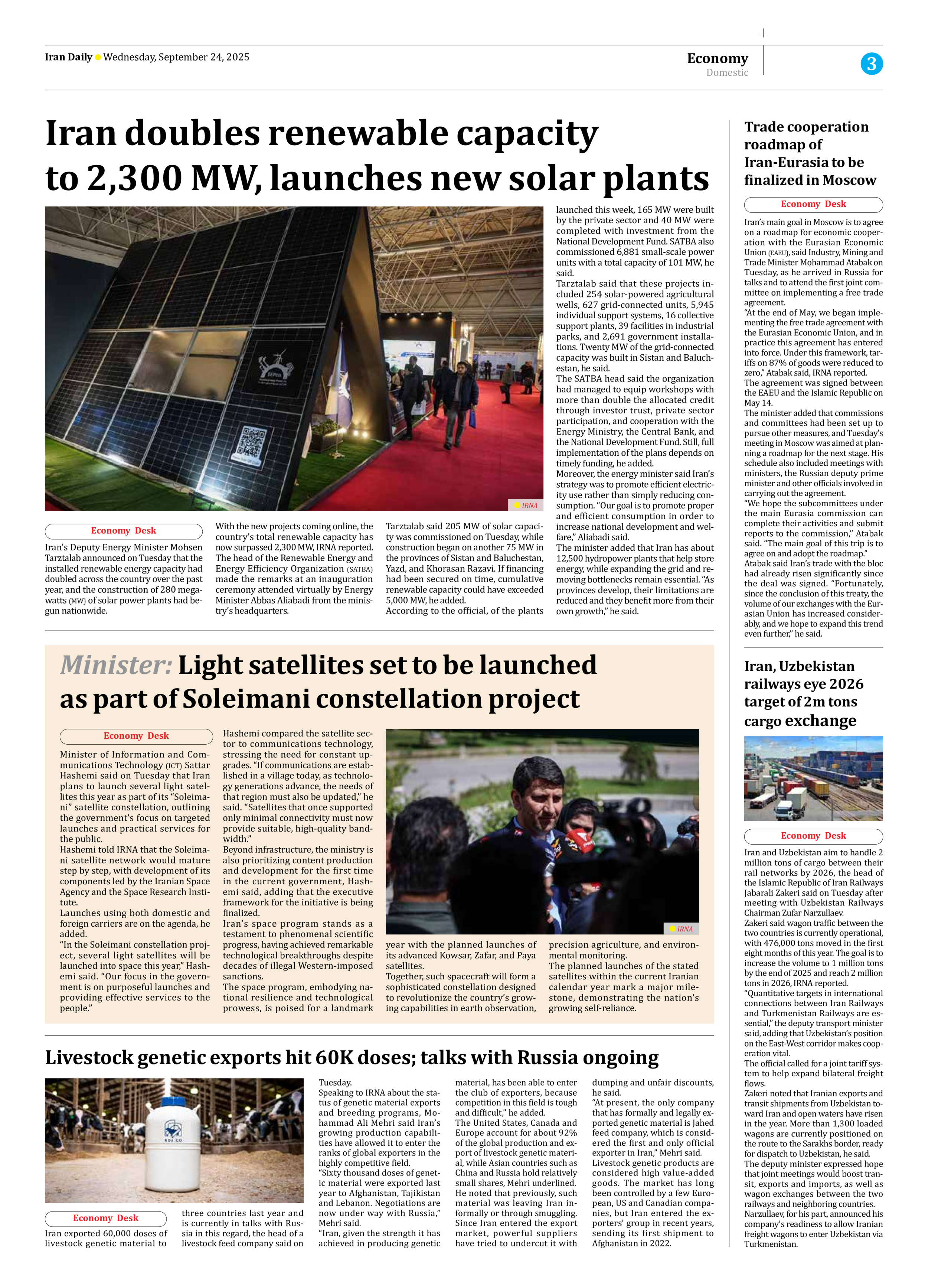


Iran doubles renewable capacity to 2,300 MW, launches new solar plants
Iran’s Deputy Energy Minister Mohsen Tarztalab announced on Tuesday that the installed renewable energy capacity had doubled across the country over the past year, and the construction of 280 megawatts (MW) of solar power plants had begun nationwide.
With the new projects coming online, the country’s total renewable capacity has now surpassed 2,300 MW, IRNA reported.
The head of the Renewable Energy and Energy Efficiency Organization (SATBA) made the remarks at an inauguration ceremony attended virtually by Energy Minister Abbas Aliabadi from the ministry’s headquarters.
Tarztalab said 205 MW of solar capacity was commissioned on Tuesday, while construction began on another 75 MW in the provinces of Sistan and Baluchestan, Yazd, and Khorasan Razavi. If financing had been secured on time, cumulative renewable capacity could have exceeded 5,000 MW, he added.
According to the official, of the plants launched this week, 165 MW were built by the private sector and 40 MW were completed with investment from the National Development Fund. SATBA also commissioned 6,881 small-scale power units with a total capacity of 101 MW, he said.
Tarztalab said that these projects included 254 solar-powered agricultural wells, 627 grid-connected units, 5,945 individual support systems, 16 collective support plants, 39 facilities in industrial parks, and 2,691 government installations. Twenty MW of the grid-connected capacity was built in Sistan and Baluchestan, he said.
The SATBA head said the organization had managed to equip workshops with more than double the allocated credit through investor trust, private sector participation, and cooperation with the Energy Ministry, the Central Bank, and the National Development Fund. Still, full implementation of the plans depends on timely funding, he added.
Moreover, the energy minister said Iran’s strategy was to promote efficient electricity use rather than simply reducing consumption. “Our goal is to promote proper and efficient consumption in order to increase national development and welfare,” Aliabadi said.
The minister added that Iran has about 12,500 hydropower plants that help store energy, while expanding the grid and removing bottlenecks remain essential. “As provinces develop, their limitations are reduced and they benefit more from their own growth,” he said.