







Copy in clipboard...
Araghchi urges E3’s ‘responsible response’ to Iran-IAEA deal
Top security chief says Tehran will accept reasonable, fair proposal
Iran’s Foreign Minister Abbas Araghchi on Tuesday urged a “reciprocal and responsible response” from the European powers to Iran’s recent agreement with the UN nuclear agency to put an end to a dispute over Iran’s nuclear program.
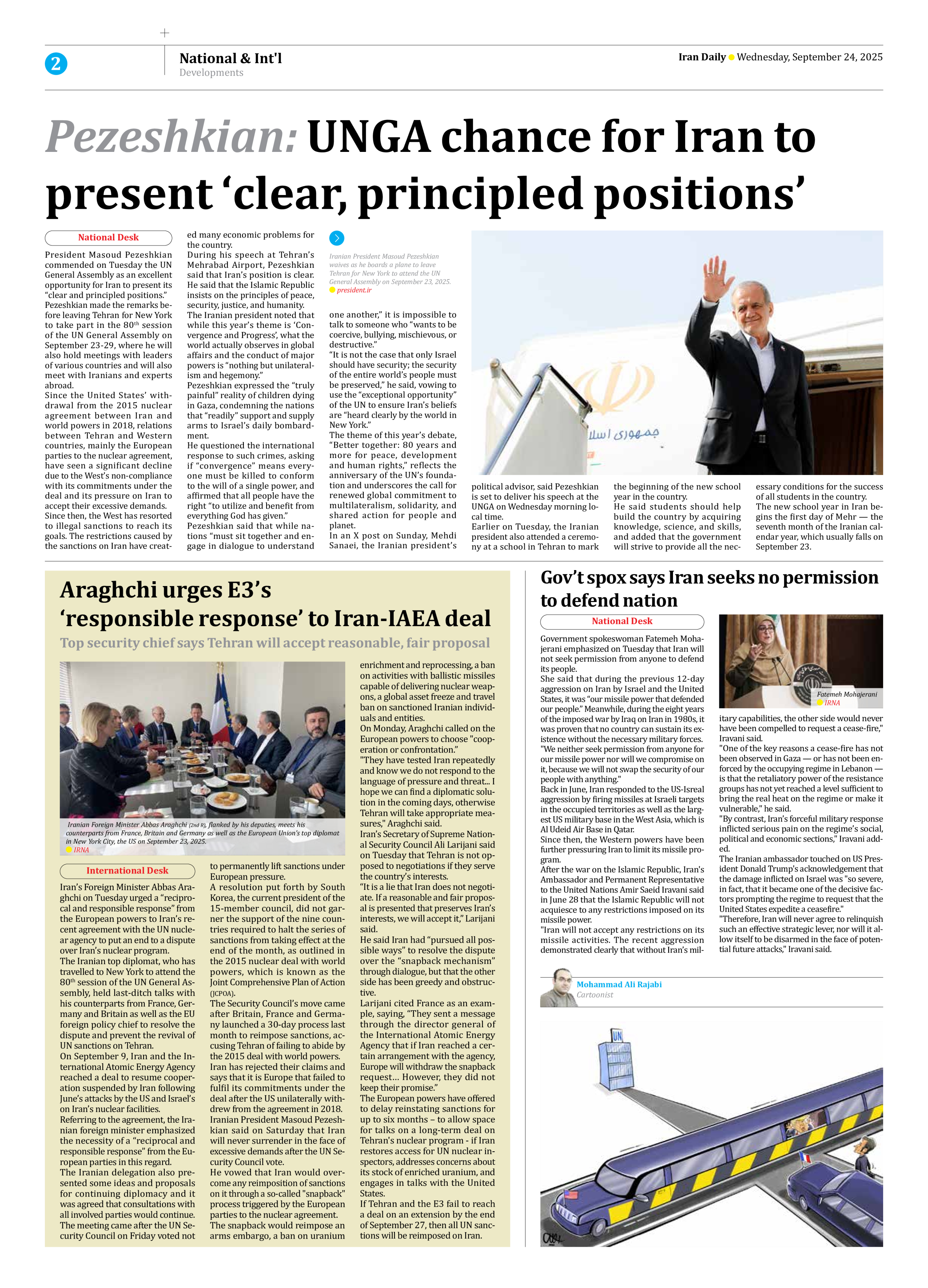
The Iranian top diplomat, who has travelled to New York to attend the 80th session of the UN General Assembly, held last-ditch talks with his counterparts from France, Germany and Britain as well as the EU foreign policy chief to resolve the dispute and prevent the revival of UN sanctions on Tehran.
On September 9, Iran and the International Atomic Energy Agency reached a deal to resume cooperation suspended by Iran following June’s attacks by the US and Israel’s on Iran’s nuclear facilities.
Referring to the agreement, the Iranian foreign minister emphasized the necessity of a “reciprocal and responsible response” from the European parties in this regard.
The Iranian delegation also presented some ideas and proposals for continuing diplomacy and it was agreed that consultations with all involved parties would continue.
The meeting came after the UN Security Council on Friday voted not to permanently lift sanctions under European pressure.
A resolution put forth by South Korea, the current president of the 15-member council, did not garner the support of the nine countries required to halt the series of sanctions from taking effect at the end of the month, as outlined in the 2015 nuclear deal with world powers, which is known as the Joint Comprehensive Plan of Action (JCPOA).
The Security Council’s move came after Britain, France and Germany launched a 30-day process last month to reimpose sanctions, accusing Tehran of failing to abide by the 2015 deal with world powers.
Iran has rejected their claims and says that it is Europe that failed to fulfil its commitments under the deal after the US unilaterally withdrew from the agreement in 2018.
Iranian President Masoud Pezeshkian said on Saturday that Iran will never surrender in the face of excessive demands after the UN Security Council vote.
He vowed that Iran would overcome any reimposition of sanctions on it through a so-called "snapback" process triggered by the European parties to the nuclear agreement.
The snapback would reimpose an arms embargo, a ban on uranium enrichment and reprocessing, a ban on activities with ballistic missiles capable of delivering nuclear weapons, a global asset freeze and travel ban on sanctioned Iranian individuals and entities.
On Monday, Araghchi called on the European powers to choose "cooperation or confrontation.”
"They have tested Iran repeatedly and know we do not respond to the language of pressure and threat... I hope we can find a diplomatic solution in the coming days, otherwise Tehran will take appropriate measures," Araghchi said.
Iran’s Secretary of Supreme National Security Council Ali Larijani said on Tuesday that Tehran is not opposed to negotiations if they serve the country’s interests.
“It is a lie that Iran does not negotiate. If a reasonable and fair proposal is presented that preserves Iran’s interests, we will accept it,” Larijani said.
He said Iran had “pursued all possible ways” to resolve the dispute over the “snapback mechanism” through dialogue, but that the other side has been greedy and obstructive.
Larijani cited France as an example, saying, “They sent a message through the director general of the International Atomic Energy Agency that if Iran reached a certain arrangement with the agency, Europe will withdraw the snapback request… However, they did not keep their promise.”
The European powers have offered to delay reinstating sanctions for up to six months – to allow space for talks on a long-term deal on Tehran's nuclear program - if Iran restores access for UN nuclear inspectors, addresses concerns about its stock of enriched uranium, and engages in talks with the United States.
If Tehran and the E3 fail to reach a deal on an extension by the end of September 27, then all UN sanctions will be reimposed on Iran.