





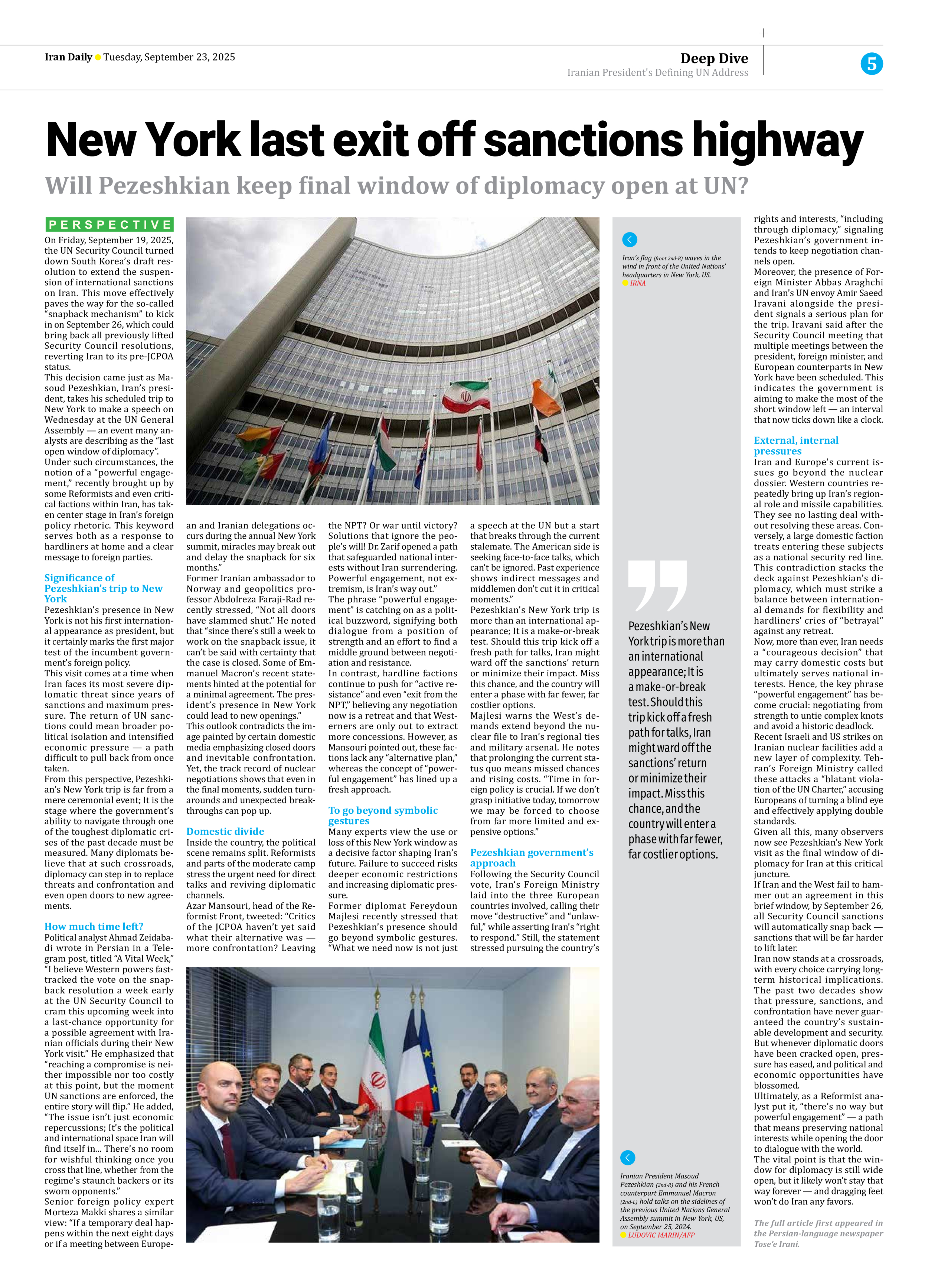


New York last exit off sanctions highway
Will Pezeshkian keep final window of diplomacy open at UN?
On Friday, September 19, 2025, the UN Security Council turned down South Korea’s draft resolution to extend the suspension of international sanctions on Iran. This move effectively paves the way for the so-called “snapback mechanism” to kick in on September 26, which could bring back all previously lifted Security Council resolutions, reverting Iran to its pre-JCPOA status.
This decision came just as Masoud Pezeshkian, Iran’s president, takes his scheduled trip to New York to make a speech on Wednesday at the UN General Assembly — an event many analysts are describing as the “last open window of diplomacy”.
Under such circumstances, the notion of a “powerful engagement,” recently brought up by some Reformists and even critical factions within Iran, has taken center stage in Iran’s foreign policy rhetoric. This keyword serves both as a response to hardliners at home and a clear message to foreign parties.
Significance of Pezeshkian’s trip to New York
Pezeshkian’s presence in New York is not his first international appearance as president, but it certainly marks the first major test of the incumbent government’s foreign policy.
This visit comes at a time when Iran faces its most severe diplomatic threat since years of sanctions and maximum pressure. The return of UN sanctions could mean broader political isolation and intensified economic pressure — a path difficult to pull back from once taken.
From this perspective, Pezeshkian’s New York trip is far from a mere ceremonial event; It is the stage where the government’s ability to navigate through one of the toughest diplomatic crises of the past decade must be measured. Many diplomats believe that at such crossroads, diplomacy can step in to replace threats and confrontation and even open doors to new agreements.
How much time left?
Political analyst Ahmad Zeidabadi wrote in Persian in a Telegram post, titled “A Vital Week,” “I believe Western powers fast-tracked the vote on the snapback resolution a week early at the UN Security Council to cram this upcoming week into a last-chance opportunity for a possible agreement with Iranian officials during their New York visit.” He emphasized that “reaching a compromise is neither impossible nor too costly at this point, but the moment UN sanctions are enforced, the entire story will flip.” He added, “The issue isn’t just economic repercussions; It’s the political and international space Iran will find itself in... There’s no room for wishful thinking once you cross that line, whether from the regime’s staunch backers or its sworn opponents.”
Senior foreign policy expert Morteza Makki shares a similar view: “If a temporary deal happens within the next eight days or if a meeting between European and Iranian delegations occurs during the annual New York summit, miracles may break out and delay the snapback for six months.”
Former Iranian ambassador to Norway and geopolitics professor Abdolreza Faraji-Rad recently stressed, “Not all doors have slammed shut.” He noted that “since there’s still a week to work on the snapback issue, it can’t be said with certainty that the case is closed. Some of Emmanuel Macron’s recent statements hinted at the potential for a minimal agreement. The president’s presence in New York could lead to new openings.”
This outlook contradicts the image painted by certain domestic media emphasizing closed doors and inevitable confrontation. Yet, the track record of nuclear negotiations shows that even in the final moments, sudden turnarounds and unexpected breakthroughs can pop up.
Domestic divide
Inside the country, the political scene remains split. Reformists and parts of the moderate camp stress the urgent need for direct talks and reviving diplomatic channels.
Azar Mansouri, head of the Reformist Front, tweeted: “Critics of the JCPOA haven’t yet said what their alternative was — more confrontation? Leaving the NPT? Or war until victory? Solutions that ignore the people’s will! Dr. Zarif opened a path that safeguarded national interests without Iran surrendering. Powerful engagement, not extremism, is Iran’s way out.”
The phrase “powerful engagement” is catching on as a political buzzword, signifying both dialogue from a position of strength and an effort to find a middle ground between negotiation and resistance.
In contrast, hardline factions continue to push for “active resistance” and even “exit from the NPT,” believing any negotiation now is a retreat and that Westerners are only out to extract more concessions. However, as Mansouri pointed out, these factions lack any “alternative plan,” whereas the concept of “powerful engagement” has lined up a fresh approach.
To go beyond symbolic gestures
Many experts view the use or loss of this New York window as a decisive factor shaping Iran’s future. Failure to succeed risks deeper economic restrictions and increasing diplomatic pressure.
Former diplomat Fereydoun Majlesi recently stressed that Pezeshkian’s presence should go beyond symbolic gestures. “What we need now is not just a speech at the UN but a start that breaks through the current stalemate. The American side is seeking face-to-face talks, which can’t be ignored. Past experience shows indirect messages and middlemen don’t cut it in critical moments.”
Pezeshkian’s New York trip is more than an international appearance; It is a make-or-break test. Should this trip kick off a fresh path for talks, Iran might ward off the sanctions’ return or minimize their impact. Miss this chance, and the country will enter a phase with far fewer, far costlier options.
Majlesi warns the West’s demands extend beyond the nuclear file to Iran’s regional ties and military arsenal. He notes that prolonging the current status quo means missed chances and rising costs. “Time in foreign policy is crucial. If we don’t grasp initiative today, tomorrow we may be forced to choose from far more limited and expensive options.”
Pezeshkian government’s approach
Following the Security Council vote, Iran’s Foreign Ministry laid into the three European countries involved, calling their move “destructive” and “unlawful,” while asserting Iran’s “right to respond.” Still, the statement stressed pursuing the country’s rights and interests, “including through diplomacy,” signaling Pezeshkian’s government intends to keep negotiation channels open.
Moreover, the presence of Foreign Minister Abbas Araghchi and Iran’s UN envoy Amir Saeed Iravani alongside the president signals a serious plan for the trip. Iravani said after the Security Council meeting that multiple meetings between the president, foreign minister, and European counterparts in New York have been scheduled. This indicates the government is aiming to make the most of the short window left — an interval that now ticks down like a clock.
External, internal pressures
Iran and Europe’s current issues go beyond the nuclear dossier. Western countries repeatedly bring up Iran’s regional role and missile capabilities. They see no lasting deal without resolving these areas. Conversely, a large domestic faction treats entering these subjects as a national security red line. This contradiction stacks the deck against Pezeshkian’s diplomacy, which must strike a balance between international demands for flexibility and hardliners’ cries of “betrayal” against any retreat.
Now, more than ever, Iran needs a “courageous decision” that may carry domestic costs but ultimately serves national interests. Hence, the key phrase “powerful engagement” has become crucial: negotiating from strength to untie complex knots and avoid a historic deadlock.
Recent Israeli and US strikes on Iranian nuclear facilities add a new layer of complexity. Tehran’s Foreign Ministry called these attacks a “blatant violation of the UN Charter,” accusing Europeans of turning a blind eye and effectively applying double standards.
Given all this, many observers now see Pezeshkian’s New York visit as the final window of diplomacy for Iran at this critical juncture.
If Iran and the West fail to hammer out an agreement in this brief window, by September 26, all Security Council sanctions will automatically snap back — sanctions that will be far harder to lift later.
Iran now stands at a crossroads, with every choice carrying long-term historical implications. The past two decades show that pressure, sanctions, and confrontation have never guaranteed the country’s sustainable development and security. But whenever diplomatic doors have been cracked open, pressure has eased, and political and economic opportunities have blossomed.
Ultimately, as a Reformist analyst put it, “there’s no way but powerful engagement” — a path that means preserving national interests while opening the door to dialogue with the world.
The vital point is that the window for diplomacy is still wide open, but it likely won’t stay that way forever — and dragging feet won’t do Iran any favors.
The full article first appeared in the Persian-language newspaper Tose’e Irani.