





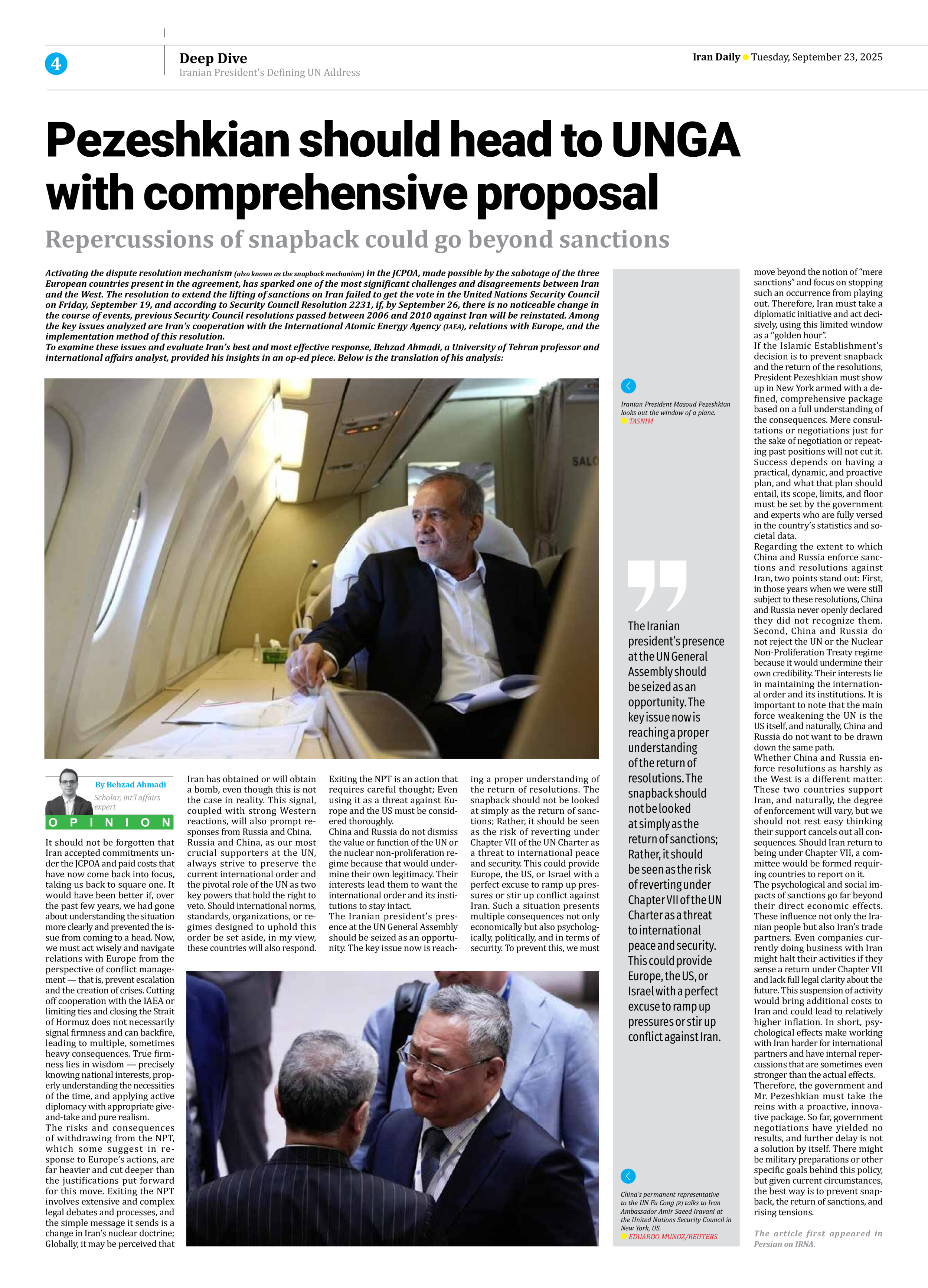


Pezeshkian should head to UNGA with comprehensive proposal
Repercussions of snapback could go beyond sanctions
Activating the dispute resolution mechanism (also known as the snapback mechanism) in the JCPOA, made possible by the sabotage of the three European countries present in the agreement, has sparked one of the most significant challenges and disagreements between Iran and the West. The resolution to extend the lifting of sanctions on Iran failed to get the vote in the United Nations Security Council on Friday, September 19, and according to Security Council Resolution 2231, if, by September 26, there is no noticeable change in the course of events, previous Security Council resolutions passed between 2006 and 2010 against Iran will be reinstated. Among the key issues analyzed are Iran’s cooperation with the International Atomic Energy Agency (IAEA), relations with Europe, and the implementation method of this resolution. To examine these issues and evaluate Iran’s best and most effective response, Behzad Ahmadi, a University of Tehran professor and international affairs analyst, provided his insights in an op-ed piece. Below is the translation of his analysis:
By Behzad Ahmadi
Scholar, int’l affairs expert
It should not be forgotten that Iran accepted commitments under the JCPOA and paid costs that have now come back into focus, taking us back to square one. It would have been better if, over the past few years, we had gone about understanding the situation more clearly and prevented the issue from coming to a head. Now, we must act wisely and navigate relations with Europe from the perspective of conflict management — that is, prevent escalation and the creation of crises. Cutting off cooperation with the IAEA or limiting ties and closing the Strait of Hormuz does not necessarily signal firmness and can backfire, leading to multiple, sometimes heavy consequences. True firmness lies in wisdom — precisely knowing national interests, properly understanding the necessities of the time, and applying active diplomacy with appropriate give-and-take and pure realism.
The risks and consequences of withdrawing from the NPT, which some suggest in response to Europe’s actions, are far heavier and cut deeper than the justifications put forward for this move. Exiting the NPT involves extensive and complex legal debates and processes, and the simple message it sends is a change in Iran’s nuclear doctrine; Globally, it may be perceived that Iran has obtained or will obtain a bomb, even though this is not the case in reality. This signal, coupled with strong Western reactions, will also prompt responses from Russia and China.
Russia and China, as our most crucial supporters at the UN, always strive to preserve the current international order and the pivotal role of the UN as two key powers that hold the right to veto. Should international norms, standards, organizations, or regimes designed to uphold this order be set aside, in my view, these countries will also respond. Exiting the NPT is an action that requires careful thought; Even using it as a threat against Europe and the US must be considered thoroughly.
China and Russia do not dismiss the value or function of the UN or the nuclear non-proliferation regime because that would undermine their own legitimacy. Their interests lead them to want the international order and its institutions to stay intact.
The Iranian president’s presence at the UN General Assembly should be seized as an opportunity. The key issue now is reaching a proper understanding of the return of resolutions. The snapback should not be looked at simply as the return of sanctions; Rather, it should be seen as the risk of reverting under Chapter VII of the UN Charter as a threat to international peace and security. This could provide Europe, the US, or Israel with a perfect excuse to ramp up pressures or stir up conflict against Iran. Such a situation presents multiple consequences not only economically but also psychologically, politically, and in terms of security. To prevent this, we must move beyond the notion of “mere sanctions” and focus on stopping such an occurrence from playing out. Therefore, Iran must take a diplomatic initiative and act decisively, using this limited window as a “golden hour”.
If the Islamic Establishment’s decision is to prevent snapback and the return of the resolutions, President Pezeshkian must show up in New York armed with a defined, comprehensive package based on a full understanding of the consequences. Mere consultations or negotiations just for the sake of negotiation or repeating past positions will not cut it. Success depends on having a practical, dynamic, and proactive plan, and what that plan should entail, its scope, limits, and floor must be set by the government and experts who are fully versed in the country’s statistics and societal data.
Regarding the extent to which China and Russia enforce sanctions and resolutions against Iran, two points stand out: First, in those years when we were still subject to these resolutions, China and Russia never openly declared they did not recognize them. Second, China and Russia do not reject the UN or the Nuclear Non-Proliferation Treaty regime because it would undermine their own credibility. Their interests lie in maintaining the international order and its institutions. It is important to note that the main force weakening the UN is the US itself, and naturally, China and Russia do not want to be drawn down the same path.
Whether China and Russia enforce resolutions as harshly as the West is a different matter. These two countries support Iran, and naturally, the degree of enforcement will vary, but we should not rest easy thinking their support cancels out all consequences. Should Iran return to being under Chapter VII, a committee would be formed requiring countries to report on it.
The psychological and social impacts of sanctions go far beyond their direct economic effects. These influence not only the Iranian people but also Iran’s trade partners. Even companies currently doing business with Iran might halt their activities if they sense a return under Chapter VII and lack full legal clarity about the future. This suspension of activity would bring additional costs to Iran and could lead to relatively higher inflation. In short, psychological effects make working with Iran harder for international partners and have internal repercussions that are sometimes even stronger than the actual effects.
Therefore, the government and Mr. Pezeshkian must take the reins with a proactive, innovative package. So far, government negotiations have yielded no results, and further delay is not a solution by itself. There might be military preparations or other specific goals behind this policy, but given current circumstances, the best way is to prevent snapback, the return of sanctions, and rising tensions.
The article first appeared in
Persian on IRNA.