





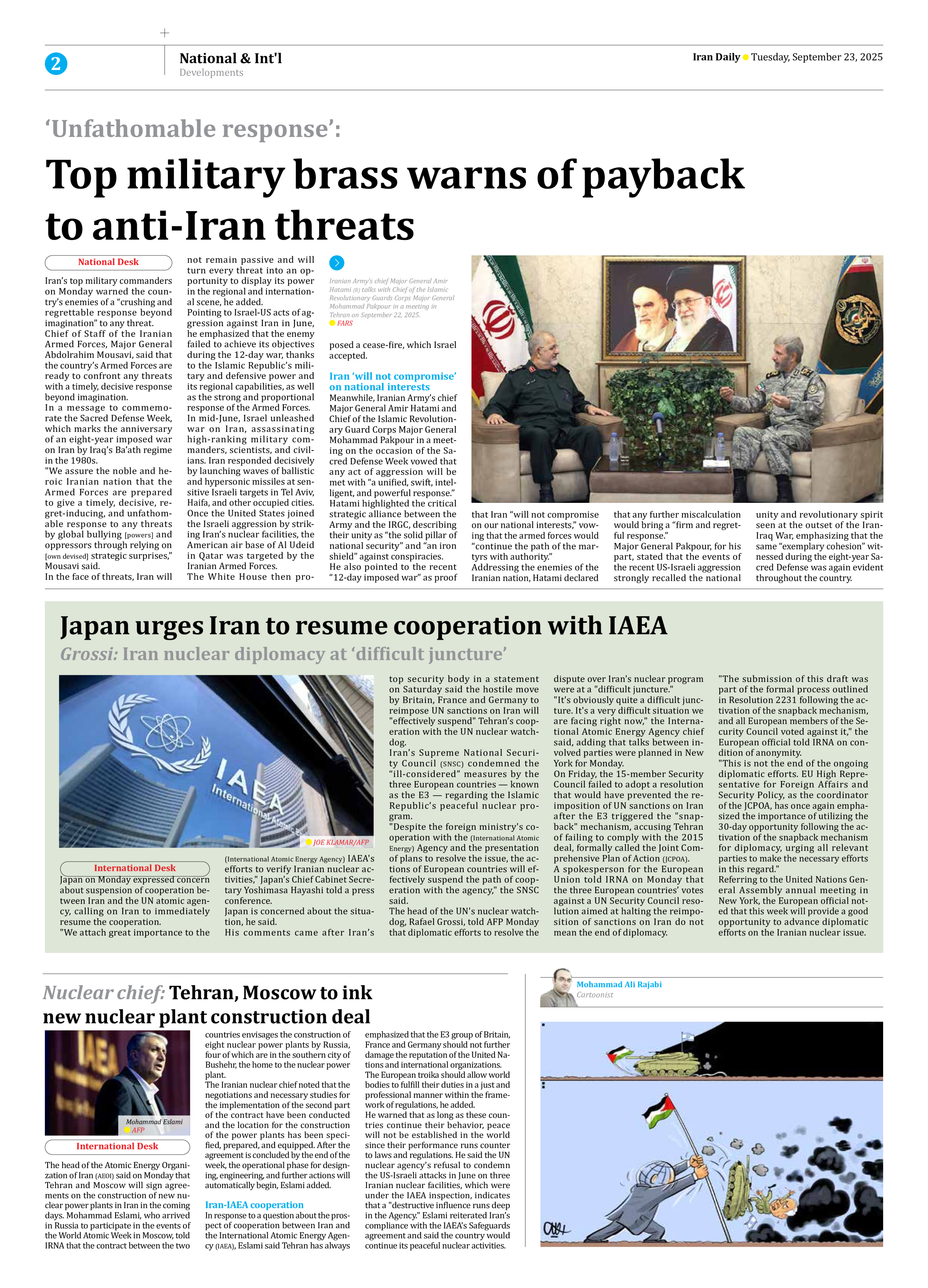


Japan urges Iran to resume cooperation with IAEA
Grossi: Iran nuclear diplomacy at ‘difficult juncture’
Japan on Monday expressed concern about suspension of cooperation between Iran and the UN atomic agency, calling on Iran to immediately resume the cooperation.
"We attach great importance to the (International Atomic Energy Agency) IAEA's efforts to verify Iranian nuclear activities," Japan’s Chief Cabinet Secretary Yoshimasa Hayashi told a press conference.
Japan is concerned about the situation, he said.
His comments came after Iran’s top security body in a statement on Saturday said the hostile move by Britain, France and Germany to reimpose UN sanctions on Iran will "effectively suspend" Tehran’s cooperation with the UN nuclear watchdog.
Iran’s Supreme National Security Council (SNSC) condemned the “ill-considered” measures by the three European countries — known as the E3 — regarding the Islamic Republic’s peaceful nuclear program.
"Despite the foreign ministry's cooperation with the (International Atomic Energy) Agency and the presentation of plans to resolve the issue, the actions of European countries will effectively suspend the path of cooperation with the agency," the SNSC said.
The head of the UN's nuclear watchdog, Rafael Grossi, told AFP Monday that diplomatic efforts to resolve the dispute over Iran's nuclear program were at a "difficult juncture."
"It's obviously quite a difficult juncture. It's a very difficult situation we are facing right now," the International Atomic Energy Agency chief said, adding that talks between involved parties were planned in New York for Monday.
On Friday, the 15-member Security Council failed to adopt a resolution that would have prevented the reimposition of UN sanctions on Iran after the E3 triggered the "snapback" mechanism, accusing Tehran of failing to comply with the 2015 deal, formally called the Joint Comprehensive Plan of Action (JCPOA).
A spokesperson for the European Union told IRNA on Monday that the three European countries’ votes against a UN Security Council resolution aimed at halting the reimposition of sanctions on Iran do not mean the end of diplomacy.
"The submission of this draft was part of the formal process outlined in Resolution 2231 following the activation of the snapback mechanism, and all European members of the Security Council voted against it," the European official told IRNA on condition of anonymity.
"This is not the end of the ongoing diplomatic efforts. EU High Representative for Foreign Affairs and Security Policy, as the coordinator of the JCPOA, has once again emphasized the importance of utilizing the 30-day opportunity following the activation of the snapback mechanism for diplomacy, urging all relevant parties to make the necessary efforts in this regard."
Referring to the United Nations General Assembly annual meeting in New York, the European official noted that this week will provide a good opportunity to advance diplomatic efforts on the Iranian nuclear issue.