





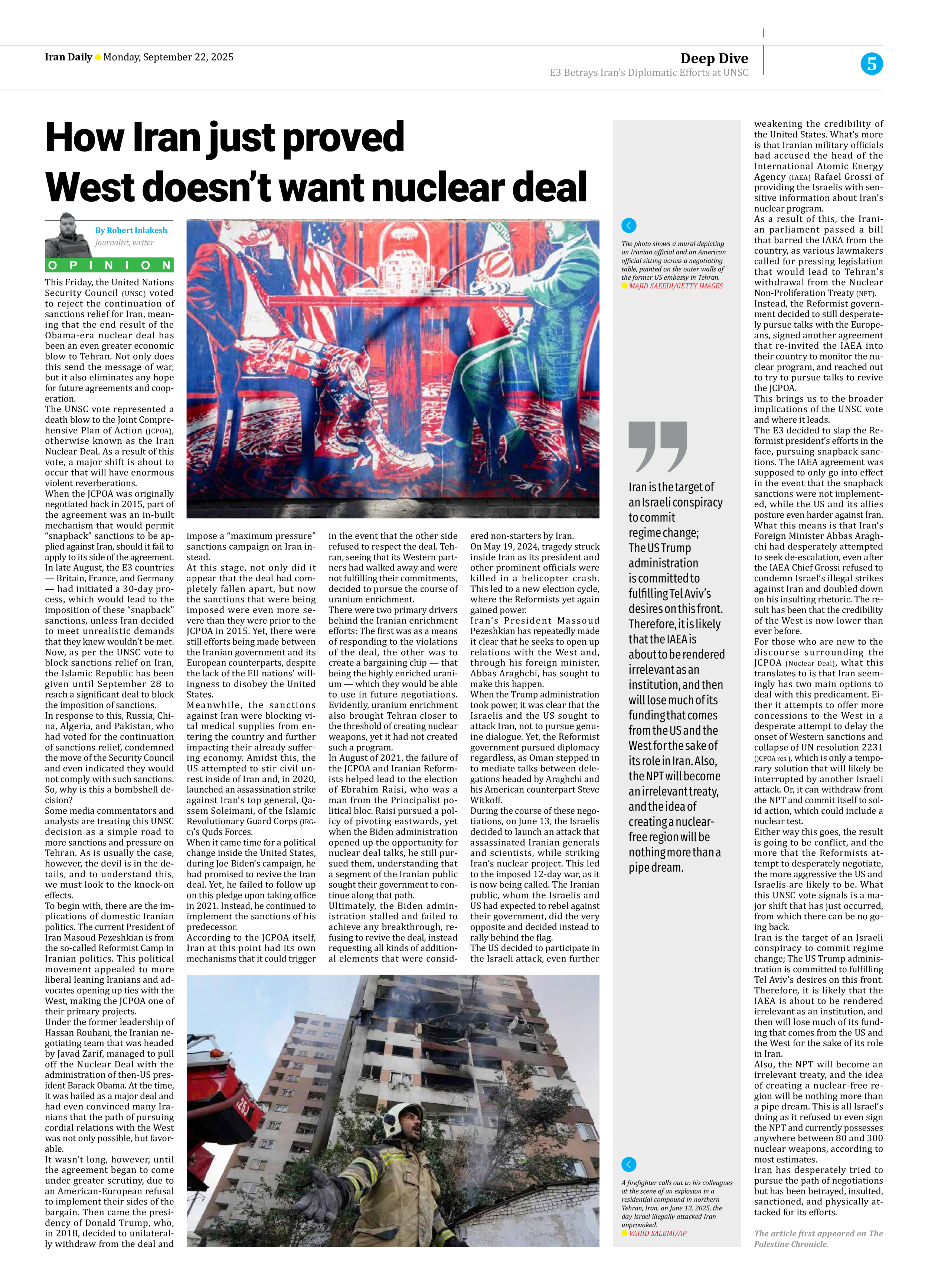


How Iran just proved West doesn’t want nuclear deal
By Robert Inlakesh
Journalist, writer
This Friday, the United Nations Security Council (UNSC) voted to reject the continuation of sanctions relief for Iran, meaning that the end result of the Obama-era nuclear deal has been an even greater economic blow to Tehran. Not only does this send the message of war, but it also eliminates any hope for future agreements and cooperation.
The UNSC vote represented a death blow to the Joint Comprehensive Plan of Action (JCPOA), otherwise known as the Iran Nuclear Deal. As a result of this vote, a major shift is about to occur that will have enormous violent reverberations.
When the JCPOA was originally negotiated back in 2015, part of the agreement was an in-built mechanism that would permit “snapback” sanctions to be applied against Iran, should it fail to apply to its side of the agreement.
In late August, the E3 countries — Britain, France, and Germany — had initiated a 30-day process, which would lead to the imposition of these “snapback” sanctions, unless Iran decided to meet unrealistic demands that they knew wouldn’t be met. Now, as per the UNSC vote to block sanctions relief on Iran, the Islamic Republic has been given until September 28 to reach a significant deal to block the imposition of sanctions.
In response to this, Russia, China, Algeria, and Pakistan, who had voted for the continuation of sanctions relief, condemned the move of the Security Council and even indicated they would not comply with such sanctions.
So, why is this a bombshell decision?
Some media commentators and analysts are treating this UNSC decision as a simple road to more sanctions and pressure on Tehran. As is usually the case, however, the devil is in the details, and to understand this, we must look to the knock-on effects.
To begin with, there are the implications of domestic Iranian politics. The current President of Iran Masoud Pezeshkian is from the so-called Reformist Camp in Iranian politics. This political movement appealed to more liberal leaning Iranians and advocates opening up ties with the West, making the JCPOA one of their primary projects.
Under the former leadership of Hassan Rouhani, the Iranian negotiating team that was headed by Javad Zarif, managed to pull off the Nuclear Deal with the administration of then-US president Barack Obama. At the time, it was hailed as a major deal and had even convinced many Iranians that the path of pursuing cordial relations with the West was not only possible, but favorable.
It wasn’t long, however, until the agreement began to come under greater scrutiny, due to an American-European refusal to implement their sides of the bargain. Then came the presidency of Donald Trump, who, in 2018, decided to unilaterally withdraw from the deal and impose a “maximum pressure” sanctions campaign on Iran instead.
At this stage, not only did it appear that the deal had completely fallen apart, but now the sanctions that were being imposed were even more severe than they were prior to the JCPOA in 2015. Yet, there were still efforts being made between the Iranian government and its European counterparts, despite the lack of the EU nations’ willingness to disobey the United States.
Meanwhile, the sanctions against Iran were blocking vital medical supplies from entering the country and further impacting their already suffering economy. Amidst this, the US attempted to stir civil unrest inside of Iran and, in 2020, launched an assassination strike against Iran’s top general, Qassem Soleimani, of the Islamic Revolutionary Guard Corps (IRGC)’s Quds Forces.
When it came time for a political change inside the United States, during Joe Biden’s campaign, he had promised to revive the Iran deal. Yet, he failed to follow up on this pledge upon taking office in 2021. Instead, he continued to implement the sanctions of his predecessor.
According to the JCPOA itself, Iran at this point had its own mechanisms that it could trigger in the event that the other side refused to respect the deal. Tehran, seeing that its Western partners had walked away and were not fulfilling their commitments, decided to pursue the course of uranium enrichment.
There were two primary drivers behind the Iranian enrichment efforts: The first was as a means of responding to the violations of the deal, the other was to create a bargaining chip — that being the highly enriched uranium — which they would be able to use in future negotiations. Evidently, uranium enrichment also brought Tehran closer to the threshold of creating nuclear weapons, yet it had not created such a program.
In August of 2021, the failure of the JCPOA and Iranian Reformists helped lead to the election of Ebrahim Raisi, who was a man from the Principalist political bloc. Raisi pursued a policy of pivoting eastwards, yet when the Biden administration opened up the opportunity for nuclear deal talks, he still pursued them, understanding that a segment of the Iranian public sought their government to continue along that path.
Ultimately, the Biden administration stalled and failed to achieve any breakthrough, refusing to revive the deal, instead requesting all kinds of additional elements that were considered non-starters by Iran.
On May 19, 2024, tragedy struck inside Iran as its president and other prominent officials were killed in a helicopter crash. This led to a new election cycle, where the Reformists yet again gained power.
Iran’s President Massoud Pezeshkian has repeatedly made it clear that he seeks to open up relations with the West and, through his foreign minister, Abbas Araghchi, has sought to make this happen.
When the Trump administration took power, it was clear that the Israelis and the US sought to attack Iran, not to pursue genuine dialogue. Yet, the Reformist government pursued diplomacy regardless, as Oman stepped in to mediate talks between delegations headed by Araghchi and his American counterpart Steve Witkoff.
During the course of these negotiations, on June 13, the Israelis decided to launch an attack that assassinated Iranian generals and scientists, while striking Iran’s nuclear project. This led to the imposed 12-day war, as it is now being called. The Iranian public, whom the Israelis and US had expected to rebel against their government, did the very opposite and decided instead to rally behind the flag.
The US decided to participate in the Israeli attack, even further weakening the credibility of the United States. What’s more is that Iranian military officials had accused the head of the International Atomic Energy Agency (IAEA) Rafael Grossi of providing the Israelis with sensitive information about Iran’s nuclear program.
As a result of this, the Iranian parliament passed a bill that barred the IAEA from the country, as various lawmakers called for pressing legislation that would lead to Tehran’s withdrawal from the Nuclear Non-Proliferation Treaty (NPT).
Instead, the Reformist government decided to still desperately pursue talks with the Europeans, signed another agreement that re-invited the IAEA into their country to monitor the nuclear program, and reached out to try to pursue talks to revive the JCPOA.
This brings us to the broader implications of the UNSC vote and where it leads.
The E3 decided to slap the Reformist president’s efforts in the face, pursuing snapback sanctions. The IAEA agreement was supposed to only go into effect in the event that the snapback sanctions were not implemented, while the US and its allies posture even harder against Iran.
What this means is that Iran’s Foreign Minister Abbas Araghchi had desperately attempted to seek de-escalation, even after the IAEA Chief Grossi refused to condemn Israel’s illegal strikes against Iran and doubled down on his insulting rhetoric. The result has been that the credibility of the West is now lower than ever before.
For those who are new to the discourse surrounding the JCPOA (Nuclear Deal), what this translates to is that Iran seemingly has two main options to deal with this predicament. Either it attempts to offer more concessions to the West in a desperate attempt to delay the onset of Western sanctions and collapse of UN resolution 2231 (JCPOA res.), which is only a temporary solution that will likely be interrupted by another Israeli attack. Or, it can withdraw from the NPT and commit itself to solid action, which could include a nuclear test.
Either way this goes, the result is going to be conflict, and the more that the Reformists attempt to desperately negotiate, the more aggressive the US and Israelis are likely to be. What this UNSC vote signals is a major shift that has just occurred, from which there can be no going back.
Iran is the target of an Israeli conspiracy to commit regime change; The US Trump administration is committed to fulfilling Tel Aviv’s desires on this front. Therefore, it is likely that the IAEA is about to be rendered irrelevant as an institution, and then will lose much of its funding that comes from the US and the West for the sake of its role in Iran.
Also, the NPT will become an irrelevant treaty, and the idea of creating a nuclear-free region will be nothing more than a pipe dream. This is all Israel’s doing as it refused to even sign the NPT and currently possesses anywhere between 80 and 300 nuclear weapons, according to most estimates.
Iran has desperately tried to pursue the path of negotiations but has been betrayed, insulted, sanctioned, and physically attacked for its efforts.
The article first appeared on The Palestine Chronicle.