





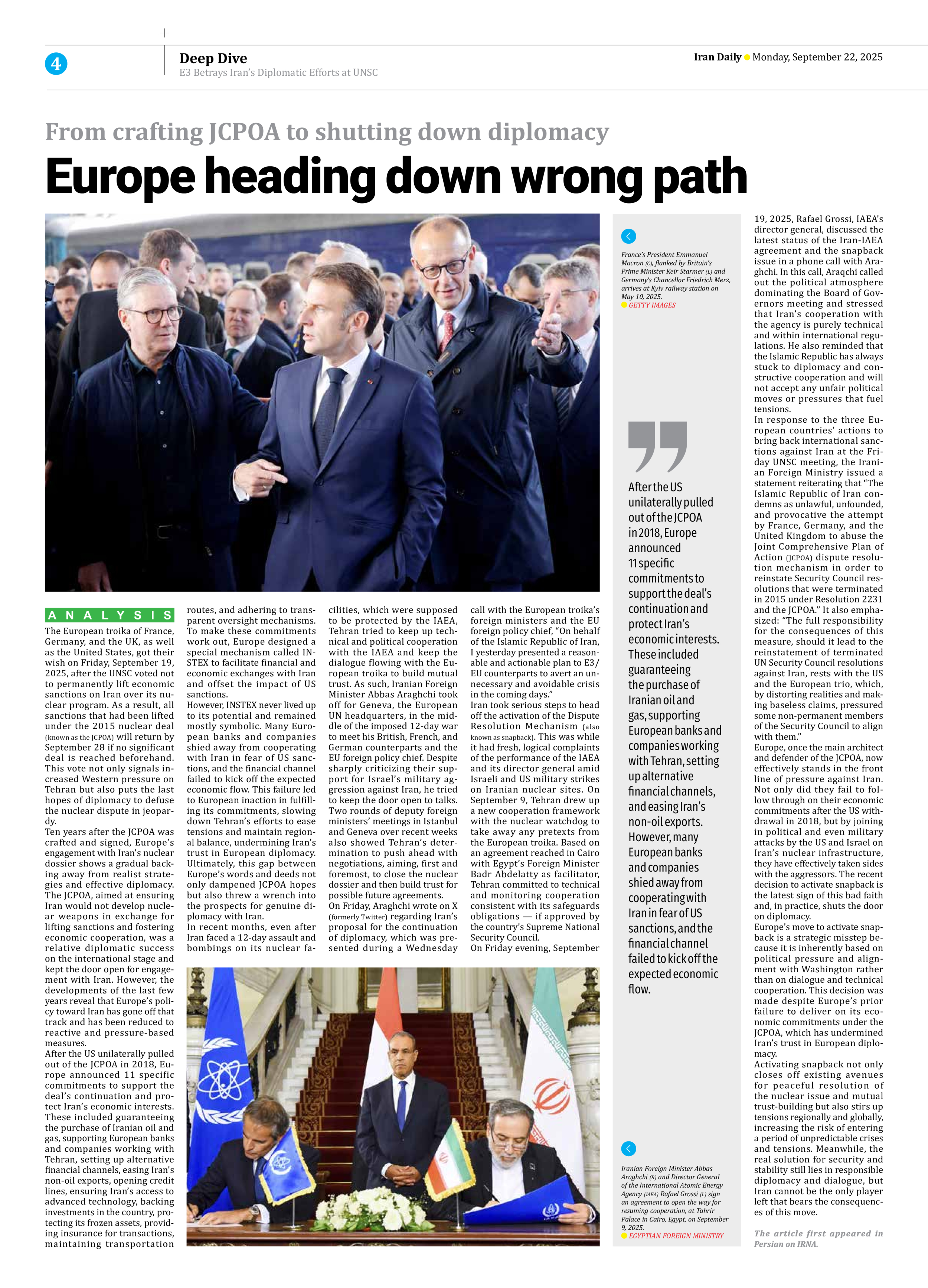


From crafting JCPOA to shutting down diplomacy
Europe heading down wrong path
The European troika of France, Germany, and the UK, as well as the United States, got their wish on Friday, September 19, 2025, after the UNSC voted not to permanently lift economic sanctions on Iran over its nuclear program. As a result, all sanctions that had been lifted under the 2015 nuclear deal (known as the JCPOA) will return by September 28 if no significant deal is reached beforehand. This vote not only signals increased Western pressure on Tehran but also puts the last hopes of diplomacy to defuse the nuclear dispute in jeopardy.
Ten years after the JCPOA was crafted and signed, Europe’s engagement with Iran’s nuclear dossier shows a gradual backing away from realist strategies and effective diplomacy. The JCPOA, aimed at ensuring Iran would not develop nuclear weapons in exchange for lifting sanctions and fostering economic cooperation, was a relative diplomatic success on the international stage and kept the door open for engagement with Iran. However, the developments of the last few years reveal that Europe’s policy toward Iran has gone off that track and has been reduced to reactive and pressure-based measures.
After the US unilaterally pulled out of the JCPOA in 2018, Europe announced 11 specific commitments to support the deal’s continuation and protect Iran’s economic interests. These included guaranteeing the purchase of Iranian oil and gas, supporting European banks and companies working with Tehran, setting up alternative financial channels, easing Iran’s non-oil exports, opening credit lines, ensuring Iran’s access to advanced technology, backing investments in the country, protecting its frozen assets, providing insurance for transactions, maintaining transportation routes, and adhering to transparent oversight mechanisms. To make these commitments work out, Europe designed a special mechanism called INSTEX to facilitate financial and economic exchanges with Iran and offset the impact of US sanctions.
However, INSTEX never lived up to its potential and remained mostly symbolic. Many European banks and companies shied away from cooperating with Iran in fear of US sanctions, and the financial channel failed to kick off the expected economic flow. This failure led to European inaction in fulfilling its commitments, slowing down Tehran’s efforts to ease tensions and maintain regional balance, undermining Iran’s trust in European diplomacy. Ultimately, this gap between Europe’s words and deeds not only dampened JCPOA hopes but also threw a wrench into the prospects for genuine diplomacy with Iran.
In recent months, even after Iran faced a 12-day assault and bombings on its nuclear facilities, which were supposed to be protected by the IAEA, Tehran tried to keep up technical and political cooperation with the IAEA and keep the dialogue flowing with the European troika to build mutual trust. As such, Iranian Foreign Minister Abbas Araghchi took off for Geneva, the European UN headquarters, in the middle of the imposed 12-day war to meet his British, French, and German counterparts and the EU foreign policy chief. Despite sharply criticizing their support for Israel’s military aggression against Iran, he tried to keep the door open to talks. Two rounds of deputy foreign ministers’ meetings in Istanbul and Geneva over recent weeks also showed Tehran’s determination to push ahead with negotiations, aiming, first and foremost, to close the nuclear dossier and then build trust for possible future agreements.
On Friday, Araghchi wrote on X (formerly Twitter) regarding Iran’s proposal for the continuation of diplomacy, which was presented during a Wednesday call with the European troika’s foreign ministers and the EU foreign policy chief, “On behalf of the Islamic Republic of Iran, I yesterday presented a reasonable and actionable plan to E3/EU counterparts to avert an unnecessary and avoidable crisis in the coming days.”
Iran took serious steps to head off the activation of the Dispute Resolution Mechanism (also known as snapback). This was while it had fresh, logical complaints of the performance of the IAEA and its director general amid Israeli and US military strikes on Iranian nuclear sites. On September 9, Tehran drew up a new cooperation framework with the nuclear watchdog to take away any pretexts from the European troika. Based on an agreement reached in Cairo with Egypt’s Foreign Minister Badr Abdelatty as facilitator, Tehran committed to technical and monitoring cooperation consistent with its safeguards obligations — if approved by the country’s Supreme National Security Council.
On Friday evening, September 19, 2025, Rafael Grossi, IAEA’s director general, discussed the latest status of the Iran-IAEA agreement and the snapback issue in a phone call with Araghchi. In this call, Araqchi called out the political atmosphere dominating the Board of Governors meeting and stressed that Iran’s cooperation with the agency is purely technical and within international regulations. He also reminded that the Islamic Republic has always stuck to diplomacy and constructive cooperation and will not accept any unfair political moves or pressures that fuel tensions.
In response to the three European countries’ actions to bring back international sanctions against Iran at the Friday UNSC meeting, the Iranian Foreign Ministry issued a statement reiterating that “The Islamic Republic of Iran condemns as unlawful, unfounded, and provocative the attempt by France, Germany, and the United Kingdom to abuse the Joint Comprehensive Plan of Action (JCPOA) dispute resolution mechanism in order to reinstate Security Council resolutions that were terminated in 2015 under Resolution 2231 and the JCPOA.” It also emphasized: “The full responsibility for the consequences of this measure, should it lead to the reinstatement of terminated UN Security Council resolutions against Iran, rests with the US and the European trio, which, by distorting realities and making baseless claims, pressured some non-permanent members of the Security Council to align with them.”
Europe, once the main architect and defender of the JCPOA, now effectively stands in the front line of pressure against Iran. Not only did they fail to follow through on their economic commitments after the US withdrawal in 2018, but by joining in political and even military attacks by the US and Israel on Iran’s nuclear infrastructure, they have effectively taken sides with the aggressors. The recent decision to activate snapback is the latest sign of this bad faith and, in practice, shuts the door on diplomacy.
Europe’s move to activate snapback is a strategic misstep because it is inherently based on political pressure and alignment with Washington rather than on dialogue and technical cooperation. This decision was made despite Europe’s prior failure to deliver on its economic commitments under the JCPOA, which has undermined Iran’s trust in European diplomacy.
Activating snapback not only closes off existing avenues for peaceful resolution of the nuclear issue and mutual trust-building but also stirs up tensions regionally and globally, increasing the risk of entering a period of unpredictable crises and tensions. Meanwhile, the real solution for security and stability still lies in responsible diplomacy and dialogue, but Iran cannot be the only player left that bears the consequences of this move.
The article first appeared in
Persian on IRNA.