







Copy in clipboard...
Asiatic cheetah conservation plan revived after six-year pause
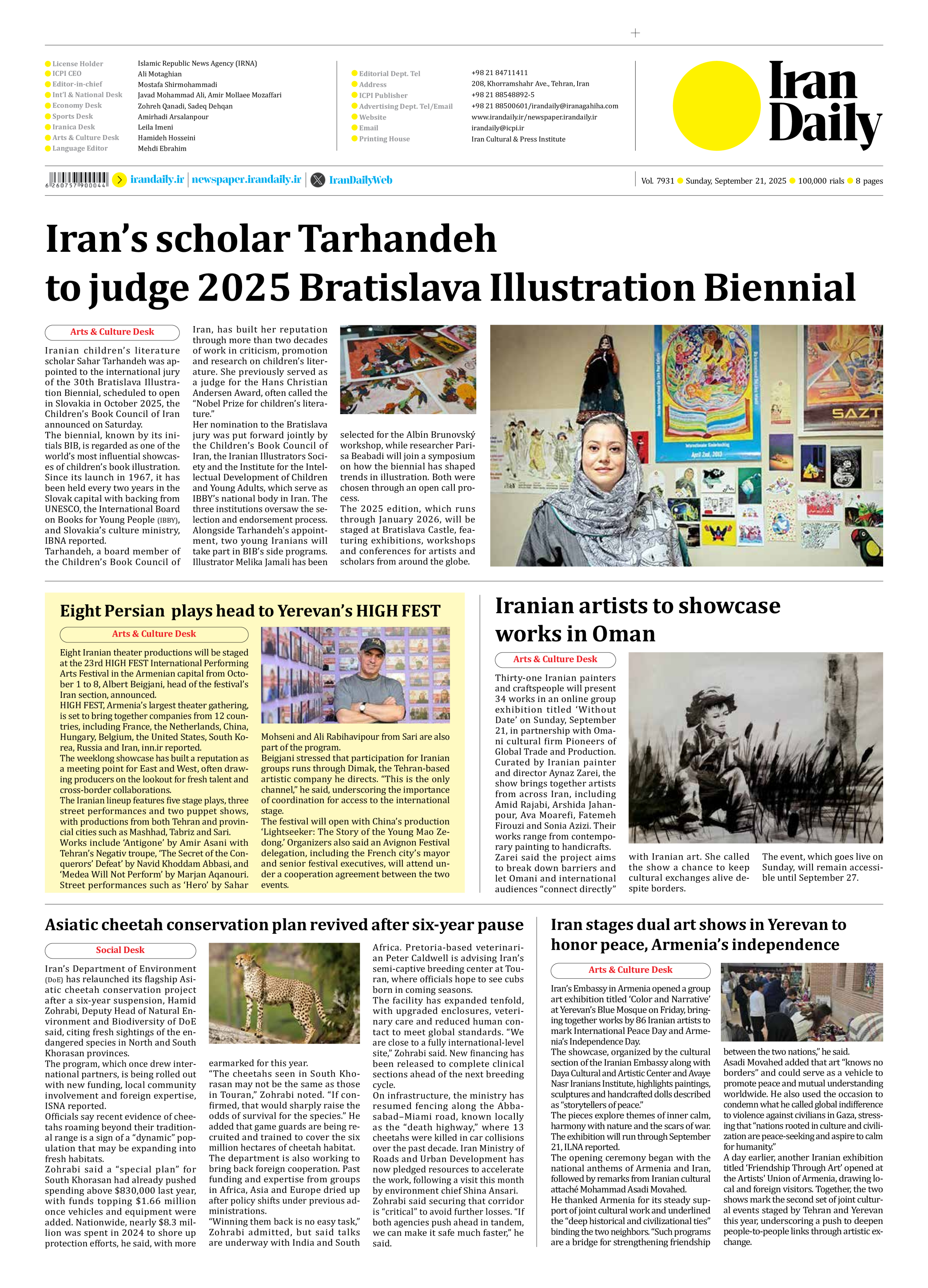
Iran’s Department of Environment (DoE) has relaunched its flagship Asiatic cheetah conservation project after a six-year suspension, Hamid Zohrabi, Deputy Head of Natural Environment and Biodiversity of DoE said, citing fresh sightings of the endangered species in North and South Khorasan provinces.
The program, which once drew international partners, is being rolled out with new funding, local community involvement and foreign expertise, ISNA reported.
Officials say recent evidence of cheetahs roaming beyond their traditional range is a sign of a “dynamic” population that may be expanding into fresh habitats.
Zohrabi said a “special plan” for South Khorasan had already pushed spending above $830,000 last year, with funds topping $1.66 million once vehicles and equipment were added. Nationwide, nearly $8.3 million was spent in 2024 to shore up protection efforts, he said, with more earmarked for this year.
“The cheetahs seen in South Khorasan may not be the same as those in Touran,” Zohrabi noted. “If confirmed, that would sharply raise the odds of survival for the species.” He added that game guards are being recruited and trained to cover the six million hectares of cheetah habitat.
The department is also working to bring back foreign cooperation. Past funding and expertise from groups in Africa, Asia and Europe dried up after policy shifts under previous administrations.
“Winning them back is no easy task,” Zohrabi admitted, but said talks are underway with India and South Africa. Pretoria-based veterinarian Peter Caldwell is advising Iran’s semi-captive breeding center at Touran, where officials hope to see cubs born in coming seasons.
The facility has expanded tenfold, with upgraded enclosures, veterinary care and reduced human contact to meet global standards. “We are close to a fully international-level site,” Zohrabi said. New financing has been released to complete clinical sections ahead of the next breeding cycle.
On infrastructure, the ministry has resumed fencing along the Abbasabad–Miami road, known locally as the “death highway,” where 13 cheetahs were killed in car collisions over the past decade. Iran Ministry of Roads and Urban Development has now pledged resources to accelerate the work, following a visit this month by environment chief Shina Ansari.
Zohrabi said securing that corridor is “critical” to avoid further losses. “If both agencies push ahead in tandem, we can make it safe much faster,” he said.