





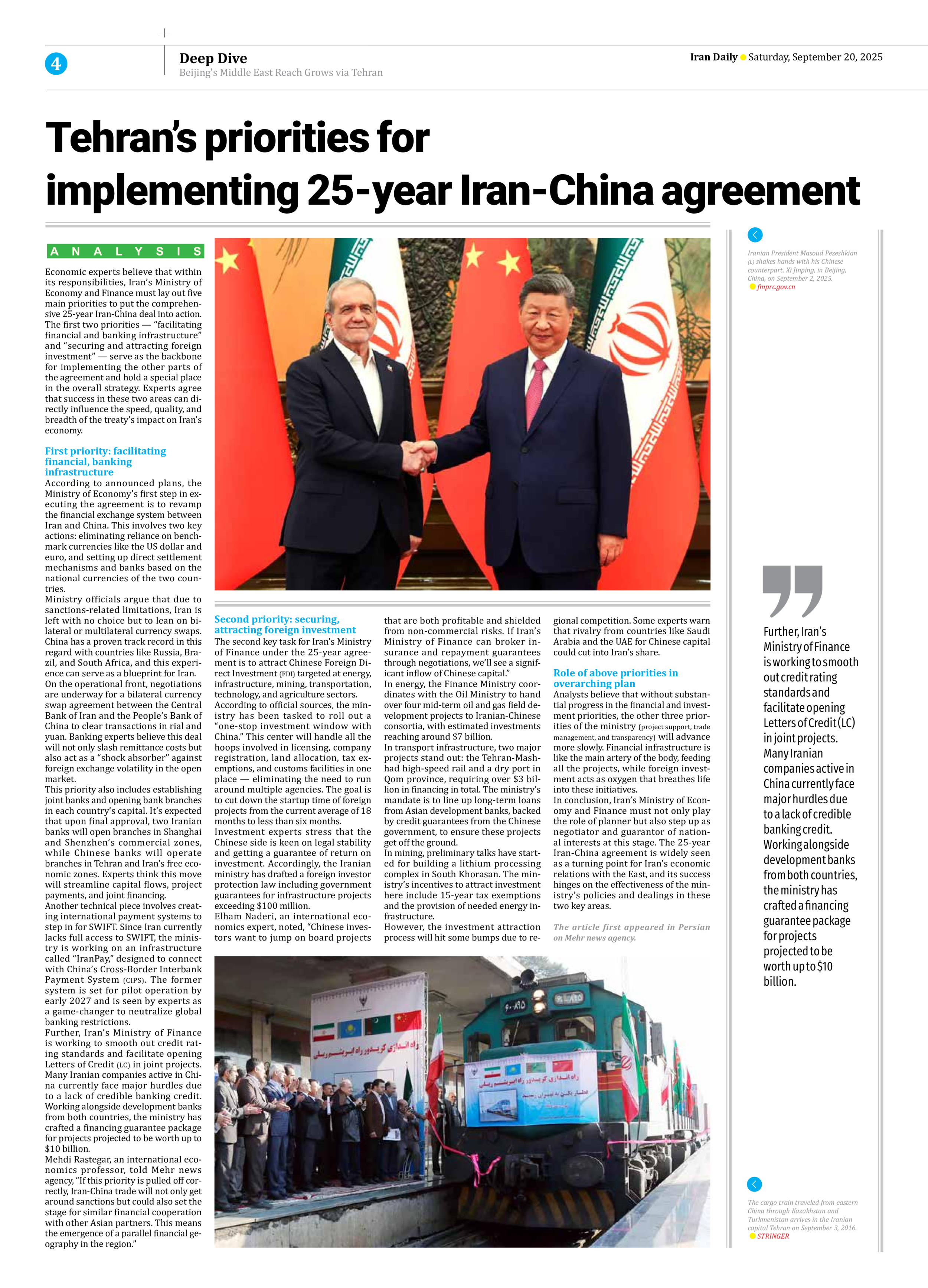


Tehran’s priorities for implementing 25-year Iran-China agreement
Economic experts believe that within its responsibilities, Iran’s Ministry of Economy and Finance must lay out five main priorities to put the comprehensive 25-year Iran-China deal into action. The first two priorities — “facilitating financial and banking infrastructure” and “securing and attracting foreign investment” — serve as the backbone for implementing the other parts of the agreement and hold a special place in the overall strategy. Experts agree that success in these two areas can directly influence the speed, quality, and breadth of the treaty’s impact on Iran’s economy.
First priority: facilitating financial, banking infrastructure
According to announced plans, the Ministry of Economy’s first step in executing the agreement is to revamp the financial exchange system between Iran and China. This involves two key actions: eliminating reliance on benchmark currencies like the US dollar and euro, and setting up direct settlement mechanisms and banks based on the national currencies of the two countries.
Ministry officials argue that due to sanctions-related limitations, Iran is left with no choice but to lean on bilateral or multilateral currency swaps. China has a proven track record in this regard with countries like Russia, Brazil, and South Africa, and this experience can serve as a blueprint for Iran.
On the operational front, negotiations are underway for a bilateral currency swap agreement between the Central Bank of Iran and the People’s Bank of China to clear transactions in rial and yuan. Banking experts believe this deal will not only slash remittance costs but also act as a “shock absorber” against foreign exchange volatility in the open market.
This priority also includes establishing joint banks and opening bank branches in each country’s capital. It’s expected that upon final approval, two Iranian banks will open branches in Shanghai and Shenzhen’s commercial zones, while Chinese banks will operate branches in Tehran and Iran’s free economic zones. Experts think this move will streamline capital flows, project payments, and joint financing.
Another technical piece involves creating international payment systems to step in for SWIFT. Since Iran currently lacks full access to SWIFT, the ministry is working on an infrastructure called “IranPay,” designed to connect with China’s Cross-Border Interbank Payment System (CIPS). The former system is set for pilot operation by early 2027 and is seen by experts as a game-changer to neutralize global banking restrictions.
Further, Iran’s Ministry of Finance is working to smooth out credit rating standards and facilitate opening Letters of Credit (LC) in joint projects. Many Iranian companies active in China currently face major hurdles due to a lack of credible banking credit. Working alongside development banks from both countries, the ministry has crafted a financing guarantee package for projects projected to be worth up to $10 billion.
Mehdi Rastegar, an international economics professor, told Mehr news agency, “If this priority is pulled off correctly, Iran-China trade will not only get around sanctions but could also set the stage for similar financial cooperation with other Asian partners. This means the emergence of a parallel financial geography in the region.”
Second priority: securing, attracting foreign investment
The second key task for Iran’s Ministry of Finance under the 25-year agreement is to attract Chinese Foreign Direct Investment (FDI) targeted at energy, infrastructure, mining, transportation, technology, and agriculture sectors.
According to official sources, the ministry has been tasked to roll out a “one-stop investment window with China.” This center will handle all the hoops involved in licensing, company registration, land allocation, tax exemptions, and customs facilities in one place — eliminating the need to run around multiple agencies. The goal is to cut down the startup time of foreign projects from the current average of 18 months to less than six months.
Investment experts stress that the Chinese side is keen on legal stability and getting a guarantee of return on investment. Accordingly, the Iranian ministry has drafted a foreign investor protection law including government guarantees for infrastructure projects exceeding $100 million.
Elham Naderi, an international economics expert, noted, “Chinese investors want to jump on board projects that are both profitable and shielded from non-commercial risks. If Iran’s Ministry of Finance can broker insurance and repayment guarantees through negotiations, we’ll see a significant inflow of Chinese capital.”
In energy, the Finance Ministry coordinates with the Oil Ministry to hand over four mid-term oil and gas field development projects to Iranian-Chinese consortia, with estimated investments reaching around $7 billion.
In transport infrastructure, two major projects stand out: the Tehran-Mashhad high-speed rail and a dry port in Qom province, requiring over $3 billion in financing in total. The ministry’s mandate is to line up long-term loans from Asian development banks, backed by credit guarantees from the Chinese government, to ensure these projects get off the ground.
In mining, preliminary talks have started for building a lithium processing complex in South Khorasan. The ministry’s incentives to attract investment here include 15-year tax exemptions and the provision of needed energy infrastructure.
However, the investment attraction process will hit some bumps due to regional competition. Some experts warn that rivalry from countries like Saudi Arabia and the UAE for Chinese capital could cut into Iran’s share.
Role of above priorities in overarching plan
Analysts believe that without substantial progress in the financial and investment priorities, the other three priorities of the ministry (project support, trade management, and transparency) will advance more slowly. Financial infrastructure is like the main artery of the body, feeding all the projects, while foreign investment acts as oxygen that breathes life into these initiatives.
In conclusion, Iran’s Ministry of Economy and Finance must not only play the role of planner but also step up as negotiator and guarantor of national interests at this stage. The 25-year Iran-China agreement is widely seen as a turning point for Iran’s economic relations with the East, and its success hinges on the effectiveness of the ministry’s policies and dealings in these two key areas.
The article first appeared in Persian
on Mehr news agency.