







Qatar rethinks US security umbrella
By James Durso
Columnist
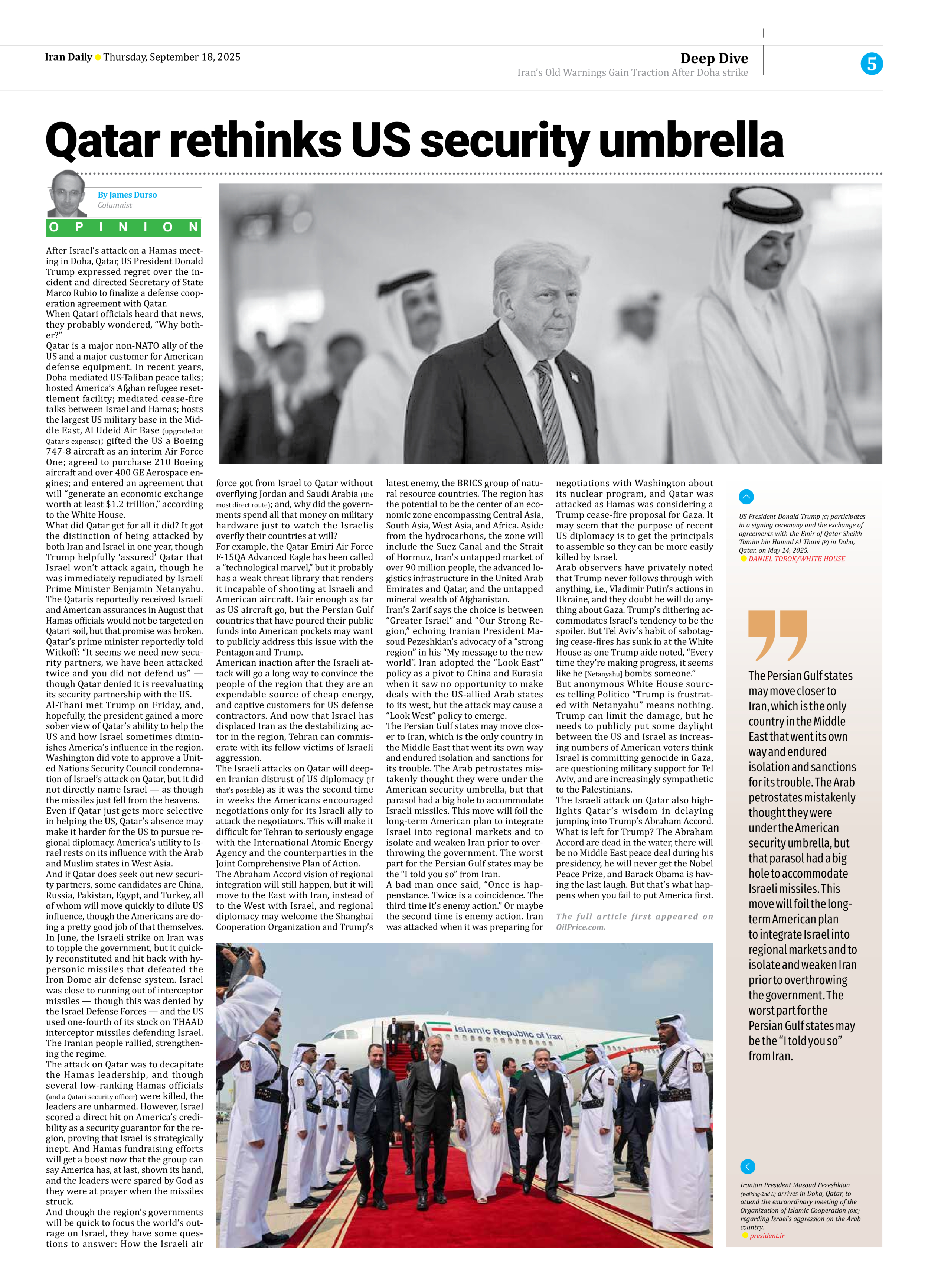
After Israel’s attack on a Hamas meeting in Doha, Qatar, US President Donald Trump expressed regret over the incident and directed Secretary of State Marco Rubio to finalize a defense cooperation agreement with Qatar.
When Qatari officials heard that news, they probably wondered, “Why bother?”
Qatar is a major non-NATO ally of the US and a major customer for American defense equipment. In recent years, Doha mediated US-Taliban peace talks; hosted America’s Afghan refugee resettlement facility; mediated cease-fire talks between Israel and Hamas; hosts the largest US military base in the Middle East, Al Udeid Air Base (upgraded at Qatar’s expense); gifted the US a Boeing 747-8 aircraft as an interim Air Force One; agreed to purchase 210 Boeing aircraft and over 400 GE Aerospace engines; and entered an agreement that will “generate an economic exchange worth at least $1.2 trillion,” according to the White House.
What did Qatar get for all it did? It got the distinction of being attacked by both Iran and Israel in one year, though Trump helpfully ‘assured’ Qatar that Israel won’t attack again, though he was immediately repudiated by Israeli Prime Minister Benjamin Netanyahu. The Qataris reportedly received Israeli and American assurances in August that Hamas officials would not be targeted on Qatari soil, but that promise was broken.
Qatar’s prime minister reportedly told Witkoff: “It seems we need new security partners, we have been attacked twice and you did not defend us” — though Qatar denied it is reevaluating its security partnership with the US.
Al-Thani met Trump on Friday, and, hopefully, the president gained a more sober view of Qatar’s ability to help the US and how Israel sometimes diminishes America’s influence in the region. Washington did vote to approve a United Nations Security Council condemnation of Israel’s attack on Qatar, but it did not directly name Israel — as though the missiles just fell from the heavens.
Even if Qatar just gets more selective in helping the US, Qatar’s absence may make it harder for the US to pursue regional diplomacy. America’s utility to Israel rests on its influence with the Arab and Muslim states in West Asia.
And if Qatar does seek out new security partners, some candidates are China, Russia, Pakistan, Egypt, and Turkey, all of whom will move quickly to dilute US influence, though the Americans are doing a pretty good job of that themselves.
In June, the Israeli strike on Iran was to topple the government, but it quickly reconstituted and hit back with hypersonic missiles that defeated the Iron Dome air defense system. Israel was close to running out of interceptor missiles — though this was denied by the Israel Defense Forces — and the US used one-fourth of its stock on THAAD interceptor missiles defending Israel. The Iranian people rallied, strengthening the regime.
The attack on Qatar was to decapitate the Hamas leadership, and though several low-ranking Hamas officials (and a Qatari security officer) were killed, the leaders are unharmed. However, Israel scored a direct hit on America’s credibility as a security guarantor for the region, proving that Israel is strategically inept. And Hamas fundraising efforts will get a boost now that the group can say America has, at last, shown its hand, and the leaders were spared by God as they were at prayer when the missiles struck.
And though the region’s governments will be quick to focus the world’s outrage on Israel, they have some questions to answer: How the Israeli air force got from Israel to Qatar without overflying Jordan and Saudi Arabia (the most direct route); and, why did the governments spend all that money on military hardware just to watch the Israelis overfly their countries at will?
For example, the Qatar Emiri Air Force F-15QA Advanced Eagle has been called a “technological marvel,” but it probably has a weak threat library that renders it incapable of shooting at Israeli and American aircraft. Fair enough as far as US aircraft go, but the Persian Gulf countries that have poured their public funds into American pockets may want to publicly address this issue with the Pentagon and Trump.
American inaction after the Israeli attack will go a long way to convince the people of the region that they are an expendable source of cheap energy, and captive customers for US defense contractors. And now that Israel has displaced Iran as the destabilizing actor in the region, Tehran can commiserate with its fellow victims of Israeli aggression.
The Israeli attacks on Qatar will deepen Iranian distrust of US diplomacy (if that’s possible) as it was the second time in weeks the Americans encouraged negotiations only for its Israeli ally to attack the negotiators. This will make it difficult for Tehran to seriously engage with the International Atomic Energy Agency and the counterparties in the Joint Comprehensive Plan of Action.
The Abraham Accord vision of regional integration will still happen, but it will move to the East with Iran, instead of to the West with Israel, and regional diplomacy may welcome the Shanghai Cooperation Organization and Trump’s latest enemy, the BRICS group of natural resource countries. The region has the potential to be the center of an economic zone encompassing Central Asia, South Asia, West Asia, and Africa. Aside from the hydrocarbons, the zone will include the Suez Canal and the Strait of Hormuz, Iran’s untapped market of over 90 million people, the advanced logistics infrastructure in the United Arab Emirates and Qatar, and the untapped mineral wealth of Afghanistan.
Iran’s Zarif says the choice is between “Greater Israel” and “Our Strong Region,” echoing Iranian President Masoud Pezeshkian’s advocacy of a “strong region” in his “My message to the new world”. Iran adopted the “Look East” policy as a pivot to China and Eurasia when it saw no opportunity to make deals with the US-allied Arab states to its west, but the attack may cause a “Look West” policy to emerge.
The Persian Gulf states may move closer to Iran, which is the only country in the Middle East that went its own way and endured isolation and sanctions for its trouble. The Arab petrostates mistakenly thought they were under the American security umbrella, but that parasol had a big hole to accommodate Israeli missiles. This move will foil the long-term American plan to integrate Israel into regional markets and to isolate and weaken Iran prior to overthrowing the government. The worst part for the Persian Gulf states may be the “I told you so” from Iran.
A bad man once said, “Once is happenstance. Twice is a coincidence. The third time it’s enemy action.” Or maybe the second time is enemy action. Iran was attacked when it was preparing for negotiations with Washington about its nuclear program, and Qatar was attacked as Hamas was considering a Trump cease-fire proposal for Gaza. It may seem that the purpose of recent US diplomacy is to get the principals to assemble so they can be more easily killed by Israel.
Arab observers have privately noted that Trump never follows through with anything, i.e., Vladimir Putin’s actions in Ukraine, and they doubt he will do anything about Gaza. Trump’s dithering accommodates Israel’s tendency to be the spoiler. But Tel Aviv’s habit of sabotaging cease-fires has sunk in at the White House as one Trump aide noted, “Every time they’re making progress, it seems like he [Netanyahu] bombs someone.”
But anonymous White House sources telling Politico “Trump is frustrated with Netanyahu” means nothing. Trump can limit the damage, but he needs to publicly put some daylight between the US and Israel as increasing numbers of American voters think Israel is committing genocide in Gaza, are questioning military support for Tel Aviv, and are increasingly sympathetic to the Palestinians.
The Israeli attack on Qatar also highlights Qatar’s wisdom in delaying jumping into Trump’s Abraham Accord. What is left for Trump? The Abraham Accord are dead in the water, there will be no Middle East peace deal during his presidency, he will never get the Nobel Peace Prize, and Barack Obama is having the last laugh. But that’s what happens when you fail to put America first.
The full article first appeared on
OilPrice.com.