







Failed Hamas decapitation supposed to facilitate current Gaza attack
The foreign ministers and leaders of Islamic countries came together on Sunday and Monday this week for a fresh emergency session in Doha, Qatar. This time, the pretext for this gathering was Israel’s attack on Qatar, an unprecedented act that stood out from Tel Aviv’s past adventurisms and bombings of US allies. The breach of Qatar’s territorial integrity quickly made headlines worldwide. Tel Aviv was struggling to assassinate Hamas leaders in Doha. This was while the Palestinians were engaged in negotiations and gathered there to hammer out a solution to end the genocide in Gaza. Yet, evidence suggests that Israeli Prime Minister Benjamin Netanyahu fell short of his goals. Although this move by Israel is not surprising given the past two years’ actions, the attack on Qatar has definitely shaken up at least some regional countries. To examine the reasons behind Israel’s actions and their regional aftermath, and also Iran’s special role right now, an interview was conducted with Hadi Borhani, university professor and international affairs analyst, a translation of which follows.
Israel struck one of America’s key regional allies, Qatar, with an air attack on September 9, 2025. Why did Israel take such a risky gamble at this moment?
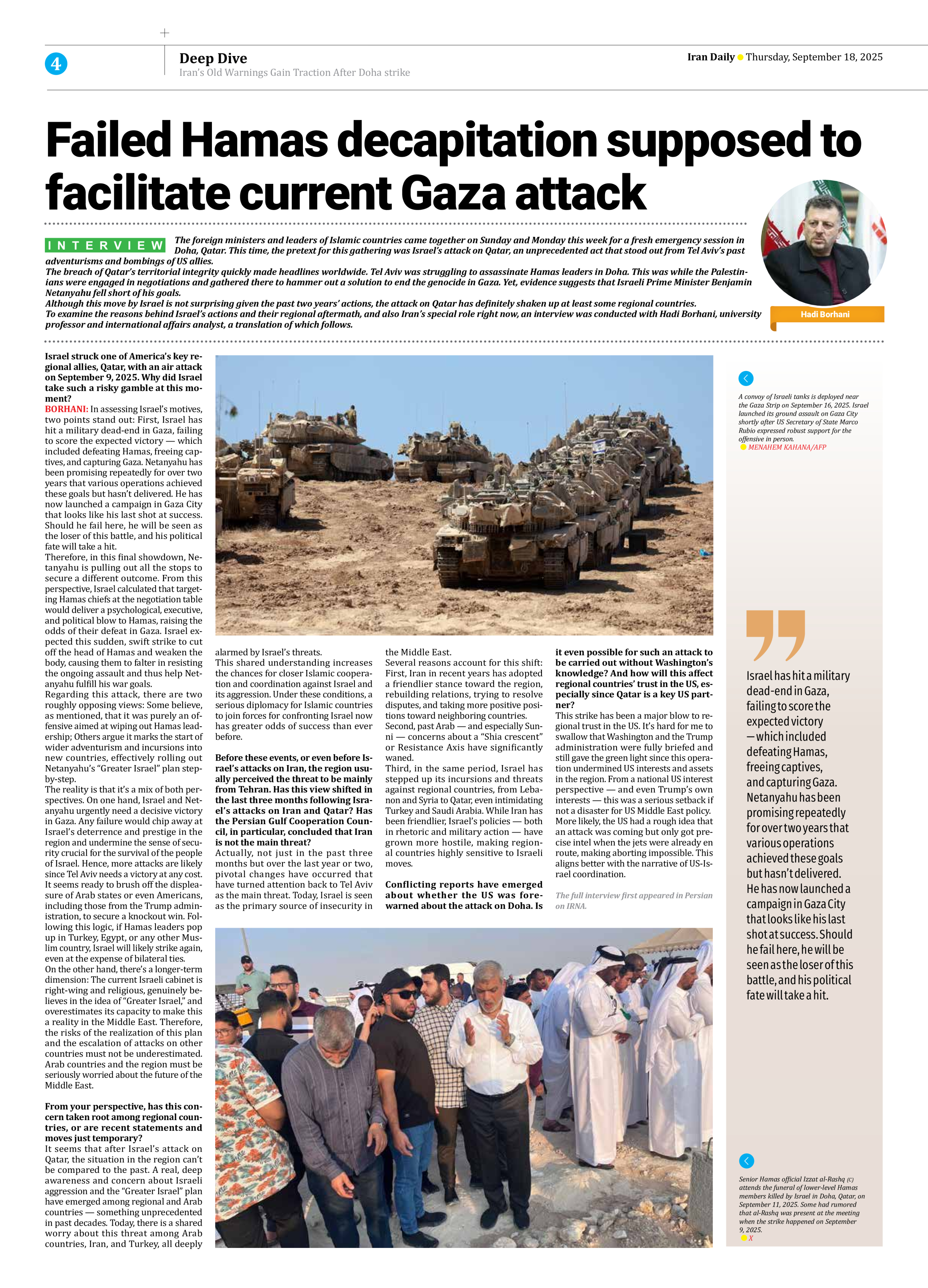
BORHANI: In assessing Israel’s motives, two points stand out: First, Israel has hit a military dead-end in Gaza, failing to score the expected victory — which included defeating Hamas, freeing captives, and capturing Gaza. Netanyahu has been promising repeatedly for over two years that various operations achieved these goals but hasn’t delivered. He has now launched a campaign in Gaza City that looks like his last shot at success. Should he fail here, he will be seen as the loser of this battle, and his political fate will take a hit.
Therefore, in this final showdown, Netanyahu is pulling out all the stops to secure a different outcome. From this perspective, Israel calculated that targeting Hamas chiefs at the negotiation table would deliver a psychological, executive, and political blow to Hamas, raising the odds of their defeat in Gaza. Israel expected this sudden, swift strike to cut off the head of Hamas and weaken the body, causing them to falter in resisting the ongoing assault and thus help Netanyahu fulfill his war goals.
Regarding this attack, there are two roughly opposing views: Some believe, as mentioned, that it was purely an offensive aimed at wiping out Hamas leadership; Others argue it marks the start of wider adventurism and incursions into new countries, effectively rolling out Netanyahu’s “Greater Israel” plan step-by-step.
The reality is that it’s a mix of both perspectives. On one hand, Israel and Netanyahu urgently need a decisive victory in Gaza. Any failure would chip away at Israel’s deterrence and prestige in the region and undermine the sense of security crucial for the survival of the people of Israel. Hence, more attacks are likely since Tel Aviv needs a victory at any cost. It seems ready to brush off the displeasure of Arab states or even Americans, including those from the Trump administration, to secure a knockout win. Following this logic, if Hamas leaders pop up in Turkey, Egypt, or any other Muslim country, Israel will likely strike again, even at the expense of bilateral ties.
On the other hand, there’s a longer-term dimension: The current Israeli cabinet is right-wing and religious, genuinely believes in the idea of “Greater Israel,” and overestimates its capacity to make this a reality in the Middle East. Therefore, the risks of the realization of this plan and the escalation of attacks on other countries must not be underestimated. Arab countries and the region must be seriously worried about the future of the Middle East.
From your perspective, has this concern taken root among regional countries, or are recent statements and moves just temporary?
It seems that after Israel’s attack on Qatar, the situation in the region can’t be compared to the past. A real, deep awareness and concern about Israeli aggression and the “Greater Israel” plan have emerged among regional and Arab countries — something unprecedented in past decades. Today, there is a shared worry about this threat among Arab countries, Iran, and Turkey, all deeply alarmed by Israel’s threats.
This shared understanding increases the chances for closer Islamic cooperation and coordination against Israel and its aggression. Under these conditions, a serious diplomacy for Islamic countries to join forces for confronting Israel now has greater odds of success than ever before.
Before these events, or even before Israel’s attacks on Iran, the region usually perceived the threat to be mainly from Tehran. Has this view shifted in the last three months following Israel’s attacks on Iran and Qatar? Has the Persian Gulf Cooperation Council, in particular, concluded that Iran is not the main threat?
Actually, not just in the past three months but over the last year or two, pivotal changes have occurred that have turned attention back to Tel Aviv as the main threat. Today, Israel is seen as the primary source of insecurity in the Middle East.
Several reasons account for this shift: First, Iran in recent years has adopted a friendlier stance toward the region, rebuilding relations, trying to resolve disputes, and taking more positive positions toward neighboring countries.
Second, past Arab — and especially Sunni — concerns about a “Shia crescent” or Resistance Axis have significantly waned.
Third, in the same period, Israel has stepped up its incursions and threats against regional countries, from Lebanon and Syria to Qatar, even intimidating Turkey and Saudi Arabia. While Iran has been friendlier, Israel’s policies — both in rhetoric and military action — have grown more hostile, making regional countries highly sensitive to Israeli moves.
Conflicting reports have emerged about whether the US was forewarned about the attack on Doha. Is it even possible for such an attack to be carried out without Washington’s knowledge? And how will this affect regional countries’ trust in the US, especially since Qatar is a key US partner?
This strike has been a major blow to regional trust in the US. It’s hard for me to swallow that Washington and the Trump administration were fully briefed and still gave the green light since this operation undermined US interests and assets in the region. From a national US interest perspective — and even Trump’s own interests — this was a serious setback if not a disaster for US Middle East policy.
More likely, the US had a rough idea that an attack was coming but only got precise intel when the jets were already en route, making aborting impossible. This aligns better with the narrative of US-Israel coordination.
The full interview first appeared in Persian on IRNA.