







Iran-Kuwait trade rose 17% in 2024, hit $130m in Q1 2025
By Sadeq Dehqan
Staff writer
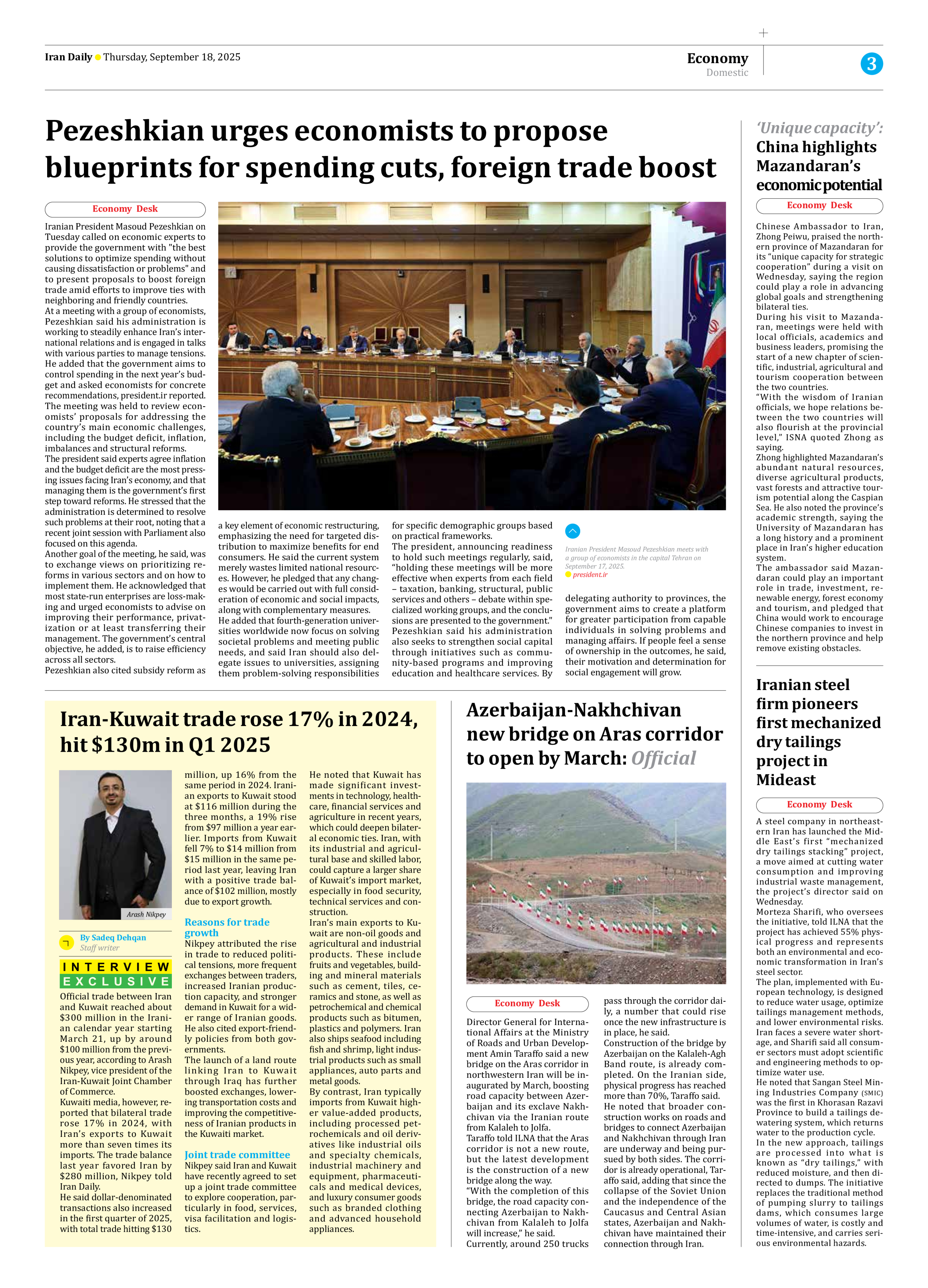
Official trade between Iran and Kuwait reached about $300 million in the Iranian calendar year starting March 21, up by around $100 million from the previous year, according to Arash Nikpey, vice president of the Iran-Kuwait Joint Chamber of Commerce.
Kuwaiti media, however, reported that bilateral trade rose 17% in 2024, with Iran’s exports to Kuwait more than seven times its imports. The trade balance last year favored Iran by $280 million, Nikpey told Iran Daily.
He said dollar-denominated transactions also increased in the first quarter of 2025, with total trade hitting $130 million, up 16% from the same period in 2024. Iranian exports to Kuwait stood at $116 million during the three months, a 19% rise from $97 million a year earlier. Imports from Kuwait fell 7% to $14 million from $15 million in the same period last year, leaving Iran with a positive trade balance of $102 million, mostly due to export growth.
Reasons for trade growth
Nikpey attributed the rise in trade to reduced political tensions, more frequent exchanges between traders, increased Iranian production capacity, and stronger demand in Kuwait for a wider range of Iranian goods. He also cited export-friendly policies from both governments.
The launch of a land route linking Iran to Kuwait through Iraq has further boosted exchanges, lowering transportation costs and improving the competitiveness of Iranian products in the Kuwaiti market.
Joint trade committee
Nikpey said Iran and Kuwait have recently agreed to set up a joint trade committee to explore cooperation, particularly in food, services, visa facilitation and logistics.
He noted that Kuwait has made significant investments in technology, healthcare, financial services and agriculture in recent years, which could deepen bilateral economic ties. Iran, with its industrial and agricultural base and skilled labor, could capture a larger share of Kuwait’s import market, especially in food security, technical services and construction.
Iran’s main exports to Kuwait are non-oil goods and agricultural and industrial products. These include fruits and vegetables, building and mineral materials such as cement, tiles, ceramics and stone, as well as petrochemical and chemical products such as bitumen, plastics and polymers. Iran also ships seafood including fish and shrimp, light industrial products such as small appliances, auto parts and metal goods.
By contrast, Iran typically imports from Kuwait higher value-added products, including processed petrochemicals and oil derivatives like industrial oils and specialty chemicals, industrial machinery and equipment, pharmaceuticals and medical devices, and luxury consumer goods such as branded clothing and advanced household appliances.