







Cairo defining opportunity to move toward lasting agreement: Expert
On September 9, a major accord between the Islamic Republic of Iran and the International Atomic Energy Agency was hammered out with Egypt acting as mediator. Under this deal, the two sides settled on a new framework and modality for cooperation regarding Iran’s nuclear activities. This breakthrough could mark a turning point in Tehran–IAEA relations and pave the way for smoother talks and inspections in the future. The significance of this accord lies not only in winning back mutual trust but also in the role of a regional player like Egypt in stepping in to smooth the path of negotiations. The deal could both help dial down nuclear tensions and elevate once again on the weight of multilateral diplomacy in handling Iran’s case. To examine the dimensions of this matter and its impact on diplomacy between Tehran and the three European parties to the JCPOA, a conversation was held with Abolghassem Delfi, former Iranian ambassador to France and an international affairs analyst. The full translated text is presented below.
Following many ups and downs between Iran and the IAEA in the wake of the bombing of Iran’s nuclear facilities, a new cooperation modality was agreed upon. What is your overall assessment of this deal, given that its details are still murky?
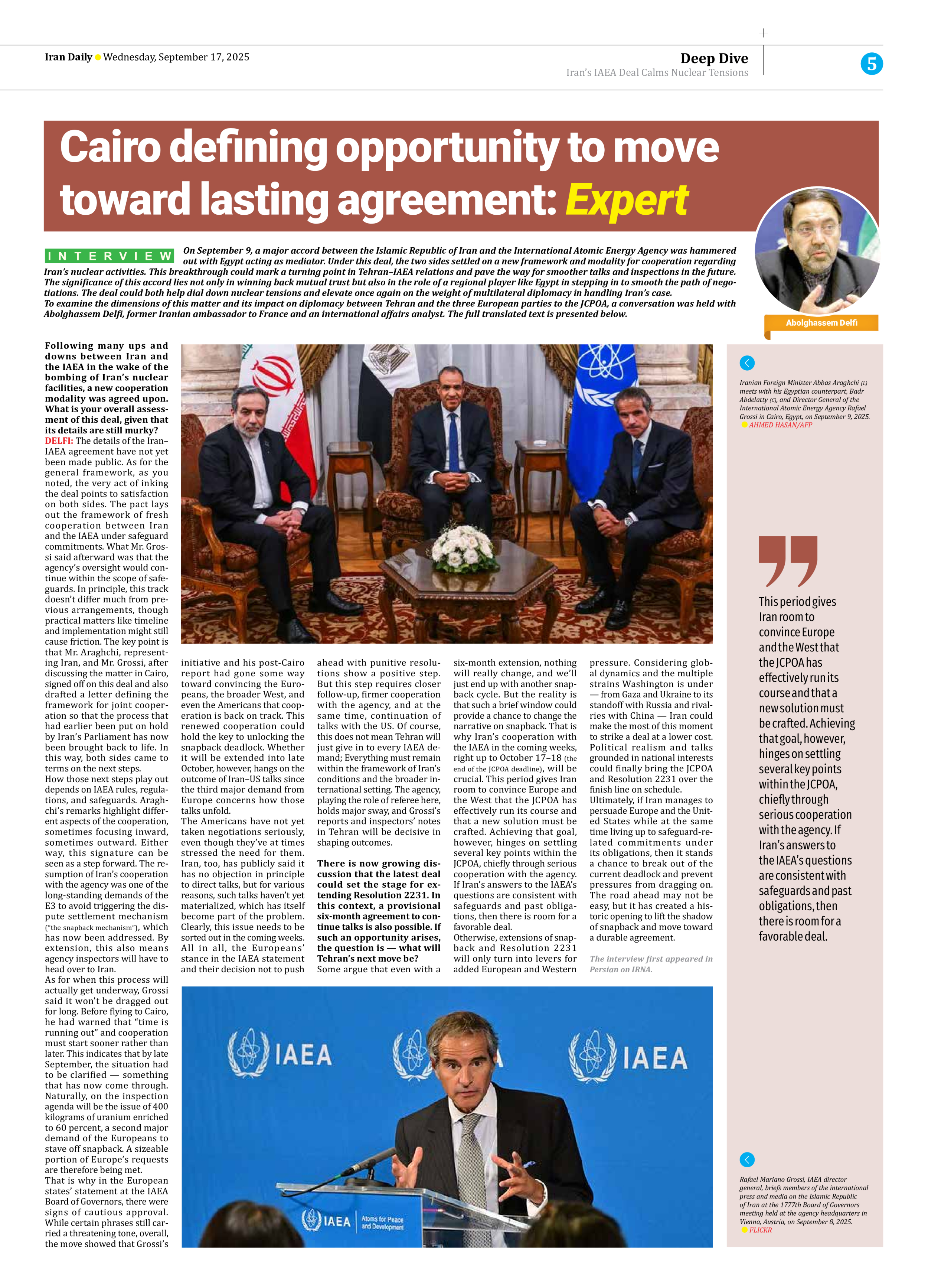
DELFI: The details of the Iran–IAEA agreement have not yet been made public. As for the general framework, as you noted, the very act of inking the deal points to satisfaction on both sides. The pact lays out the framework of fresh cooperation between Iran and the IAEA under safeguard commitments. What Mr. Grossi said afterward was that the agency’s oversight would continue within the scope of safeguards. In principle, this track doesn’t differ much from previous arrangements, though practical matters like timeline and implementation might still cause friction. The key point is that Mr. Araghchi, representing Iran, and Mr. Grossi, after discussing the matter in Cairo, signed off on this deal and also drafted a letter defining the framework for joint cooperation so that the process that had earlier been put on hold by Iran’s Parliament has now been brought back to life. In this way, both sides came to terms on the next steps.
How those next steps play out depends on IAEA rules, regulations, and safeguards. Araghchi’s remarks highlight different aspects of the cooperation, sometimes focusing inward, sometimes outward. Either way, this signature can be seen as a step forward. The resumption of Iran’s cooperation with the agency was one of the long-standing demands of the E3 to avoid triggering the dispute settlement mechanism (“the snapback mechanism”), which has now been addressed. By extension, this also means agency inspectors will have to head over to Iran.
As for when this process will actually get underway, Grossi said it won’t be dragged out for long. Before flying to Cairo, he had warned that “time is running out” and cooperation must start sooner rather than later. This indicates that by late September, the situation had to be clarified — something that has now come through. Naturally, on the inspection agenda will be the issue of 400 kilograms of uranium enriched to 60 percent, a second major demand of the Europeans to stave off snapback. A sizeable portion of Europe’s requests are therefore being met.
That is why in the European states’ statement at the IAEA Board of Governors, there were signs of cautious approval. While certain phrases still carried a threatening tone, overall, the move showed that Grossi’s initiative and his post-Cairo report had gone some way toward convincing the Europeans, the broader West, and even the Americans that cooperation is back on track. This renewed cooperation could hold the key to unlocking the snapback deadlock. Whether it will be extended into late October, however, hangs on the outcome of Iran–US talks since the third major demand from Europe concerns how those talks unfold.
The Americans have not yet taken negotiations seriously, even though they’ve at times stressed the need for them. Iran, too, has publicly said it has no objection in principle to direct talks, but for various reasons, such talks haven’t yet materialized, which has itself become part of the problem. Clearly, this issue needs to be sorted out in the coming weeks.
All in all, the Europeans’ stance in the IAEA statement and their decision not to push ahead with punitive resolutions show a positive step. But this step requires closer follow-up, firmer cooperation with the agency, and at the same time, continuation of talks with the US. Of course, this does not mean Tehran will just give in to every IAEA demand; Everything must remain within the framework of Iran’s conditions and the broader international setting. The agency, playing the role of referee here, holds major sway, and Grossi’s reports and inspectors’ notes in Tehran will be decisive in shaping outcomes.
There is now growing discussion that the latest deal could set the stage for extending Resolution 2231. In this context, a provisional six-month agreement to continue talks is also possible. If such an opportunity arises, the question is — what will Tehran’s next move be?
Some argue that even with a six-month extension, nothing will really change, and we’ll just end up with another snapback cycle. But the reality is that such a brief window could provide a chance to change the narrative on snapback. That is why Iran’s cooperation with the IAEA in the coming weeks, right up to October 17–18 (the end of the JCPOA deadline), will be crucial. This period gives Iran room to convince Europe and the West that the JCPOA has effectively run its course and that a new solution must be crafted. Achieving that goal, however, hinges on settling several key points within the JCPOA, chiefly through serious cooperation with the agency. If Iran’s answers to the IAEA’s questions are consistent with safeguards and past obligations, then there is room for a favorable deal.
Otherwise, extensions of snapback and Resolution 2231 will only turn into levers for added European and Western pressure. Considering global dynamics and the multiple strains Washington is under — from Gaza and Ukraine to its standoff with Russia and rivalries with China — Iran could make the most of this moment to strike a deal at a lower cost. Political realism and talks grounded in national interests could finally bring the JCPOA and Resolution 2231 over the finish line on schedule.
Ultimately, if Iran manages to persuade Europe and the United States while at the same time living up to safeguard-related commitments under its obligations, then it stands a chance to break out of the current deadlock and prevent pressures from dragging on. The road ahead may not be easy, but it has created a historic opening to lift the shadow of snapback and move toward a durable agreement.
The interview first appeared in Persian on IRNA.