







Cairo agreement Tehran’s positive tact: Former official
Resuming cooperation with IAEA ‘aligns with our national interests’
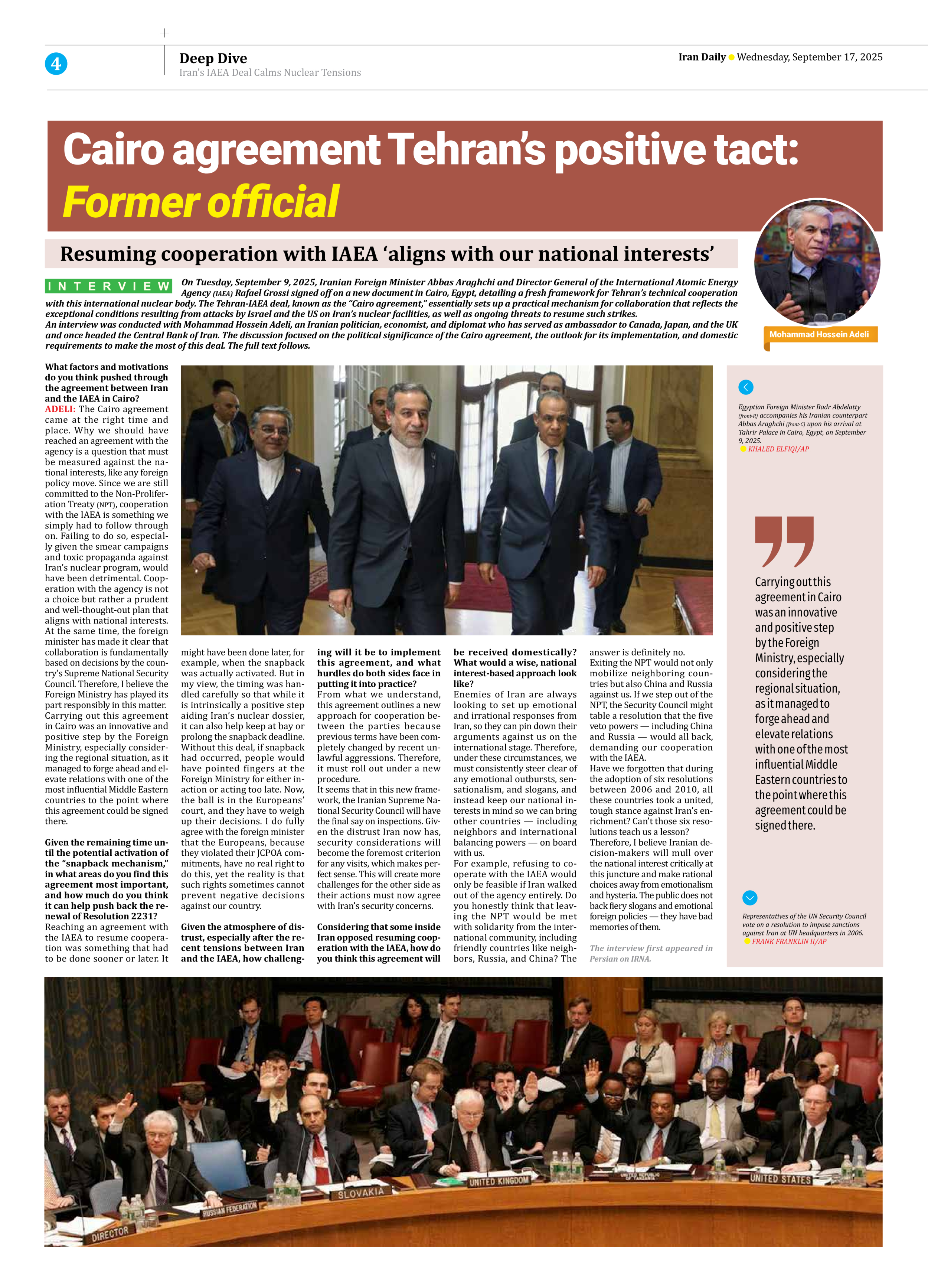
On Tuesday, September 9, 2025, Iranian Foreign Minister Abbas Araghchi and Director General of the International Atomic Energy Agency (IAEA) Rafael Grossi signed off on a new document in Cairo, Egypt, detailing a fresh framework for Tehran’s technical cooperation with this international nuclear body. The Tehran-IAEA deal, known as the “Cairo agreement,” essentially sets up a practical mechanism for collaboration that reflects the exceptional conditions resulting from attacks by Israel and the US on Iran’s nuclear facilities, as well as ongoing threats to resume such strikes. An interview was conducted with Mohammad Hossein Adeli, an Iranian politician, economist, and diplomat who has served as ambassador to Canada, Japan, and the UK and once headed the Central Bank of Iran. The discussion focused on the political significance of the Cairo agreement, the outlook for its implementation, and domestic requirements to make the most of this deal. The full text follows.
What factors and motivations do you think pushed through the agreement between Iran and the IAEA in Cairo?
ADELI: The Cairo agreement came at the right time and place. Why we should have reached an agreement with the agency is a question that must be measured against the national interests, like any foreign policy move. Since we are still committed to the Non-Proliferation Treaty (NPT), cooperation with the IAEA is something we simply had to follow through on. Failing to do so, especially given the smear campaigns and toxic propaganda against Iran’s nuclear program, would have been detrimental. Cooperation with the agency is not a choice but rather a prudent and well-thought-out plan that aligns with national interests. At the same time, the foreign minister has made it clear that collaboration is fundamentally based on decisions by the country’s Supreme National Security Council. Therefore, I believe the Foreign Ministry has played its part responsibly in this matter.
Carrying out this agreement in Cairo was an innovative and positive step by the Foreign Ministry, especially considering the regional situation, as it managed to forge ahead and elevate relations with one of the most influential Middle Eastern countries to the point where this agreement could be signed there.
Given the remaining time until the potential activation of the “snapback mechanism,” in what areas do you find this agreement most important, and how much do you think it can help push back the renewal of Resolution 2231?
Reaching an agreement with the IAEA to resume cooperation was something that had to be done sooner or later. It might have been done later, for example, when the snapback was actually activated. But in my view, the timing was handled carefully so that while it is intrinsically a positive step aiding Iran’s nuclear dossier, it can also help keep at bay or prolong the snapback deadline. Without this deal, if snapback had occurred, people would have pointed fingers at the Foreign Ministry for either inaction or acting too late. Now, the ball is in the Europeans’ court, and they have to weigh up their decisions. I do fully agree with the foreign minister that the Europeans, because they violated their JCPOA commitments, have no real right to do this, yet the reality is that such rights sometimes cannot prevent negative decisions against our country.
Given the atmosphere of distrust, especially after the recent tensions between Iran and the IAEA, how challenging will it be to implement this agreement, and what hurdles do both sides face in putting it into practice?
From what we understand, this agreement outlines a new approach for cooperation between the parties because previous terms have been completely changed by recent unlawful aggressions. Therefore, it must roll out under a new procedure.
It seems that in this new framework, the Iranian Supreme National Security Council will have the final say on inspections. Given the distrust Iran now has, security considerations will become the foremost criterion for any visits, which makes perfect sense. This will create more challenges for the other side as their actions must now agree with Iran’s security concerns.
Considering that some inside Iran opposed resuming cooperation with the IAEA, how do you think this agreement will be received domestically? What would a wise, national interest-based approach look like?
Enemies of Iran are always looking to set up emotional and irrational responses from Iran, so they can pin down their arguments against us on the international stage. Therefore, under these circumstances, we must consistently steer clear of any emotional outbursts, sensationalism, and slogans, and instead keep our national interests in mind so we can bring other countries — including neighbors and international balancing powers — on board with us.
For example, refusing to cooperate with the IAEA would only be feasible if Iran walked out of the agency entirely. Do you honestly think that leaving the NPT would be met with solidarity from the international community, including friendly countries like neighbors, Russia, and China? The answer is definitely no.
Exiting the NPT would not only mobilize neighboring countries but also China and Russia against us. If we step out of the NPT, the Security Council might table a resolution that the five veto powers — including China and Russia — would all back, demanding our cooperation with the IAEA.
Have we forgotten that during the adoption of six resolutions between 2006 and 2010, all these countries took a united, tough stance against Iran’s enrichment? Can’t those six resolutions teach us a lesson?
Therefore, I believe Iranian decision-makers will mull over the national interest critically at this juncture and make rational choices away from emotionalism and hysteria. The public does not back fiery slogans and emotional foreign policies — they have bad memories of them.
The interview first appeared in Persian on IRNA.