







ECO chief extols Iran’s central role in advancing regional cooperation
FM casts multilateral relations among developing nations as ‘necessity’
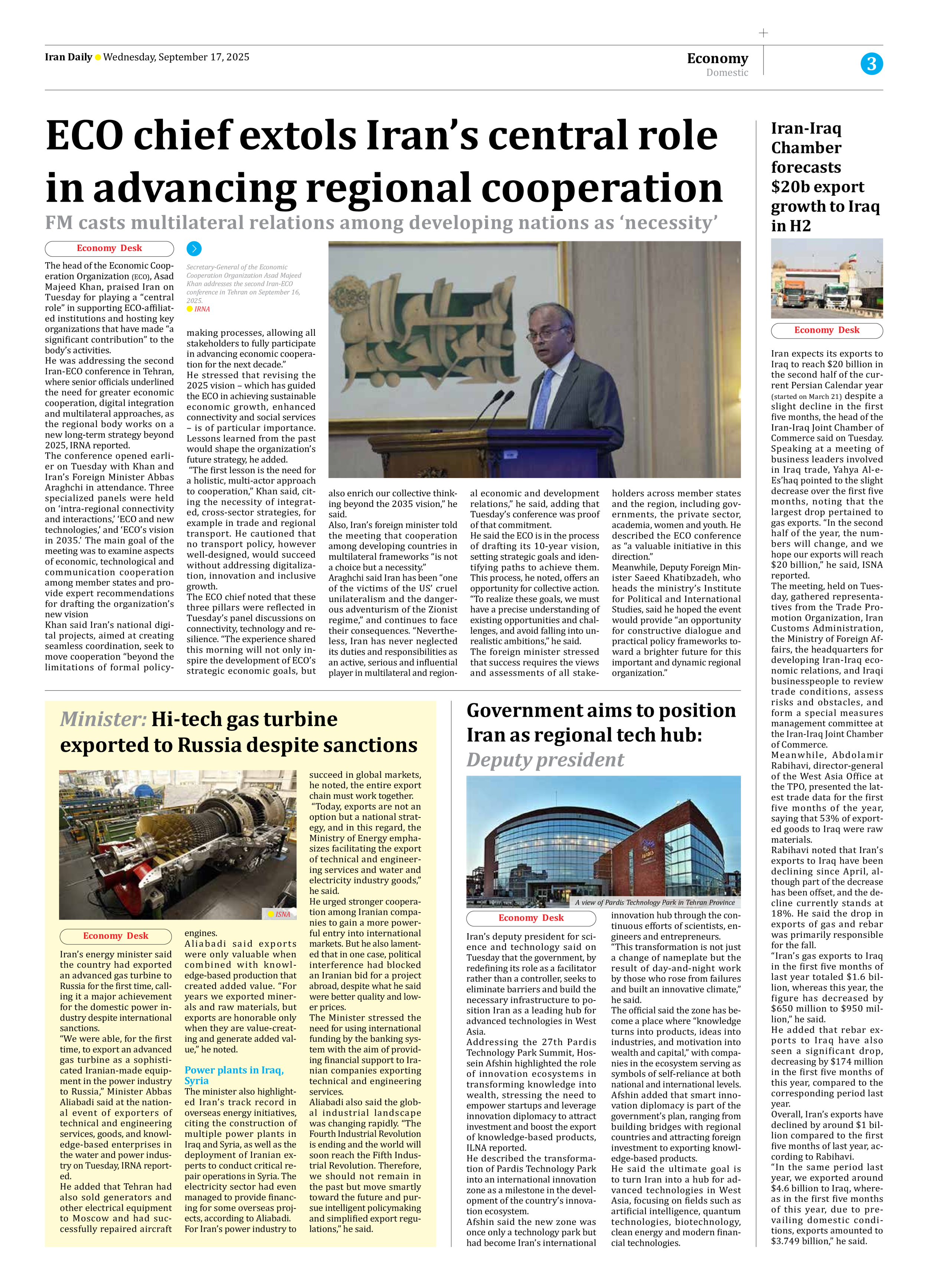
The head of the Economic Cooperation Organization (ECO), Asad Majeed Khan, praised Iran on Tuesday for playing a “central role” in supporting ECO-affiliated institutions and hosting key organizations that have made “a significant contribution” to the body’s activities.
He was addressing the second Iran-ECO conference in Tehran, where senior officials underlined the need for greater economic cooperation, digital integration and multilateral approaches, as the regional body works on a new long-term strategy beyond 2025, IRNA reported.
The conference opened earlier on Tuesday with Khan and Iran’s Foreign Minister Abbas Araghchi in attendance. Three specialized panels were held on ‘intra-regional connectivity and interactions,’ ‘ECO and new technologies,’ and ‘ECO’s vision in 2035.’ The main goal of the meeting was to examine aspects of economic, technological and communication cooperation among member states and provide expert recommendations for drafting the organization’s new vision
Khan said Iran’s national digital projects, aimed at creating seamless coordination, seek to move cooperation “beyond the limitations of formal policymaking processes, allowing all stakeholders to fully participate in advancing economic cooperation for the next decade.”
He stressed that revising the 2025 vision – which has guided the ECO in achieving sustainable economic growth, enhanced connectivity and social services – is of particular importance. Lessons learned from the past would shape the organization’s future strategy, he added.
“The first lesson is the need for a holistic, multi-actor approach to cooperation,” Khan said, citing the necessity of integrated, cross-sector strategies, for example in trade and regional transport. He cautioned that no transport policy, however well-designed, would succeed without addressing digitalization, innovation and inclusive growth.
The ECO chief noted that these three pillars were reflected in Tuesday’s panel discussions on connectivity, technology and resilience. “The experience shared this morning will not only inspire the development of ECO’s strategic economic goals, but also enrich our collective thinking beyond the 2035 vision,” he said.
Also, Iran’s foreign minister told the meeting that cooperation among developing countries in multilateral frameworks “is not a choice but a necessity.”
Araghchi said Iran has been “one of the victims of the US’ cruel unilateralism and the dangerous adventurism of the Zionist regime,” and continues to face their consequences. “Nevertheless, Iran has never neglected its duties and responsibilities as an active, serious and influential player in multilateral and regional economic and development relations,” he said, adding that Tuesday’s conference was proof of that commitment.
He said the ECO is in the process of drafting its 10-year vision, setting strategic goals and identifying paths to achieve them. This process, he noted, offers an opportunity for collective action. “To realize these goals, we must have a precise understanding of existing opportunities and challenges, and avoid falling into unrealistic ambitions,” he said.
The foreign minister stressed that success requires the views and assessments of all stakeholders across member states and the region, including governments, the private sector, academia, women and youth. He described the ECO conference as “a valuable initiative in this direction.”
Meanwhile, Deputy Foreign Minister Saeed Khatibzadeh, who heads the ministry’s Institute for Political and International Studies, said he hoped the event would provide “an opportunity for constructive dialogue and practical policy frameworks toward a brighter future for this important and dynamic regional organization.”