





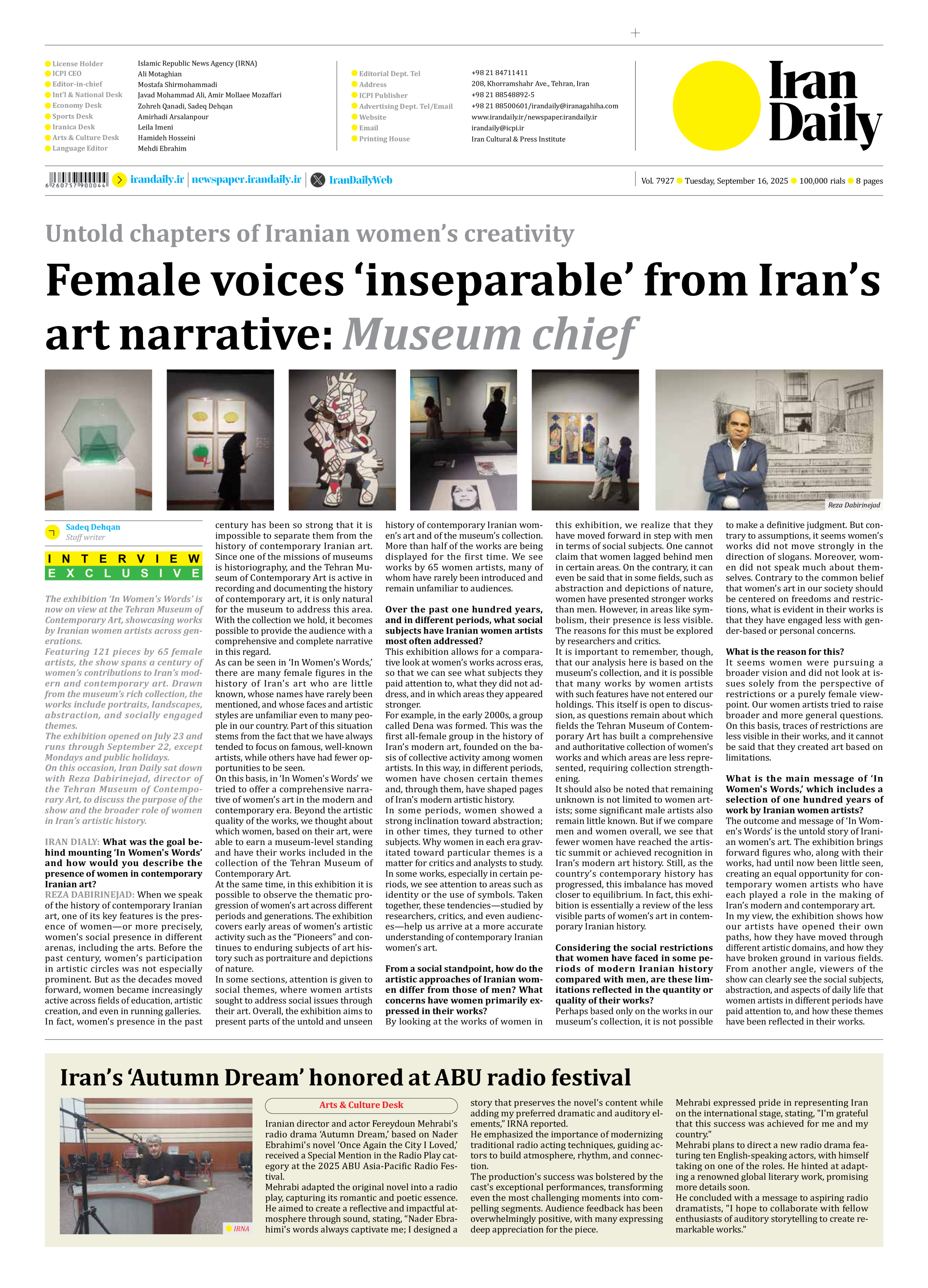


Untold chapters of Iranian women’s creativity
Female voices ‘inseparable’ from Iran’s art narrative: Museum chief
Sadeq Dehqan
Staff writer
The exhibition ‘In Women's Words’ is now on view at the Tehran Museum of Contemporary Art, showcasing works by Iranian women artists across generations.
Featuring 121 pieces by 65 female artists, the show spans a century of women’s contributions to Iran’s modern and contemporary art. Drawn from the museum’s rich collection, the works include portraits, landscapes, abstraction, and socially engaged themes.
The exhibition opened on July 23 and runs through September 22, except Mondays and public holidays.
On this occasion, Iran Daily sat down with Reza Dabirinejad, director of the Tehran Museum of Contemporary Art, to discuss the purpose of the show and the broader role of women in Iran’s artistic history.
IRAN DIALY: What was the goal behind mounting ‘In Women's Words’ and how would you describe the presence of women in contemporary Iranian art?
REZA DABIRINEJAD: When we speak of the history of contemporary Iranian art, one of its key features is the presence of women—or more precisely, women’s social presence in different arenas, including the arts. Before the past century, women’s participation in artistic circles was not especially prominent. But as the decades moved forward, women became increasingly active across fields of education, artistic creation, and even in running galleries.
In fact, women’s presence in the past century has been so strong that it is impossible to separate them from the history of contemporary Iranian art. Since one of the missions of museums is historiography, and the Tehran Museum of Contemporary Art is active in recording and documenting the history of contemporary art, it is only natural for the museum to address this area. With the collection we hold, it becomes possible to provide the audience with a comprehensive and complete narrative in this regard.
As can be seen in ‘In Women's Words,’ there are many female figures in the history of Iran’s art who are little known, whose names have rarely been mentioned, and whose faces and artistic styles are unfamiliar even to many people in our country. Part of this situation stems from the fact that we have always tended to focus on famous, well-known artists, while others have had fewer opportunities to be seen.
On this basis, in ‘In Women's Words’ we tried to offer a comprehensive narrative of women’s art in the modern and contemporary era. Beyond the artistic quality of the works, we thought about which women, based on their art, were able to earn a museum-level standing and have their works included in the collection of the Tehran Museum of Contemporary Art.
At the same time, in this exhibition it is possible to observe the thematic progression of women’s art across different periods and generations. The exhibition covers early areas of women’s artistic activity such as the “Pioneers” and continues to enduring subjects of art history such as portraiture and depictions of nature.
In some sections, attention is given to social themes, where women artists sought to address social issues through their art. Overall, the exhibition aims to present parts of the untold and unseen history of contemporary Iranian women’s art and of the museum’s collection. More than half of the works are being displayed for the first time. We see works by 65 women artists, many of whom have rarely been introduced and remain unfamiliar to audiences.
Over the past one hundred years, and in different periods, what social subjects have Iranian women artists most often addressed?
This exhibition allows for a comparative look at women’s works across eras, so that we can see what subjects they paid attention to, what they did not address, and in which areas they appeared stronger.
For example, in the early 2000s, a group called Dena was formed. This was the first all-female group in the history of Iran’s modern art, founded on the basis of collective activity among women artists. In this way, in different periods, women have chosen certain themes and, through them, have shaped pages of Iran’s modern artistic history.
In some periods, women showed a strong inclination toward abstraction; in other times, they turned to other subjects. Why women in each era gravitated toward particular themes is a matter for critics and analysts to study. In some works, especially in certain periods, we see attention to areas such as identity or the use of symbols. Taken together, these tendencies—studied by researchers, critics, and even audiences—help us arrive at a more accurate understanding of contemporary Iranian women’s art.
From a social standpoint, how do the artistic approaches of Iranian women differ from those of men? What concerns have women primarily expressed in their works?
By looking at the works of women in this exhibition, we realize that they have moved forward in step with men in terms of social subjects. One cannot claim that women lagged behind men in certain areas. On the contrary, it can even be said that in some fields, such as abstraction and depictions of nature, women have presented stronger works than men. However, in areas like symbolism, their presence is less visible. The reasons for this must be explored by researchers and critics.
It is important to remember, though, that our analysis here is based on the museum’s collection, and it is possible that many works by women artists with such features have not entered our holdings. This itself is open to discussion, as questions remain about which fields the Tehran Museum of Contemporary Art has built a comprehensive and authoritative collection of women’s works and which areas are less represented, requiring collection strengthening.
It should also be noted that remaining unknown is not limited to women artists; some significant male artists also remain little known. But if we compare men and women overall, we see that fewer women have reached the artistic summit or achieved recognition in Iran’s modern art history. Still, as the country’s contemporary history has progressed, this imbalance has moved closer to equilibrium. In fact, this exhibition is essentially a review of the less visible parts of women’s art in contemporary Iranian history.
Considering the social restrictions that women have faced in some periods of modern Iranian history compared with men, are these limitations reflected in the quantity or quality of their works?
Perhaps based only on the works in our museum’s collection, it is not possible to make a definitive judgment. But contrary to assumptions, it seems women’s works did not move strongly in the direction of slogans. Moreover, women did not speak much about themselves. Contrary to the common belief that women’s art in our society should be centered on freedoms and restrictions, what is evident in their works is that they have engaged less with gender-based or personal concerns.
What is the reason for this?
It seems women were pursuing a broader vision and did not look at issues solely from the perspective of restrictions or a purely female viewpoint. Our women artists tried to raise broader and more general questions. On this basis, traces of restrictions are less visible in their works, and it cannot be said that they created art based on limitations.
What is the main message of ‘In Women's Words,’ which includes a selection of one hundred years of work by Iranian women artists?
The outcome and message of ‘In Women's Words’ is the untold story of Iranian women’s art. The exhibition brings forward figures who, along with their works, had until now been little seen, creating an equal opportunity for contemporary women artists who have each played a role in the making of Iran’s modern and contemporary art.
In my view, the exhibition shows how our artists have opened their own paths, how they have moved through different artistic domains, and how they have broken ground in various fields. From another angle, viewers of the show can clearly see the social subjects, abstraction, and aspects of daily life that women artists in different periods have paid attention to, and how these themes have been reflected in their works.